

I’ll admit, I approach new forex robots with caution these days. After testing dozens of expert advisors over the years, you start recognizing patterns, what works, what doesn’t, and what’s likely to blow up your account when market conditions change.
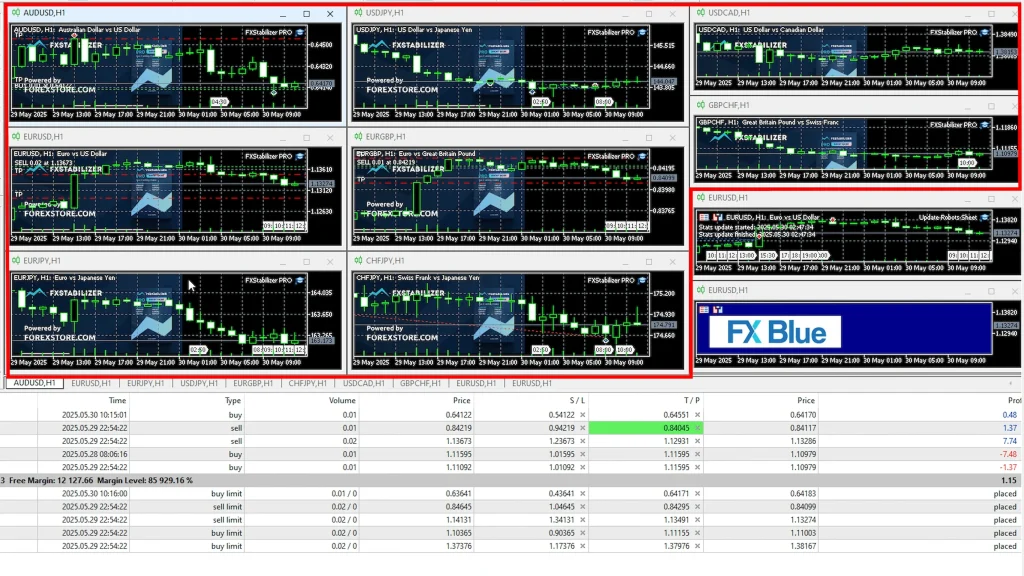
FXStabilizer PRO EA caught my attention because it’s designed to trade eight different currency pairs simultaneously. That’s unusual. Most EAs focus on one or two pairs, maybe three if they’re versatile. But eight? That either means the developer has done extensive optimization work, or they’re spreading risk across multiple markets, hoping something sticks.
So far, though, the results have been interesting. All eight recommended pairs are showing profits in my demo testing, and I’ve started running them on both a live account with Eightcap and two funded accounts with Trading.com. The performance has been positive, but there are definitely risks you need to understand before putting real money behind this system.
This FXStabilizer PRO review is based on actual testing, not vendor claims, not cherry-picked backtests. I’m showing you what’s happening in my accounts right now, including the drawdowns, the profit factors, and the currency pairs that are outperforming (and underperforming) the others.
Performance Comparison Table
| Metric | Demo Account | Live Account | Backtest (USD/CAD) |
| Testing Duration | Several months | Recently started | Complete history |
| Starting Capital | Not specified | $1,000+ | $10,000+ |
| Total Return | 21.4% | In progress | $61,163 profit |
| Maximum Drawdown | Moderate | Monitoring | 33.07% (risk 40) |
| Currency Pairs | All 8 | 4 stable pairs | USD/CAD only |
| Risk Limit Setting | Not specified | 20 | 40 |
| Current Status | Profitable | Open positions in profit | Completed |
What is FXStabilizer PRO EA?
FXStabilizer PRO is an automated forex robot that uses a grid martingale system to trade multiple currency pairs. If you’re not familiar with grid martingale strategies, here’s the basic idea: the EA opens positions at set intervals as the price moves against you, averaging your entry price. When the market reverses, all those positions close for a profit.
The Eight Currency Pairs
The system is designed to trade these eight pairs:
- AUD/USD (Aussie)
- EUR/USD (Euro)
- EUR/JPY
- USD/JPY (Yen)
- EUR/GBP
- CHF/JPY
- USD/CAD (Canadian)
- GBP/CHF
According to the vendor, four of these pairs are more stable in recent market conditions: AUD/USD, EUR/USD, EUR/GBP, and USD/CAD. I’m testing both configurations, all eight pairs on one funded account, and just the four stable pairs on another, to see which approach delivers better risk-adjusted returns.
Currency Pair Performance Breakdown
| Currency Pair | Profit | Trades | Profit Factor | Notes |
| USD/CAD | $5,525 | 16 | 46.82 | Best performer |
| USD/JPY | Not specified | 50 | 1.88 | Highest exposure |
| AUD/USD | Profitable | Not specified | >1.88 | Stable pair |
| EUR/USD | Profitable | Not specified | >1.88 | Stable pair |
| EUR/GBP | Profitable | Not specified | >1.88 | Stable pair |
| EUR/JPY | Profitable | Not specified | >1.88 | Full set |
| CHF/JPY | Profitable | Not specified | >1.88 | Full set |
| GBP/CHF | Profitable | Not specified | >1.88 | Full set |
All eight pairs are showing profitability in demo testing
Grid Martingale: The Strategy Behind the System
Grid martingale systems have a reputation in forex trading, and not always a positive one. When they work, they can generate steady profits with smooth equity curves. When they fail, they can wipe out accounts quickly if proper risk management isn’t in place.
FXStabilizer PRO includes a critical safety feature: a risk limit setting that acts as a global stop loss. You can set it to 20 or 40 (or other values), and if your account equity drops to that level, all positions close automatically. This prevents the total account blowout scenario that gives martingale systems their bad reputation.
Is this foolproof? No. But it’s better than unlimited averaging with no protection.
Demo Account Testing: First Real Results
I started testing FXStabilizer PRO on a demo account running all eight currency pairs simultaneously. The goal was simple: see if all pairs remain profitable, identify which ones perform best, and monitor drawdown levels before committing real capital.
Overall Performance
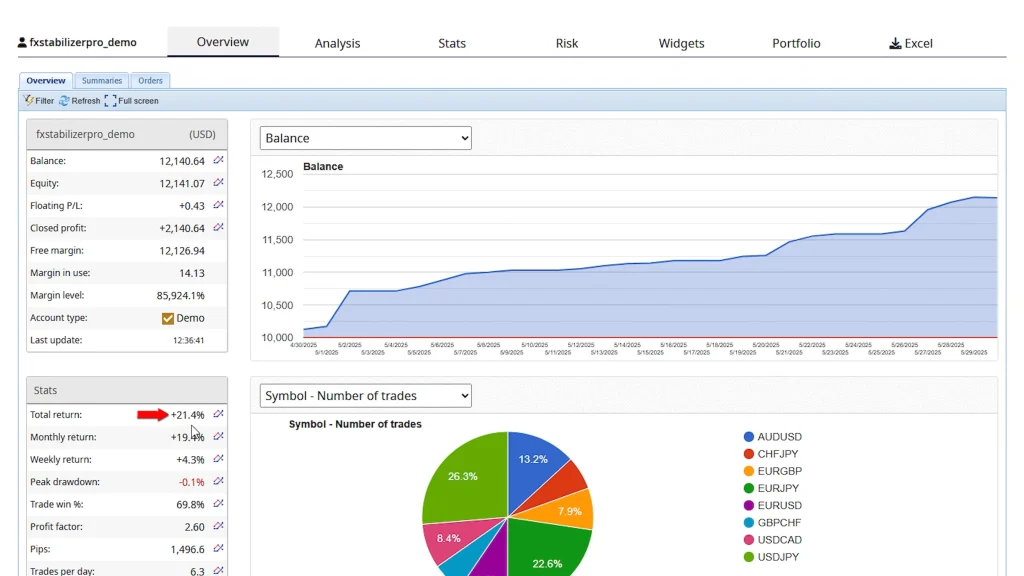
The demo account has generated over $2,000 in profits, which represents above 20% return. Specifically, the track record shows a 21.4% total return with a remarkably smooth balance line.
When I switch the view to equity instead of balance, you can see the floating profit and loss more clearly. There was one drawdown at the beginning of testing, but it recovered. Another drawdown appeared in mid-May, and after that, the equity line has been climbing steadily upward.
This kind of recovery pattern is actually encouraging with grid systems. You want to see that when drawdowns happen, the system can work its way back to profitability rather than just digging deeper holes.
The Standout Performer: USD/CAD
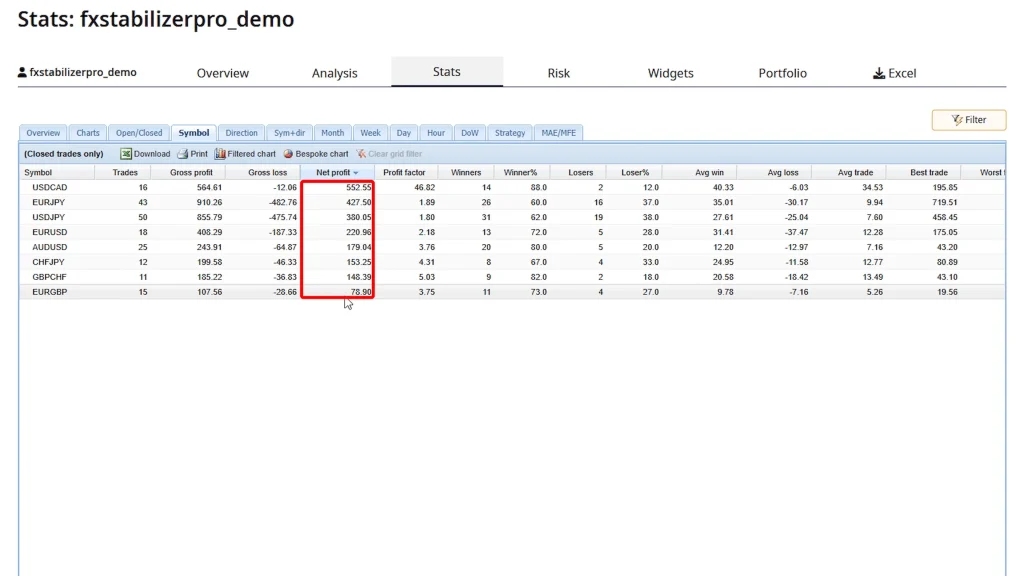
Looking at the stats broken down by currency pair, USD/CAD is the clear winner. It’s generated $5,525 in profit from just 16 trades. But here’s the really impressive number: the profit factor is 46.82.
For context, a profit factor above 1 means the strategy is profitable. A profit factor of 2 is solid. Anything above 3 is excellent. But 46.82? That’s exceptional. It means for every dollar lost, the EA made $46.82 in profits on USD/CAD trades.
I’ve rarely seen profit factors that high outside of heavily optimized backtests, so seeing it in forward testing caught my attention. Whether it continues at that level remains to be seen; profit factors can fluctuate significantly as more trades are executed, but it’s a strong start.
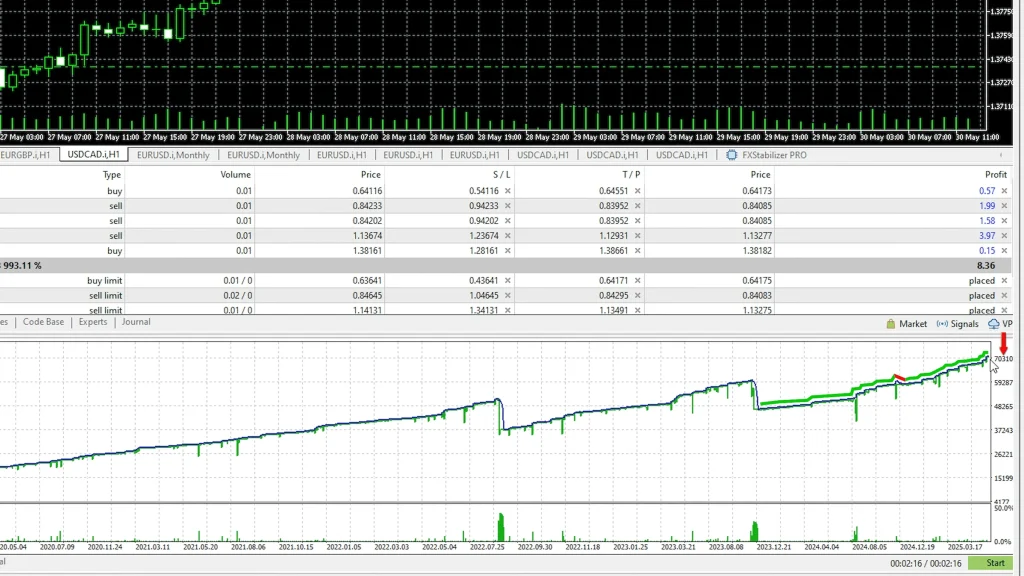
All Eight Pairs Showing Profits
Here’s what matters: every single currency pair is profitable in the demo testing. The profit factors range from 1.88 (USD/JPY with 50 trades) up to that exceptional 46.82 on USD/CAD.
USD/JPY shows the highest exposure, meaning the EA has more capital tied up in those positions. But high exposure doesn’t automatically equal high profitability, as the results demonstrate.
Live Account Performance at Eightcap
Demo results are one thing. Live performance with real money and real spreads is something else entirely. That’s why I opened a live account at Eightcap to see how FXStabilizer PRO performs under actual market conditions.
Why Eightcap?
I chose Eightcap for several reasons:
- Fully regulated broker (I’m in the EU, and they’re regulated by CySEC)
- Low spreads, which matter significantly for grid systems that open multiple positions
- Good execution speed
- Supports automated trading
When you’re running a grid martingale system, spreads eat into your profits with every position opened. On EUR/USD, Eightcap’s spreads are around one pip, with similarly tight spreads on other major pairs. That makes a tangible difference in overall profitability.
Current Live Results
The live account was started recently, so there’s no closed trade history yet. But there are several open positions, and they’re all currently in profit. That’s a good sign, though obviously we need more time and more closed trades to judge long-term performance.
What I’m trading on the live account are the four stable pairs recommended by the vendor: AUD/USD, EUR/USD, EUR/GBP, and USD/CAD.
Configuration and Risk Settings
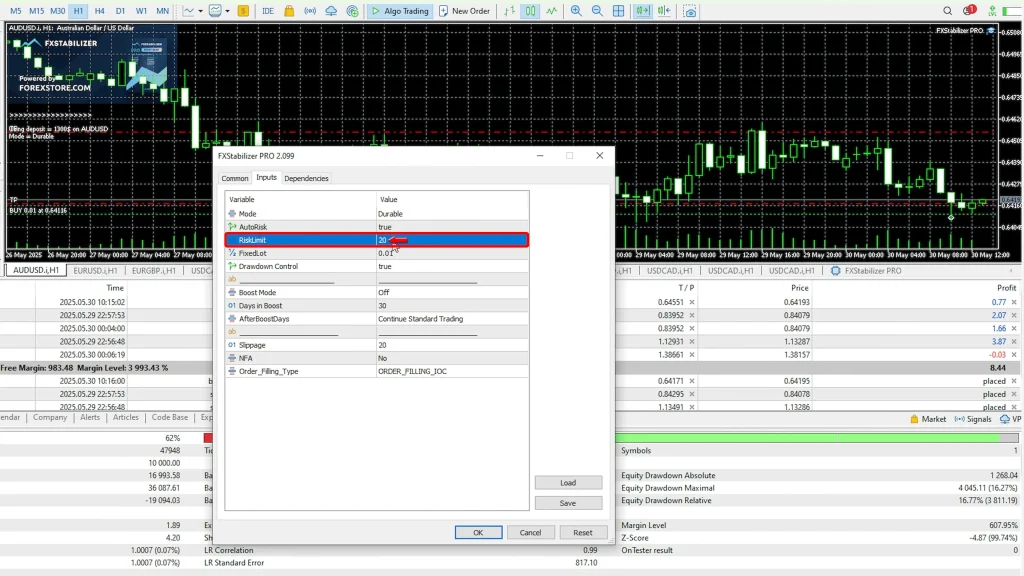
On this live account, I’m using a risk limit of 20 with auto risk enabled. Auto risk means the EA adjusts lot sizes based on the current account balance. As the balance grows, position sizes increase proportionally, and vice versa during drawdowns.
The risk limit of 20 acts as a safety net. If the account equity drops to 20% of its starting value (which would be an 80% drawdown), all positions close automatically. Is that a large drawdown? Yes. But without any limit, a grid martingale system could theoretically drain the entire account. At least with this setting, you preserve 20% to rebuild or withdraw.
Backtest Analysis: USD/CAD Deep Dive
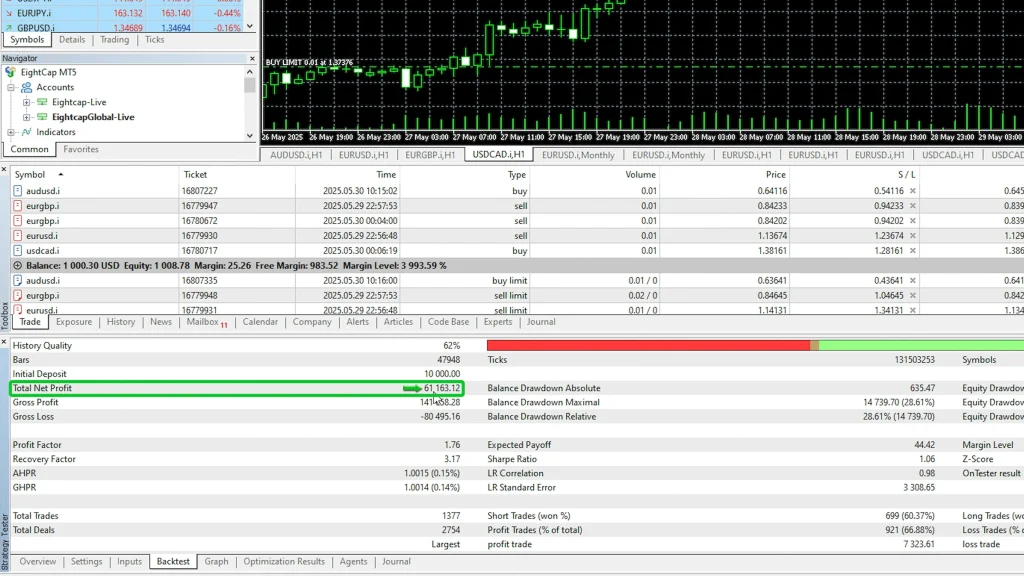
Since USD/CAD emerged as the top performer in demo testing, I ran a complete backtest using all available historical data from Eightcap. The backtest was performed on a $10,000 starting deposit.
Backtest Results
The numbers are striking:
- Total profit: $61,163
- Maximum drawdown: 33.07%
- Time period: Complete history provided by the broker
A 33% drawdown might sound high if you’re used to low-risk systems, but for a grid martingale strategy, it’s actually reasonable. Some systems in this category can see 50%, 60%, or even 70% drawdowns before recovering.
The Drawdown Events
Looking at the equity curve, there are two major drawdown events visible:
The first occurred from the beginning of the backtest until around September 2022. The equity dipped significantly as the system averaged into positions. But here’s where the risk limit setting proved its value, it triggered at the 40 setting (used for this particular backtest), closed all positions, and prevented further losses.
After that reset, the system recovered and reached approximately $70,000 in balance. Then in 2023, another drawdown event occurred. Again, the system recovered and continued climbing.
Comparing Risk Limit Settings
I also ran the backtest with a more conservative risk limit of 20 instead of 40. The results changed significantly:
- Total profit: approximately $17,000 (down from $61,163)
- Maximum drawdown: 16.77% (down from 33.07%)
So you’re making a clear trade-off. Lower risk limits reduce your drawdown exposure but also cap your profit potential. Higher risk limits allow larger gains but expose you to deeper drawdowns.
Which is better? That depends entirely on your risk tolerance and whether you’re trading your own capital or a funded account with strict drawdown rules.
Funded Account Testing
I’m running FXStabilizer PRO on two funded accounts with Trading.com, both with 10% maximum drawdown limits. This is where risk management becomes critical, exceed that 10% threshold, and you lose the account.
Configuration Differences
On the first funded account, I’m trading all eight currency pairs. On the second, I’m trading only the four stable pairs (AUD/USD, EUR/USD, EUR/GBP, USD/CAD).
Why test both configurations? I want to see if spreading across eight pairs provides better diversification and smoother returns, or if focusing on the four stable pairs delivers superior risk-adjusted performance within the 10% drawdown constraint.
Current Results
So far, I have $92 in profits across the funded accounts. That’s not a huge amount yet, but we’re in the early stages of testing. All executed trades are visible in the trade history, and I’m monitoring daily to ensure we stay well within the drawdown limits.
The real test will be whether the EA can maintain profitability while respecting that 10% maximum drawdown restriction. Grid martingale systems can easily breach drawdown limits if they enter a prolonged losing sequence, which is precisely why I wanted to test this configuration.
The Vendor’s Track Record: Long-Term Performance
FXStabilizer PRO is available on the Forex Store website, where the vendor maintains a verified track record for EUR/USD. This track record provides longer-term context than my relatively short testing period.
EUR/USD Historical Performance
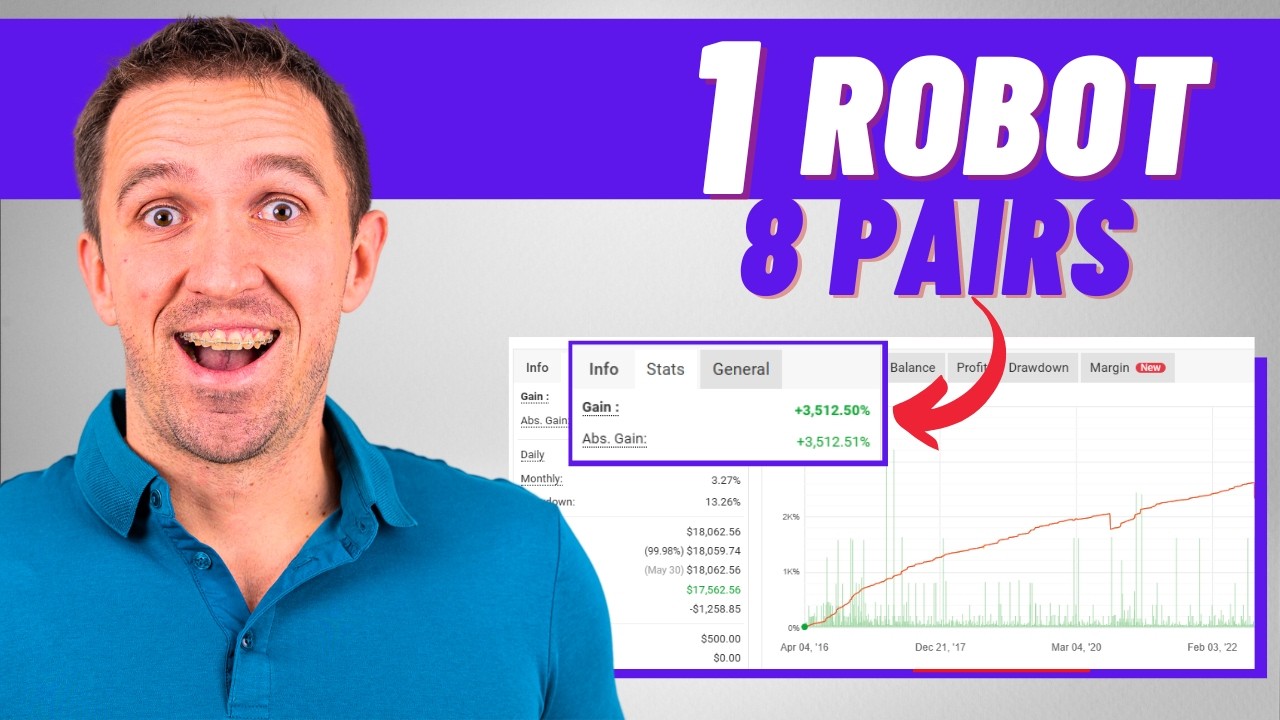
The vendor’s EUR/USD account started in 2016 with a $500 deposit. As of the most recent update, it has gained over 3,500% in total returns. That’s across approximately 9 years of trading.
Now, I’m naturally skeptical when I see track records showing 3,500%+ returns. It’s possible, but it often involves higher risk or specific market conditions that may not continue. That’s exactly why I wanted to test this EA myself across multiple accounts and currency pairs.
Stop Loss Events
What’s notable about the vendor’s track record is that you can see it hit the risk limit stop loss five times over those 9 years. Each time, the system closed all positions, took the loss, and started rebuilding. And each time, it recovered and went on to new equity highs.
This pattern shows both the risk and the resilience of the approach. Yes, there are significant drawdown events that trigger the global stop loss. But the system has historically recovered from those events and continued generating profits.
Will that pattern continue? Nobody knows. Market conditions change, volatility patterns shift, and what worked for 9 years could stop working tomorrow. But it’s at least encouraging that the strategy has weathered multiple market environments.
Risk Management: Understanding the Dangers
Let me be direct about this: grid martingale systems carry significant risk. I’m not going to pretend otherwise just because FXStabilizer PRO has been profitable so far.
How Grid Martingale Can Go Wrong
The fundamental risk is simple: if the market trends strongly in one direction without reversing, the EA keeps adding positions at worse and worse prices. Your losses grow with each additional position, and you’re hoping for a reversal that may not come in time.
This is why the risk limit feature is so important. It’s your circuit breaker; it caps your maximum loss at a predetermined level.
Drawdown Tolerance
Based on the backtests and live results, you should expect drawdowns in the 15-35% range, depending on your risk limit settings. If you can’t psychologically handle seeing your account down 20-30% at times, this EA isn’t for you.
Funded accounts with 10% drawdown limits are particularly challenging because you have less room for error. The four-pair configuration might be safer for these constraints, but I’m still gathering data on that hypothesis.
Capital Requirements
You need sufficient capital to weather the drawdowns. Running this on a $100 account is asking for trouble. The vendor’s track record started with $500, and even that’s on the aggressive side. I’d recommend at least $1,000 for live trading, and preferably more.
Turbo Mode vs. Durable Mode
FXStabilizer PRO offers different operational modes that adjust how aggressively the system trades. While the transcript didn’t detail my specific mode settings, these configurations typically affect:
- Position sizing
- Grid spacing (how far apart the EA places new positions)
- Take profit targets
- Maximum number of open positions
Turbo mode generally means more aggressive trading with tighter grid spacing and larger position sizes. Durable mode takes a more conservative approach with wider spacing and smaller positions.
For funded accounts with strict drawdown limits, durable mode makes more sense. For live accounts where you have more flexibility, turbo mode might generate higher returns, with correspondingly higher risk.
Comparing Currency Pair Performance
One of the interesting aspects of testing eight pairs simultaneously is seeing how they differ in performance characteristics.
Top Performers
- USD/CAD: Exceptional profit factor of 46.82, though based on only 16 trades
- Other pairs show consistent profitability but with more modest metrics
Higher Exposure Pairs
- USD/JPY: Highest exposure but lower profit factor (1.88)
- More trades executed (50), but smaller per-trade profits
The correlation between exposure and profitability isn’t straightforward. Sometimes pairs with lower exposure generate better returns because they catch cleaner market movements. Pairs with high exposure might be experiencing choppier conditions requiring more averaging.
Platform and Technical Requirements
MetaTrader 4 Compatibility
FXStabilizer PRO runs on MT4, which remains the most popular platform for retail forex trading. Setup is straightforward if you’ve installed EAs before, drag the file to your experts folder, attach it to charts, configure your settings, and let it run.
VPS Hosting
Like most automated systems, you’ll need a VPS to ensure 24/7 operation. Grid martingale strategies are particularly sensitive to connectivity issues because they manage multiple open positions simultaneously. Missing a critical price level could mean missing an exit opportunity or failing to place a necessary averaging position.
VPS costs typically run $20-30 monthly, which should be factored into your total operating costs.
Broker Considerations
Not all brokers are suitable for grid martingale systems. You need:
- Low spreads (because you’re opening multiple positions)
- Fast execution (to hit target entry prices)
- No restrictions on EA trading
- Sufficient leverage (though excessive leverage is dangerous)
Eightcap meets these criteria, which is why I chose them for live testing.
Pros and Cons
What’s Working Well
- Profitability across all pairs: In demo testing, all eight currency pairs are generating profits. That suggests the strategy isn’t overly optimized for specific market conditions.
- Risk limit protection: The global stop loss feature prevents total account wipeout, which is the nightmare scenario for martingale systems.
- Strong profit factors: Several pairs show profit factors well above 2, with USD/CAD showing exceptional numbers.
- Vendor transparency: The 9-year track record with visible drawdown events shows both good and bad periods rather than cherry-picked results.
- Smooth equity curves: When the system is working, it generates steady profits with relatively smooth balance growth.
Areas of Concern
- Grid martingale risk: No matter how good the risk management, the underlying strategy carries significant drawdown risk.
- Drawdown depths: 33% drawdown in backtests (or even 16.77% with conservative settings) is substantial. Not everyone can handle that psychologically.
- Limited live data: My live testing is still in early stages, with a few closed trades. Long-term performance may differ from these initial results.
- Funded account challenges: The 10% drawdown limit on funded accounts might be too tight for this EA’s natural drawdown pattern.
- Currency pair differences: Performance varies significantly between pairs. What works on USD/CAD might not translate to other pairs under different market conditions.
- Requires monitoring: While automated, you should still check the system regularly to ensure it’s functioning properly and not approaching risk limits.
Pricing and Where to Get It
FXStabilizer PRO is available through the Forex Store website. I haven’t included specific pricing in this review because it can change based on promotions and package options, but you can find current information on our dedicated page.
My Testing Plan Going Forward
I’m taking a measured approach with FXStabilizer PRO. Here’s what I’m doing:
- Continue demo testing with all eight pairs to build a longer track record
- Monitor the live Eightcap account with the four stable pairs
- Track both funded accounts separately to compare eight-pair vs. four-pair performance
- Consider scaling up to a $5,000 account if the live results remain stable
If the live account continues showing positive results over the next few months, I’ll increase capital allocation. If I see concerning drawdown patterns or performance degradation, I’ll reduce risk or exit positions.
The results will be transparently shared on our live trading page and funded accounts page, so you can follow along in real-time and make your own assessment.
Frequently Asked Questions
What makes FXStabilizer PRO different from other grid martingale EAs?
FXStabilizer PRO stands apart through its risk limit feature that functions as a global stop loss across all positions. Most grid martingale systems average down indefinitely, which can lead to complete account losses during strong trends. This EA automatically closes all positions when equity reaches your preset risk level (20, 40, or other values), preserving remaining capital.
Additionally, it’s designed to trade eight currency pairs simultaneously, providing diversification that single-pair systems lack. The vendor’s 9-year verified track record on EUR/USD demonstrates that the strategy has survived multiple market cycles, though it has triggered the risk limit five times during that period.
Which currency pairs should I trade with FXStabilizer PRO?
Based on current testing, the vendor recommends four pairs as more stable: AUD/USD, EUR/USD, EUR/GBP, and USD/CAD. In demo account results, USD/CAD has shown exceptional performance with a profit factor of 46.82 from just 16 trades.
However, all eight supported pairs (including EUR/JPY, USD/JPY, CHF/JPY, and GBP/CHF) have been profitable in testing. The choice depends on your risk tolerance; trading all eight pairs provides maximum diversification but increases complexity and capital requirements. For funded accounts with 10% drawdown limits, the four stable pairs might be safer.
Can FXStabilizer PRO work on funded accounts with strict drawdown limits?
This is challenging and depends heavily on your risk settings. Backtests show drawdowns ranging from 16.77% with conservative risk limits up to 33.07% with more aggressive settings. Most funded account programs impose 10% maximum drawdown limits, which is tighter than FXStabilizer PRO’s natural drawdown pattern.
I’m currently testing this scenario on two Trading.com funded accounts, one with all eight pairs and another with four stable pairs. Results will show whether the EA can generate consistent returns while respecting the 10% constraint. Conservative risk limit settings (20 or lower) are essential for funded account trading.
What’s the difference between turbo mode and durable mode?
Turbo mode and durable mode represent different risk-reward configurations in FXStabilizer PRO. Turbo mode typically uses tighter grid spacing, larger position sizes, and more aggressive averaging, which can generate higher returns but also leads to deeper drawdowns during adverse market movements.
Durable mode takes a conservative approach with wider grid spacing, smaller positions, and less frequent averaging, resulting in slower profit accumulation but better drawdown protection. For funded accounts or traders with lower risk tolerance, durable mode is generally recommended. For personal accounts where you can handle larger equity swings, turbo mode offers higher profit potential.
How much capital do I need to trade FXStabilizer PRO safely?
Minimum capital requirements depend on which pairs you trade and your risk settings. The vendor’s long-term track record started with $500, but that’s aggressive for most traders. Based on backtest drawdowns ranging from 16% to 33%, I recommend at least $1,000 per currency pair you’re trading, preferably more.
If trading all eight pairs, $5,000-$10,000 provides an adequate buffer for weathering drawdown periods. For funded accounts with 10% drawdown limits, you need even more conservative position sizing. Remember that grid martingale systems require sufficient capital to average down during unfavorable price movements; undercapitalization is one of the primary reasons these systems fail.
What are the main risks I should understand before using this EA?
The primary risk is inherent to grid martingale strategies: positions average down as price moves against you, and if the trend continues long enough, losses accumulate rapidly. FXStabilizer PRO’s risk limit provides protection, but you can still lose 60-80% of your account before it triggers (depending on settings).
The vendor’s track record shows five stop loss events over 9 years, demonstrating this risk is real, not theoretical. Other considerations include broker dependency (you need low spreads and fast execution), drawdown tolerance (can you psychologically handle 20-30% equity drops?), and funded account compatibility (10% limits may be too tight). Always test on demo accounts first and never risk capital you can’t afford to lose.
Final Assessment
FXStabilizer PRO has shown promising results in early testing, but I’m maintaining realistic expectations. Grid martingale systems can look fantastic for extended periods before hitting challenging market conditions.
The risk limit feature provides meaningful protection compared to unlimited martingale systems. The multi-currency approach offers diversification that single-pair EAs can’t match. And the vendor’s long-term track record demonstrates that the strategy can work across different market environments.
But the drawdowns are real, the risks are substantial, and anyone considering this EA needs to understand what they’re getting into. This isn’t a low-risk system. It’s a calculated risk approach that trades higher drawdown potential for steady profit generation during favorable conditions.
For traders comfortable with that trade-off and who can allocate sufficient capital to weather 20-30% drawdowns, FXStabilizer PRO is worth considering. For those with lower risk tolerance or limited capital, there are probably better options.
I’ll continue testing and updating results as more data accumulates. The next few months will be telling, particularly how the funded accounts perform within their 10% drawdown constraints.
Where to Learn More
If you’re interested in exploring FXStabilizer PRO further, I maintain an updated resource page on Algo Trading Space with current information about the EA, vendor track records, and setup guidance.
You can find everything at: algotradingspace.com/robots/forex/fxstabilizer-pro-ea
The page includes links to the Forex Store listing where the EA is available, along with the vendor’s verified MyFXBook accounts showing long-term performance. I update it periodically as I gather more data from my own testing across demo, live, and funded accounts.
Full transparency: if you purchase through our page, we receive a commission that helps support ongoing testing and transparent reporting. But the choice is entirely yours, do your own research, test thoroughly on demo accounts, and make decisions based on your own risk tolerance and trading goals.
You can also follow my ongoing results on our live trading page and funded accounts page to see exactly how FXStabilizer PRO performs in real market conditions over time.
For traders interested in deeper insights, Algo Trading Space offers a VIP Club that provides exclusive access to our complete trading results dashboard, priority support, and early intelligence on high-performing EAs before they become public knowledge. Members also get downloadable set files, access to our private Discord community, and our full course library.
Testing Disclosure: This review reflects ongoing testing across demo, live, and funded accounts. Results shown are based on actual account performance, but past results do not guarantee future outcomes. Grid martingale systems carry a substantial risk of significant drawdowns. Always test on demo accounts first, never risk capital you cannot afford to lose, and understand that all forex trading involves risk of loss.


Comments
No comments yet. Be the first to comment!
Leave a Comment
Your email address will not be published. Required fields are marked with *