An AI-powered grid trading system designed for steady multi-currency performance on the M5 timeframe. Built to automate decision-making using deep learning, market filters, and AI-driven forecasts—without manual intervention.

EasyAI Grid EA is an automated grid trading system that combines traditional grid mechanics with modern artificial intelligence and deep learning models. The strategy continuously analyzes market behavior across multiple currency pairs, identifying high-probability price zones and managing entries dynamically.
Learn More
EasyAI Grid EA is built around practical, transparent components that support full automation, controlled risk, and AI-driven execution.
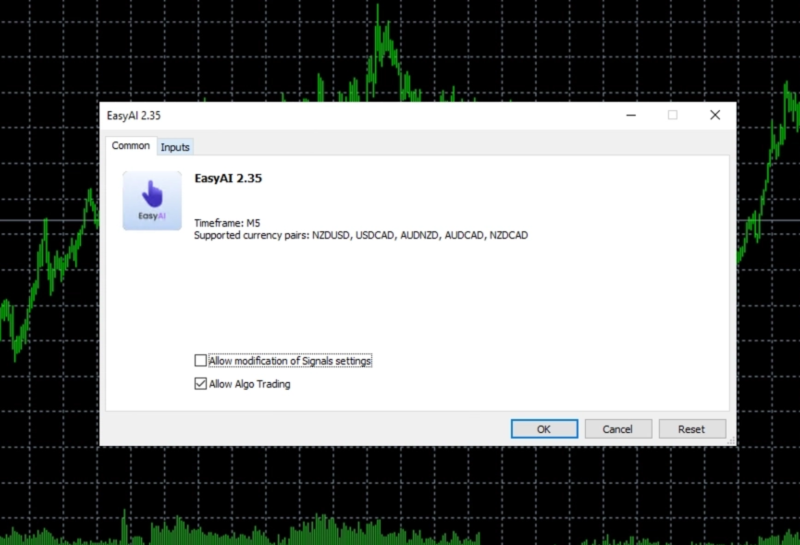
EasyAI Grid EA is an automated grid trading system that operates on the M5 timeframe across six forex pairs: NZDUSD, USDCAD, AUDNZD, AUDCAD, NZDCAD, and GBPCHF. These instruments were selected for their tendency to exhibit mean-reverting behavior and regular oscillation patterns, which suits grid trading logic well. The pair selection deliberately avoids the most heavily traded majors where trend strength can overwhelm grid systems. This grid expert advisor runs all six pairs simultaneously from a single MetaTrader setup, with grid parameters optimized individually for each instrument's volatility profile.
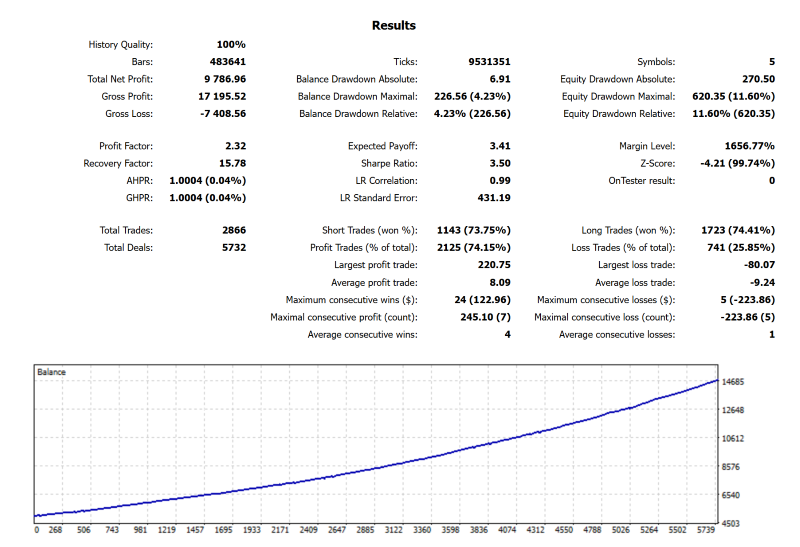
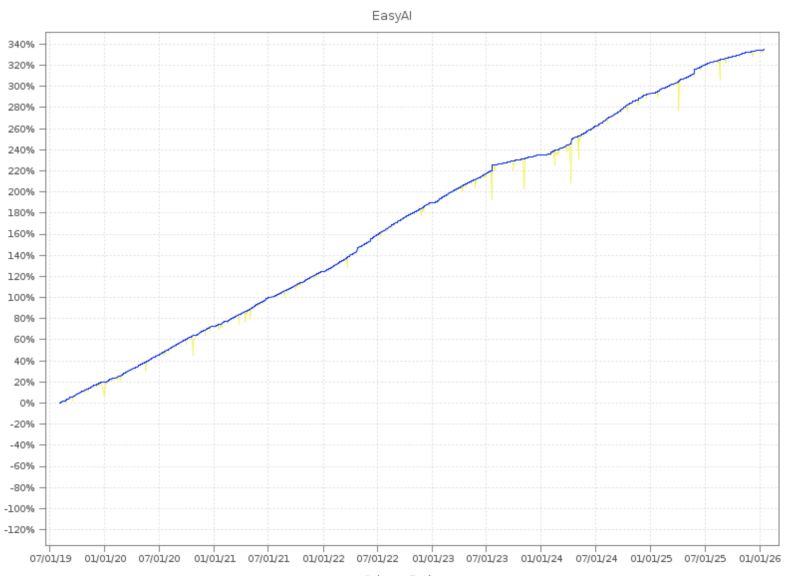
Multi-year backtesting confirms that this grid EA consistently completes cycles across varying market conditions. Among the best grid trading EAs tested, performance holds up during both ranging and moderately trending phases. The deep learning component helps the system recognize when grid orders are likely to close favorably versus when conditions warrant caution. Results across all six pairs show that the AI-filtered approach reduces the frequency of extended drawdowns compared to non-adaptive grid systems. The trading software produces reliable backtest data when run with quality tick information.
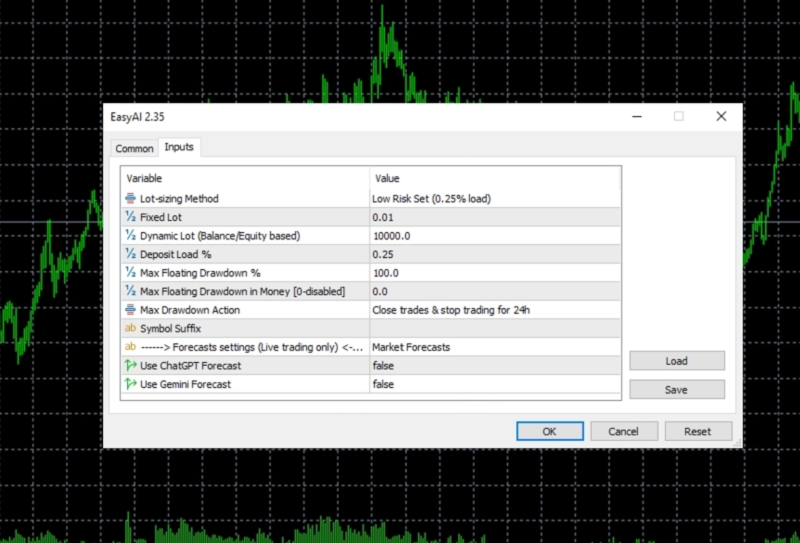
Risk controls within EasyAI Grid EA go beyond simple lotsize configuration. Users select from predefined risk levels that adjust grid spacing in pips, maximum open positions, and capital protection thresholds. The system also includes drawdown limits that trigger automatic closure of all grid trades when reached. Hedging capability allows offsetting positions during volatile periods. These layered controls help manage the inherent exposure of grid trading, which is critical because drawdowns in any grid strategy can expand quickly during sustained directional moves without proper safeguards.
The EasyAI community provides an active support network for users of this trading EA. Experts and experienced grid traders share configurations, discuss market conditions, and troubleshoot setup questions. For newer users, having access to a community where others are running the same system on the same pairs is genuinely valuable. It creates a feedback loop that helps identify broker-specific issues, optimal grid parameters, and risk settings that have worked across different account sizes. RobotFX Grid users frequently compare notes on performance and configuration adjustments.
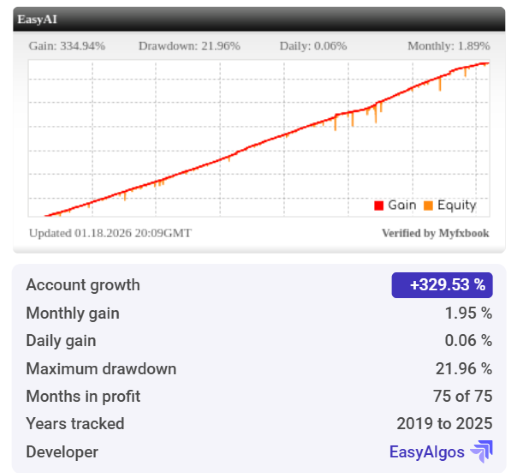
The verified MyFxBook track record shows 75 consecutive profitable months, which is a striking figure for any automated strategy, particularly one using grid logic. This record reflects the system's ability to complete grid cycles consistently over an extended period. It is worth noting that monthly profitability does not mean the absence of drawdowns; floating losses during active grid cycles are normal and expected. The distinction is that every month has ended with net positive results after all positions closed. This kind of verified consistency is uncommon among grid EAs and sets EasyAI apart from most competing grid systems in the market.


This Expert Advisor is structured for traders who value verified performance, automation, and controlled risk exposure.

Live trading track record validated through Myfxbook with continuous updates.

Deep learning models and AI forecasts enhance grid placement and timing.

Trades are layered strategically to capitalize on price retracements.

Designed to react efficiently to short-term market movements.

Adjustable risk levels, stop-loss controls, and maximum drawdown limits.

Trades six currency pairs to spread opportunity and reduce dependency on a single market.
EasyAI Grid EA is not a casual tool. It requires a $5,000 minimum balance, uses grid logic that can hold multiple open positions simultaneously, and includes an AI layer that most competing systems lack. Understanding whether it fits your profile before committing capital is important. Here is who tends to benefit most:
This is the most critical qualifier. Grid trading means positions may remain open for extended periods while the system waits for price to retrace and close the basket in profit. If watching unrealized losses accumulate while the grid works through its cycle causes you anxiety, this approach will be difficult to sustain psychologically. For those who understand how grid trades function, the 75-month profit streak demonstrates that the logic works when given adequate time and capital.
The minimum is firm. Grid systems need sufficient margin to support multiple open positions across six pairs simultaneously. Undercapitalized accounts risk stop-outs during deep grid expansion. The recommended leverage of 1:200 or higher provides adequate headroom for the strategy to operate as designed.
What separates EasyAI from conventional grid EAs is the deep learning component. The AI model analyzes market conditions and adjusts grid behavior accordingly, which helps avoid opening new grid orders during periods where trend strength is likely to overwhelm the recovery logic. For those who have been burned by static grid systems that expand blindly into strong trends, the adaptive element is worth considering.
The six pairs traded by EasyAI have low overlap with the instruments used by most trend-following or scalping EAs. Adding a grid-based mean-reversion system to a portfolio that already includes directional strategies introduces a return stream with different market dependencies. The correlation between this EA and trend-following systems is typically low.
Grid trading is not fast. Cycles can take days or weeks to complete, and some months will show significant floating drawdown before closing positively. The 75-month track record only materializes with sustained, uninterrupted operation. Traders who frequently intervene, close grid positions manually, or shut down the EA during uncomfortable periods undermine the system's ability to deliver consistent results.
Yes. Once configured, the EA operates autonomously on MetaTrader, managing grid entries, exits, and risk without manual input. The deep learning model runs internally and adjusts grid behavior based on current conditions. You do not need to intervene during normal operation, though periodic review of account equity and open exposure remains advisable.
A starting balance of $5,000 USD is required. This figure reflects the margin needed to support multiple simultaneous grid positions across six pairs on M5. Accounts below this threshold risk stop-outs during deep grid expansion. Larger balances provide additional buffer and allow for moderately higher lotsize configurations.
The EA supports NZDUSD, USDCAD, AUDNZD, AUDCAD, NZDCAD, and GBPCHF. These pairs were selected for their mean-reverting characteristics and moderate volatility, which suit grid trading logic. Running all six simultaneously provides diversification across different currency correlations and market behaviors.
All grid trades are executed on the M5 timeframe, optimized for short-term price action. The five-minute chart provides frequent enough data points for the AI model to assess conditions while keeping trade execution within a scalping-to-intraday horizon. Higher timeframes are not recommended for this specific system.
Users select from predefined risk levels that control grid spacing, lotsize, and maximum open positions. Maximum drawdown limits can be set to trigger automatic closure of all positions if the account reaches a defined threshold. Capital protection features add another layer that restricts new grid orders when equity falls below a specified level.
No. Built-in news and market filters automatically pause the opening of new grid orders before and after high-impact events. Existing positions remain open and are managed normally. The filter prevents the system from expanding the grid into volatile, unpredictable conditions where spreads widen and slippage increases.
The deep learning model is pre-trained on historical data and periodically updated through software releases. It does not retrain itself in real time on your live account data. The model uses its trained parameters to assess current market conditions and adjust grid behavior accordingly. Updates to the AI component are delivered through version releases, which may refine the model based on more recent data. This approach avoids the instability that real-time retraining can introduce, while still keeping the system current through periodic developer updates.
The AI model processes multiple input types including recent price history, volatility measures, and multi-timeframe trend analysis. Volume data is considered where available, though forex volume reporting varies by broker. The model uses these inputs to assess whether current conditions favor grid cycle completion or whether the risk of sustained directional movement is elevated. When the model identifies high-risk conditions, it restricts new grid orders and tightens parameters. The specific weighting and architecture are proprietary, but the general approach focuses on condition assessment rather than signal generation.
EasyAI Grid EA does not use classic martingale lot doubling. The grid parameters can be configured with uniform lot sizing across all levels, or with controlled progression that increases moderately per level without the aggressive doubling characteristic of martingale. The default settings use conservative progression where later grid levels carry slightly larger positions, but the scaling is far more restrained than traditional martingale. The AI layer also helps by restricting new grid orders during conditions where expansion is more likely to lead to deep drawdowns rather than recovery.
Yes, both MetaTrader 4 and MetaTrader 5 versions are available. The core grid logic and AI model operate identically across both platforms. Some traders prefer MT5 for its improved backtesting engine and multi-threaded optimization, while others remain on MT4 for broader broker compatibility. Performance differences between the two are minimal under live conditions.
A VPS is strongly recommended. Grid cycles may remain open for days, and the EA needs continuous connectivity to manage positions and apply the AI filtering logic properly. A VPS with 2 GB of RAM, a single-core processor, and latency below 10ms to your broker's server is sufficient for one MetaTrader instance running all six pairs. If running additional expert advisors alongside, consider upgrading to 4 GB of RAM. The uninterrupted uptime a VPS provides is particularly important for grid systems where disconnection during active cycles can lead to unmanaged exposure.
Leverage of 1:200 or higher is recommended. This provides adequate margin headroom for the grid to expand across multiple pairs simultaneously without approaching margin limits. Lower leverage ratios, such as 1:100, may work with reduced risk settings but could restrict the grid's ability to open necessary levels during volatile periods. Traders with access to 1:500 leverage gain additional buffer, though the risk controls should remain conservative regardless of available leverage.
Some versions include automatic GMT detection, while others require manual configuration. Incorrect GMT settings can cause the news filter to activate at wrong times, either missing event windows or blocking entries unnecessarily. Confirming your broker's server time offset and entering it correctly in the settings panel before going live is important. Your broker's support team can provide the exact offset if you are unsure.
In most cases, no. Grid strategies inherently carry the risk of extended floating drawdowns during sustained directional moves, which typically conflicts with the strict 4 to 5% daily and 8 to 12% maximum drawdown limits that most prop firms impose. Even with the AI filtering reducing adverse grid expansion, the nature of holding multiple open positions across six pairs creates exposure that could breach firm thresholds during volatile periods. Some firms with more relaxed drawdown rules may be compatible with very conservative settings, but this should be tested thoroughly on a demo before risking a funded account.
The core distinction is the AI component. Quantum StarMan uses a non-martingale grid with uniform lot sizing but no adaptive intelligence. Happy MartiGrid applies genuine martingale progression with technical filters but no machine learning. EasyAI Grid EA adds a deep learning layer that assesses market conditions before allowing grid expansion, which reduces the frequency of deep drawdowns compared to static grid systems. In terms of pairs traded, all three target different instruments, making them potentially complementary. The 75-month profit streak on MyFxBook sets EasyAI apart in terms of verified consistency, though past performance does not guarantee future results.
The primary advantage is condition awareness. Traditional grid EAs open orders at fixed intervals regardless of what the market is doing. EasyAI's deep learning model assesses whether current conditions favor mean reversion (where grids close profitably) or sustained trending (where grids can expand into deep drawdowns). By restricting new grid orders during unfavorable conditions, the AI layer helps avoid the worst-case scenarios that standard grid systems face during strong directional moves. This does not eliminate drawdown entirely, but historical data suggests it meaningfully reduces both the frequency and depth of adverse grid expansions compared to non-adaptive approaches.
Yes. The EA uses unique magic numbers to separate its grid trades from positions opened by other expert advisors. Since it trades six specific pairs that most trend-following or scalping EAs do not target, instrument overlap is uncommon. The main concern when running multiple systems is aggregate margin usage; EasyAI's grid structure can hold numerous open positions simultaneously, which consumes significant margin. Monitoring total account exposure and maintaining conservative settings across all active EAs is essential for stable multi-system operation.
If you’re looking for a hands-free, AI-enhanced grid trading system with verified performance, flexible risk controls, and multi-currency exposure, EasyAI Grid EA offers a data-driven approach built for long-term consistency.