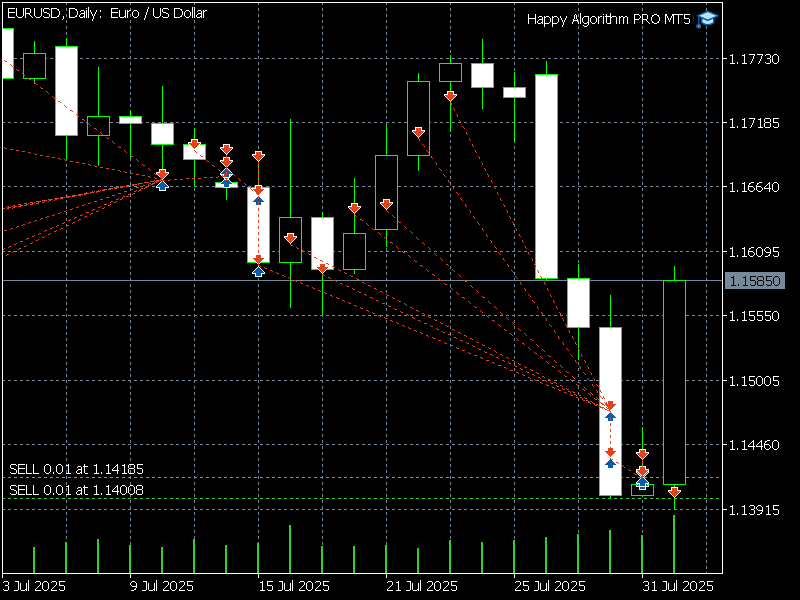
A smart correlation-based trading system that capitalizes on EUR/USD and USD/CHF price deflections using advanced statistical analysis and automated grid regulation.

Happy Algorithm PRO represents a breakthrough in algorithmic trading, utilizing sophisticated correlation analysis between EUR/USD and USD/CHF currency pairs. Unlike traditional grid systems that add risky additional trades, this EA employs variable grid regulation that prevents dangerous position scaling. The system continuously monitors the correlation deflection between these historically linked pairs, identifying when their relationship deviates from normal patterns. When significant deflections are detected, the EA opens strategic positions expecting the correlation to return to its mean value. Built by the proven HappyForex development team behind successful EAs like Heavy Forex and Heavy Gold, this system combines years of market research with cutting-edge statistical analysis for consistent, low-risk automated trading.
Go to review
Happy Algorithm PRO incorporates advanced correlation measurement, statistical optimization, and intelligent risk management to deliver consistent trading performance across multiple market conditions.
Happy Algorithm Pro EA operates exclusively on EUR/USD and USD/CHF using the D1 timeframe, a deliberate choice that keeps the strategy focused on daily price behavior and long-term statistical patterns rather than intraday noise. Both pairs were selected for their historically consistent inverse correlation, which forms the foundation of the entry logic.
The core strategy monitors the statistical relationship between EUR/USD and USD/CHF, identifying moments when the two pairs deviate beyond their historically normal range. These deflection points, where the correlation temporarily breaks down, represent the EA's primary entry opportunity, positioning for a return toward the established mean relationship.
Once configured and running on a VPS, Happy Algorithm Pro EA manages every aspect of the trading process independently, including entries, position additions, and exits. The D1 timeframe means decisions happen at a measured pace, making this genuinely practical for traders who cannot monitor positions throughout the day.
The strategy's parameters were developed and refined through extensive statistical testing across historical EUR/USD and USD/CHF data. Entry thresholds, grid intervals, and risk limits are all calibrated around what the data supports, rather than being set arbitrarily, which gives the system a more grounded performance foundation than intuition-based approaches provide.
Multiple layers of risk protection operate simultaneously, stop-loss levels on individual positions, configurable drawdown thresholds that pause activity when equity falls to defined limits, and variable grid caps that prevent sequences from extending without a boundary. These controls work together to keep exposure within manageable parameters during both normal and adverse conditions.
Happy Algorithm PRO delivers stable, low-drawdown performance through intelligent correlation analysis and proven risk management protocols tested across multiple market conditions.

Operates exclusively on D1 timeframe for stable, low-frequency signal generation

Monitors top absolute correlation pairs (EUR/USD & USD/CHF) for deflection opportunities

Variable grid regulation prevents risky position scaling and overexposure

Built-in performance analysis optimizes hidden stop-loss and take-profit levels

Designed for accounts with spreads up to 20 pips (EUR/USD) and 25 pips (USD/CHF)

Created by HappyForex, developers of successful Heavy Forex and Heavy Gold EAs
Happy Algorithm Pro EA suits traders who prefer a statistically grounded, lower-frequency approach to automation, one built around a specific and well-documented market relationship rather than broad signal scanning across multiple instruments. It's not a system that generates constant activity. That's the point.
The correlation deflection concept is more nuanced than a simple trend-following or mean-reversion premise. Traders who have some familiarity with how EUR/USD and USD/CHF relate to each other , and why that relationship exists , will find the EA's behavior considerably easier to interpret and configure appropriately. That understanding also helps when deciding whether to intervene during unusual market periods.
Operating on the D1 timeframe, this EA produces far fewer trades than shorter-timeframe alternatives. Some weeks pass with minimal activity. That pace suits traders who are comfortable evaluating performance over months rather than days, and who recognize that fewer, higher-quality setups often produce a more sustainable equity curve than constant high-frequency trading.
The accessible price range and minimum capital requirements make this a practical option for traders who are not yet operating with large accounts. The risk management framework is designed to function sensibly at these levels, provided configuration choices are made conservatively, and lot sizing reflects the actual capital available, not an aspirational figure.
Full D1 automation means the EA assesses conditions once per candle close and acts accordingly. There are no intraday alerts to monitor, no rapid position changes to track in real time. For traders with professional commitments or simply a preference for less screen time, that cadence is a genuine operational advantage over more active strategies.
Manually trading a correlation strategy across two pairs simultaneously, timing entries, managing grid additions, and monitoring both instruments at once, is genuinely demanding. Happy Algorithm Pro EA handles all of that automatically. For traders who are conceptually drawn to correlation trading but find the manual execution impractical, this EA removes that barrier entirely.
Get answers to common questions about Happy Algorithm PRO's trading methodology, setup requirements, and performance characteristics.
Happy Algorithm Pro EA trades EUR/USD and USD/CHF on the D1 timeframe using a statistical analysis framework built around correlation deflection, a method that monitors the historical relationship between these two pairs and acts when that relationship moves outside its statistically normal range. When the pairs diverge beyond defined thresholds, the EA positions for a return toward their established correlation. A variable grid regulation system manages position building during adverse moves, while intelligent risk controls govern overall exposure throughout each active cycle.
Happy Algorithm Pro EA was developed by the same team behind the broader Happy EA product range , a group with an established track record in building statistically-driven automated trading systems for MetaTrader platforms. The EA reflects years of research into currency pair correlation behavior, particularly the inverse relationship between EUR/USD and USD/CHF. The development philosophy prioritizes long-term statistical edge over short-term signal frequency, which is reflected in the D1 timeframe selection and the measured, data-driven approach to both entry logic and risk management.
With some caveats, yes. The set-and-forget automation removes the need for real-time decision-making, and the configuration process is straightforward relative to more complex multi-pair systems. That said, understanding the underlying correlation concept , even at a basic level , will help beginners interpret what the EA is doing and why. Running it on a demo account for several weeks before committing live capital is strongly recommended, regardless of experience level. A trader who understands the strategy's logic is better positioned to make sensible configuration decisions than one who simply installs it and hopes for the best.
Yes, though thoughtful consideration of combined exposure is essential before doing so. Happy Algorithm Pro EA trades EUR/USD and USD/CHF; if other EAs also hold positions on these pairs or closely associated instruments, simultaneous activity can increase total account risk during periods when the correlation trade is under pressure. Running complementary systems on unrelated instruments is the cleaner approach. Reducing lot sizes across all active EAs when combining them, and testing the full setup on a demo account first, is perhaps the most practical way to assess whether the combination is genuinely manageable.
A dedicated account is worth serious consideration. Isolating Happy Algorithm Pro EA on its own account keeps the performance record clean and readable; you can see exactly how the correlation strategy is contributing to results without other positions obscuring the picture. Separate accounts also simplify margin management, since the variable grid can hold multiple open positions simultaneously during active cycles. Mixing this with other EAs on shared capital creates situations where one system's drawdown reduces the available margin for another at exactly the moment both may need it most.
Given the D1 timeframe, trade frequency is lower than most shorter-timeframe EAs, which means a meaningful evaluation period is longer than traders often expect. A minimum of eight to twelve weeks on a demo account is a reasonable starting point, covering enough daily candles to generate a statistically relevant sample of setups. Assessing performance based on 15 or 20 completed trades tells you considerably more than a two-week window with only a handful of closed positions. Patience during the testing phase is, genuinely, one of the more important inputs into a successful live deployment.
Yes. Stop-loss protection is applied across active positions, and the variable grid regulation system includes configurable limits on how far a sequence can extend before new additions are paused. Maximum drawdown thresholds provide an additional safety layer, suspending EA activity if floating losses reach a defined ceiling. These built-in controls work together to contain the depth of any single adverse event. They don't make losses impossible, no system does, but they do provide a structured boundary that prevents an unfavorable period from compounding without limit.
Several practical steps contribute to sound risk management:rnrnMatch lot sizing to account balance, position sizes should reflect a genuine percentage of available capital, not an arbitrary fixed valuernSetting a maximum drawdown threshold, defining the point at which the EA pauses activity, is one of the most important configuration decisionsrnStart conservatively, lower risk settings during the initial deployment period give you time to observe real-world behavior before increasing exposurernMonitor open positions periodically; full automation doesn't eliminate the value of occasional oversight, particularly during periods of broad market stressrnAvoid over-leveraging; the variable grid can hold multiple concurrent positions. Sizing each one appropriately from the outset prevents margin issues during extended sequences
During periods of abnormal volatility, driven by unexpected geopolitical events, central bank emergency actions, or broad market dislocations, the statistical relationship between EUR/USD and USD/CHF can break down temporarily. The EA's risk controls respond by monitoring floating drawdown against configurable thresholds and pausing new additions within active cycles if exposure reaches defined limits. Position-level stop-losses remain active throughout these periods. The strategy is built around a long-term statistical relationship that has historically been robust, but short-term correlation breakdowns are a real risk that adequate capital allocation helps absorb.
MetaTrader's built-in terminal provides a live view of all open positions, floating profit and loss figures, and overall account equity. For a broader picture of how EUR/USD and USD/CHF are behaving relative to their historical relationship, charting both pairs simultaneously on D1 gives useful visual context. Some traders also track the spread between the two pairs using a custom indicator or a simple price ratio calculation. Third-party tools like Myfxbook provide ongoing equity curve monitoring and trade-by-trade performance records, which are particularly useful for tracking how correlation cycles are progressing over time.
The variable grid regulation system adjusts position-building behavior based on current market conditions. During periods where price movement becomes erratic or volatility spikes beyond normal parameters, the grid spacing and maximum trade count limits constrain how aggressively new positions are added. A configurable maximum drawdown threshold pauses all new activity if floating losses reach a defined equity percentage. Together, these mechanisms create a tiered response to instability; the EA doesn't simply continue operating at full capacity regardless of conditions, which is a meaningful distinction from simpler automated systems that lack conditional exposure controls.
EUR/USD and USD/CHF share a historically strong inverse correlation driven by the USD component in both pairs and the CHF-EUR relationship. Periods where this correlation weakens or temporarily breaks, often during sharp risk-off events or Swiss National Bank interventions, represent the most challenging environment for this strategy. When divergence extends beyond statistically normal boundaries without reverting, the grid may accumulate additional positions as it waits for normalization. The built-in drawdown caps and maximum trade limits prevent indefinite accumulation, but these events are precisely why adequate starting capital and conservative initial risk settings matter so significantly.
If you're seeking a sophisticated, low-risk automated trading solution that leverages proven correlation analysis without dangerous martingale strategies, Happy Algorithm PRO offers the perfect balance of innovation and stability. Backed by extensive testing and developed by the proven HappyForex team, this EA provides consistent performance through intelligent statistical optimization and careful risk management. With its set-and-forget automation and robust correlation deflection methodology, it's ideal for traders who want professional-grade algorithmic trading without constant monitoring.