Real-time sentiment analysis across 25+ currency pairs using advanced neural networks with integrated news filtering for consistent market opportunities.

Happy Neuron EA combines multiple recurrent neural network modules to read market sentiment in real-time. Unlike traditional EAs that rely on basic indicators, this system processes news events and market data simultaneously across 25+ major and minor pairs. The neural networks continuously learn from market patterns while the integrated news filter prevents trades during high-impact events. What sets it apart is the consistent trade frequency - you get steady market participation without the feast-or-famine cycles common with other automated systems.
Read Our Hands On Review
Complete automated trading system with neural network intelligence, news filtering, and multi-pair coverage for consistent market participation.
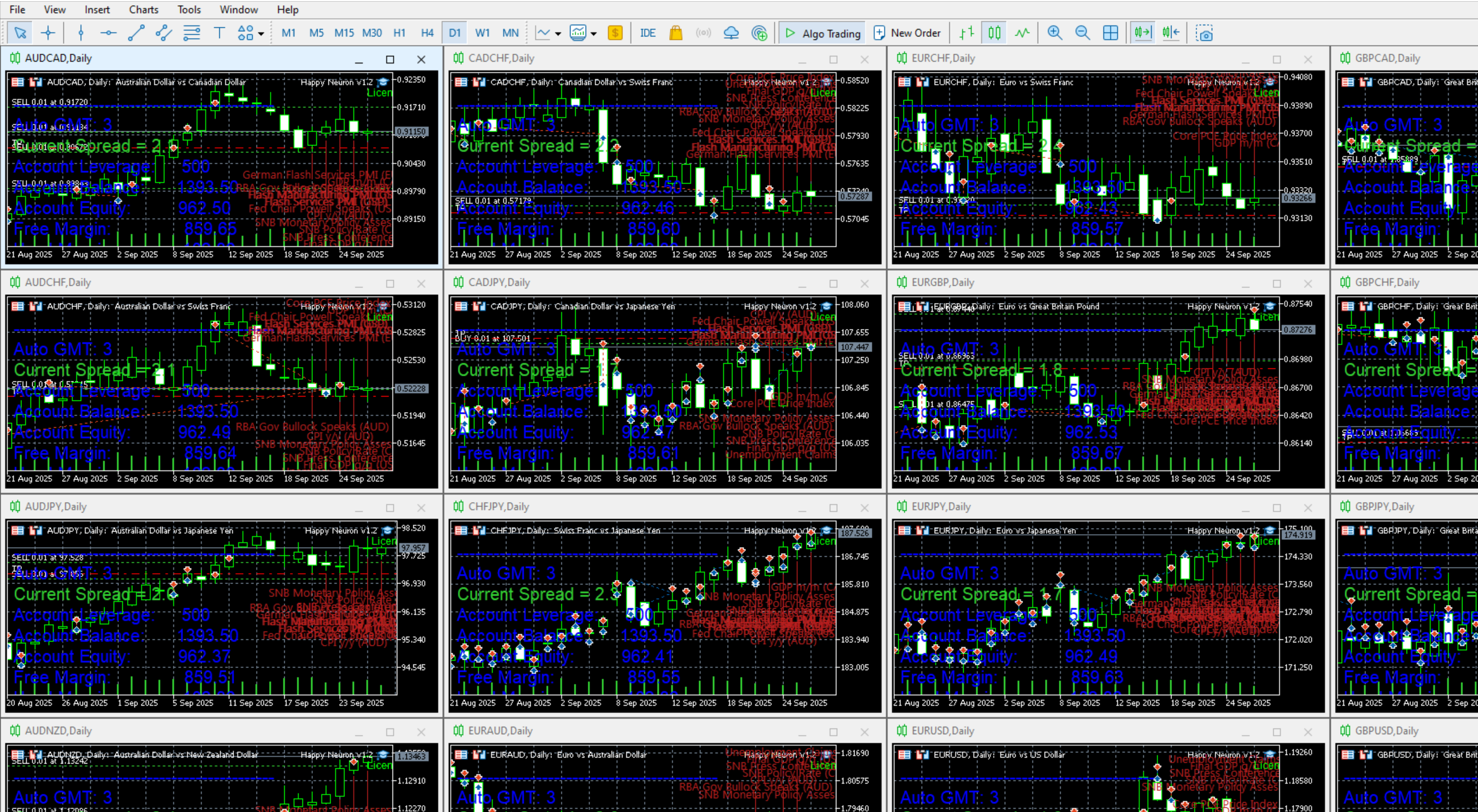
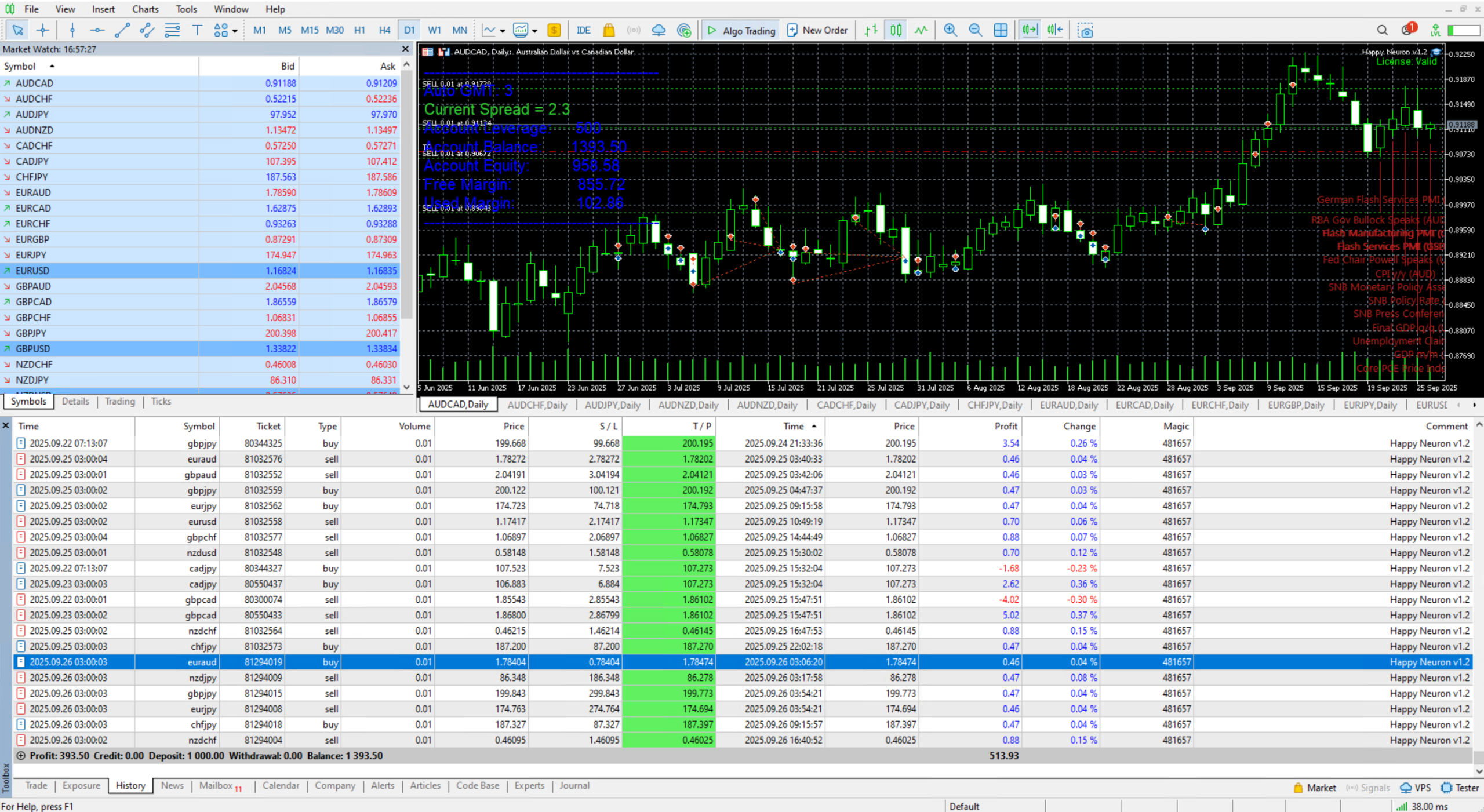
Happy Neuron EA supports up to 25 currency pairs simultaneously, covering all major pairs and a broad selection of popular minors. This wide instrument range distributes trading activity across markets that don't always move in correlation, reducing dependence on any single pair performing well at a given time.
The neural network at the core of Happy Neuron EA continuously processes market data across all active pairs, adjusting its signal recognition based on current conditions. Rather than relying on fixed rules, the system learns from pattern behavior , producing entry decisions that adapt as market dynamics change over time.
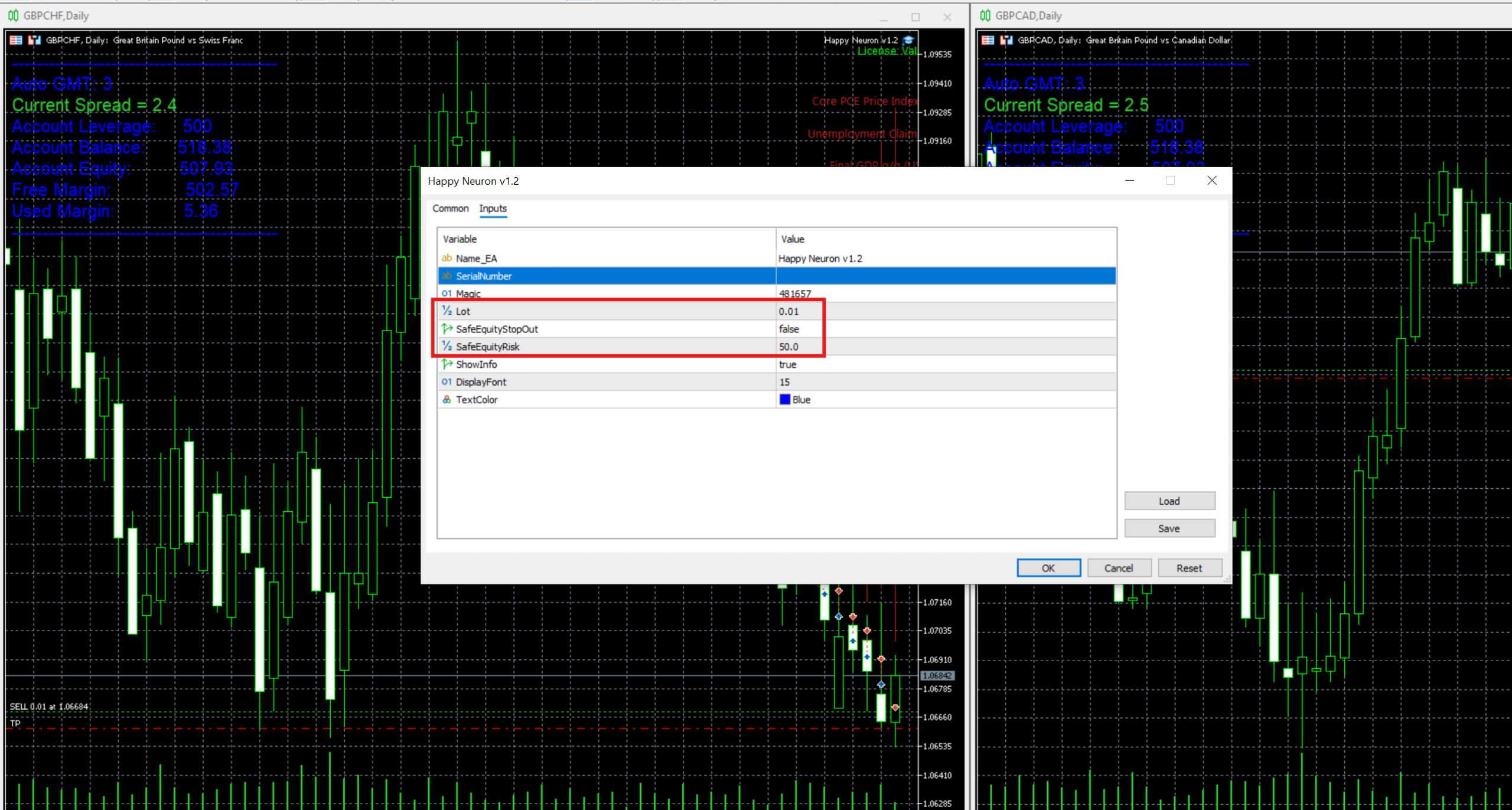
Built-in risk management covers position sizing, drawdown thresholds, and news-event filtering, all configurable to match individual account size and risk tolerance. These controls operate automatically in the background, providing a structured safety framework without requiring constant manual oversight from the trader.
Once installed and configured on a VPS, Happy Neuron EA handles every aspect of trade execution independently, including entries, exits, and ongoing risk management included. No manual intervention is required during normal operation, making it a genuinely practical option for traders who cannot monitor charts throughout the trading day.
The EA's machine learning architecture is built around modular neural network components, each trained to recognize specific market pattern types across different timeframes. This structure allows the system to assess conditions with greater nuance than single-indicator logic, producing more selective and statistically grounded entry signals.
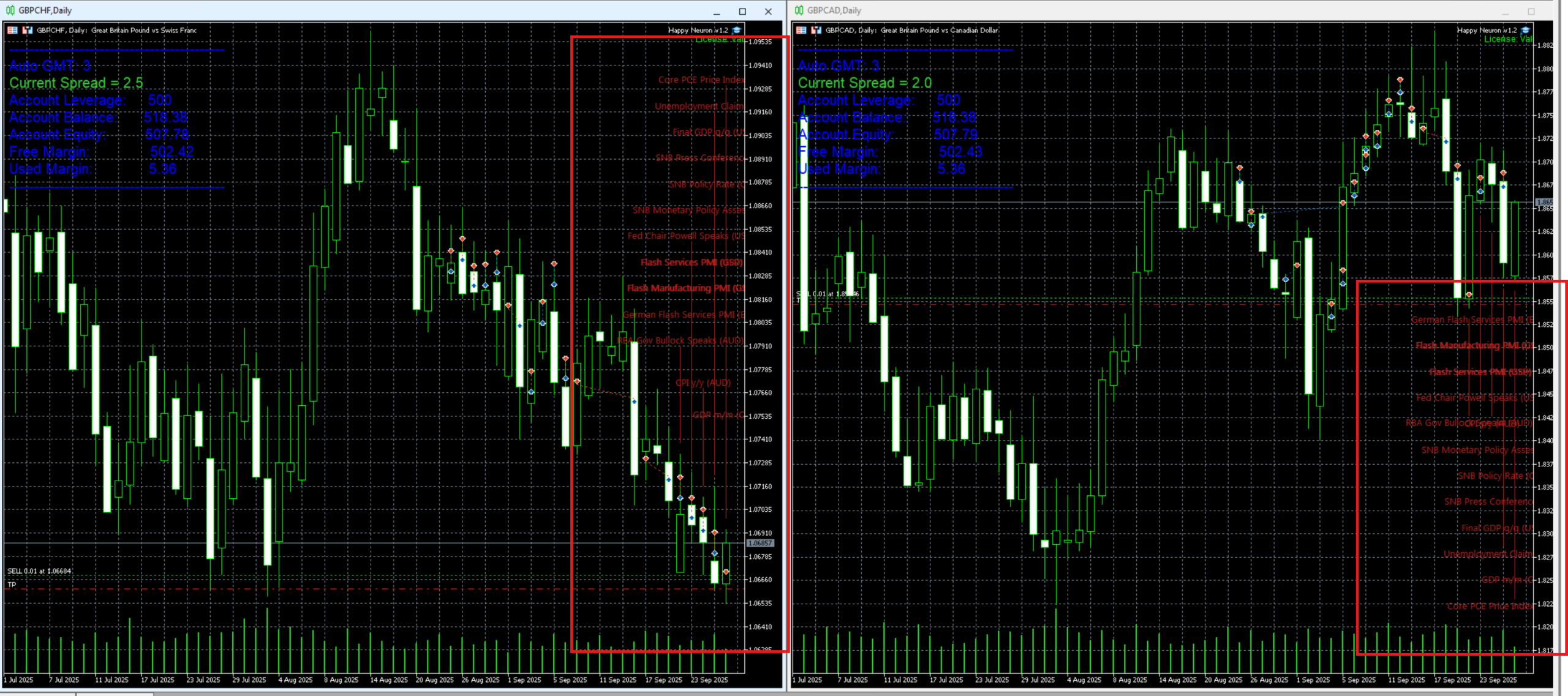
A real-time economic calendar filter pauses new trade entries around scheduled high-impact events, reducing exposure during periods when price behavior becomes less predictable. The buffer window before and after each event is fully configurable, giving traders direct control over how conservatively the filter is applied.


Key specifications and trading behavior you can expect from Happy Neuron EA's neural network approach.
Choose your preferred risk level - from conservative D1 approach to active M1/M5 trading frequency

Full major and minor pair coverage from EURUSD to NZDJPY for maximum market opportunity

Real-time neural network processing of market sentiment and price action patterns

Integrated filter prevents trading during high-impact economic releases

Operates on accounts from $20 (cent) to $5000+ with risk-appropriate settings

Works seamlessly on both MetaTrader platforms with full automation capabilities
Happy Neuron EA covers a broad range of trading profiles, from conservative traders on standard accounts to more active setups across multiple pairs and shorter timeframes. That flexibility is genuinely one of its stronger characteristics. It does not suit every type of trader equally, though, and being clear about that is worth more than overstating its universal appeal.
Managing 25 currency pairs manually is not realistic for most traders. Happy Neuron EA handles the monitoring, signal assessment, and execution across all supported instruments simultaneously , making it a practical choice for anyone who wants wider market participation without the time commitment that would normally require.
The low minimum account requirement, starting from $20 on cent accounts, and set-and-forget operation make this accessible to traders who are earlier in their experience. That said, understanding basic risk management concepts and taking time to test properly on a demo before going live will produce a considerably better outcome than treating it as a guaranteed passive income tool.
Multiple risk profiles and a wide timeframe range mean the EA can grow with the trader. Someone starting conservatively on H1 with a handful of pairs can, over time, expand to shorter timeframes and a broader instrument selection as their account and confidence develop. That kind of built-in scalability is not something every EA offers.
Running fully automated on a VPS, Happy Neuron EA operates through standard market sessions without requiring manual trade management. For traders managing other professional commitments during market hours, that level of independence is a meaningful practical advantage, provided the setup is done properly at the outset.
The machine learning foundation means the system is not locked into a fixed ruleset. For traders who have previously found traditional EAs too rigid , or who have seen rule-based systems stop performing after a market regime change , the adaptive learning approach is a structural improvement worth considering.
Quick answers about Happy Neuron EA setup and operation.
Happy Neuron EA runs on both MetaTrader 4 and MetaTrader 5, with identical functionality across both versions. There is no performance gap between platforms; the neural network logic, risk controls, and pair coverage operate consistently regardless of which version your broker supports. Traders can choose based purely on broker availability or personal preference, without any concern that one platform will produce meaningfully different results from the other.
The minimum depends on which risk profile you intend to run. Cent accounts can operate from as little as $20 under an aggressive configuration, though that carries proportionally higher exposure. Micro accounts work well from around $350 on a normal risk setting, while standard accounts are best suited to a $500 starting balance under conservative parameters. Matching your account size to the appropriate risk profile is more important than hitting any single minimum figure; underfunding an aggressive configuration is a common mistake worth avoiding.
Happy Neuron EA supports up to 25 currency pairs at once, covering all major pairs and a wide selection of popular minors, including AUD/CAD, GBP/CAD, NZD/JPY, and others. Running the full set distributes trading activity broadly across instruments that don't all move in perfect correlation, which can smooth equity performance over time. That said, traders with smaller accounts may prefer starting with a reduced selection and expanding as they grow more familiar with how the EA behaves across different market conditions.
No. Happy Neuron EA is designed for fully automated, set-and-forget operation. Built-in news filtering pauses trade activity around high-impact economic events, and the risk management framework handles position sizing and exposure without manual input. Once configured and running on a reliable VPS, the EA operates independently through standard trading sessions. Periodic equity checks are still a sensible habit, not because the system requires intervention, but because staying aware of overall account performance is good practice regardless of how automated the execution is.
Yes. Multiple risk profiles are available, ranging from conservative configurations using longer timeframes like D1, through to more active, aggressive setups on M1 and M5. Each profile comes with customizable parameters, giving traders meaningful control over how the EA behaves relative to their account size and personal risk tolerance. Adjustments can be made after installation without affecting trades already in progress. Starting at a lower risk setting and moving up gradually , rather than beginning at the most aggressive configuration , tends to produce a more stable early experience.
Yes, generally. The combination of machine learning-driven signal detection and support for multiple timeframes , from M1 through to H4, means the EA can identify and act on opportunities that rule-based systems might overlook entirely. On shorter timeframes like M1 and M5, trade frequency is considerably higher than what most conventional EAs produce. On longer settings such as H1 or H4, the pace slows considerably. The actual frequency at any point depends on market conditions, the selected timeframe, and how many pairs are active simultaneously.
The scanning frequency depends on the timeframe configuration in use. On M1 and M5 settings, the EA is effectively assessing conditions on every new candle , meaning the neural network runs its evaluation process several times per hour across all active pairs. On H1 and H4 configurations, that assessment cadence slows to once per candle close. Running shorter timeframes across a large number of pairs simultaneously places more demand on execution speed, which is part of why a reliable, low-latency VPS is particularly important when using the higher-frequency settings.
The built-in news filter suspends new trade entries around scheduled high-impact events, but it does not force-close positions already open at that point. The filter monitors an economic calendar and applies a configurable buffer window before and after major releases, central bank decisions, employment data, and similar events. Traders can adjust the duration of this buffer to suit their preference. It's worth noting that unscheduled events, sudden geopolitical developments, for example, fall outside what any calendar-based filter can anticipate, so some residual news risk always remains.
Each currency pair operates as an independent instance within the EA's framework. The neural network assesses each pair separately, applying its own entry logic and risk parameters without cross-pair interference. This means an active trade on EUR/USD does not influence how the EA handles a setup on GBP/JPY. The practical implication is that when multiple pairs are running simultaneously, total account exposure reflects the sum of all active positions , which is worth factoring into lot sizing decisions, particularly when using the full 25-pair configuration.
There's a reasonable case for both approaches, and it probably depends on account size and experience level. Running the full 25-pair selection distributes risk across a wider range of instruments and market conditions, which can reduce the impact of any single pair performing poorly. On the other hand, managing 25 simultaneous instances requires sufficient capital to support that level of potential exposure, and reviewing performance across that many pairs takes more effort. Starting with a focused selection of 8 to 12 pairs and expanding gradually is, I think, a more measured way to begin.
Several mechanisms work together during difficult stretches. The risk management framework reduces position sizing when drawdown approaches configurable thresholds, preventing losses from compounding at full lot size. The news filter limits exposure during the event windows most likely to produce sharp adverse moves. At the strategy level, the neural network's signal filtering is designed to reduce low-quality entries, though no system can eliminate losing trades entirely. Traders who also set a maximum daily loss limit as an external parameter add an additional layer of protection beyond what the EA itself manages internally.
A few indicators are worth checking regularly:rnrnTrades are opening on the expected pairs and timeframes, consistent with the active configurationrnPosition sizes correspond correctly to the lot sizing rules and risk profile you've set rnThe news filter is pausing entries around scheduled high-impact events as expected rnNo persistent error messages appear in the MetaTrader journal or expert log tab rnAccount equity is moving broadly in line with backtested behavior for the current settings rnrnIf trades stop appearing entirely during active hours, or if lot sizes look inconsistent, a VPS connection issue or a parameter misconfiguration is usually the first place to check.
A minimum of four to six weeks on a demo account is a practical starting point, though longer is better. That window captures at least some variation in market conditions, ranging from sessions to trending periods, and at least a handful of news events, giving a more representative sample of how the EA behaves. Backtesting provides useful historical context, but demo testing on a live feed exposes actual spread conditions and execution behavior specific to your broker. Some traders run parallel demo and live accounts for the first month, which is a reasonable way to build confidence before committing full capital.
Yes, though it requires thoughtful setup. Running additional EAs on the same account increases total position exposure, and if other systems trade overlapping pairs, the combined risk during active periods can grow quickly. Before combining Happy Neuron EA with other systems, it's worth mapping out which pairs each EA covers and whether their active trading windows coincide. Reducing lot sizes across all running EAs when operating them together is a sensible precaution. Testing the combined configuration on a demo account first is strongly recommended before applying it to a live balance.
Generally, yes, and for several practical reasons. A dedicated account keeps Happy Neuron EA's performance data clean and readable, making it straightforward to assess how the system is performing without other activity muddying the results. It also eliminates the risk of conflicting trade management between systems. If multiple EAs are running on shared capital, drawdown events from one system reduce the available margin for others. Separating accounts by strategy is a common practice among experienced algorithmic traders, and it's a habit worth adopting early rather than after a problem occurs.
Join traders who've moved beyond traditional indicators to AI-powered market analysis. Happy Neuron EA delivers consistent market participation across 25+ pairs with intelligent news filtering and automated risk management.