A recovery-focused forex robot engineered to mitigate losses using adaptive grid logic across major pairs on the M15 timeframe.

WallStreet Recovery Pro EA is a strategic add-on to the WallStreet Forex Robot suite, purpose-built to recover drawdowns from failed trades using a smart grid-based approach. Operating on the M15 timeframe, it uses an advanced averaging system and partial hedging logic to scale into market reversals. Unlike traditional grid bots, this EA incorporates dynamic lot scaling, broker protection filters, and spread control to reduce risk exposure. It is ideal for traders who want an automated safety net for previous losses or consistent profit capture through controlled recovery cycles.
Read Our Hands On Review
WallStreet Recovery Pro EA is designed to step in when standard systems falter, leveraging smart lot-sizing, price averaging, and full automation to recover negative trades efficiently.
WallStreet Recovery Pro is configured for EUR/USD, GBP/USD, and USD/JPY on the M15 timeframe , three major pairs selected for their liquidity and consistent price behavior. This focused approach ensures the strategy logic is properly suited to the instruments it trades, rather than being applied broadly across unfamiliar markets.
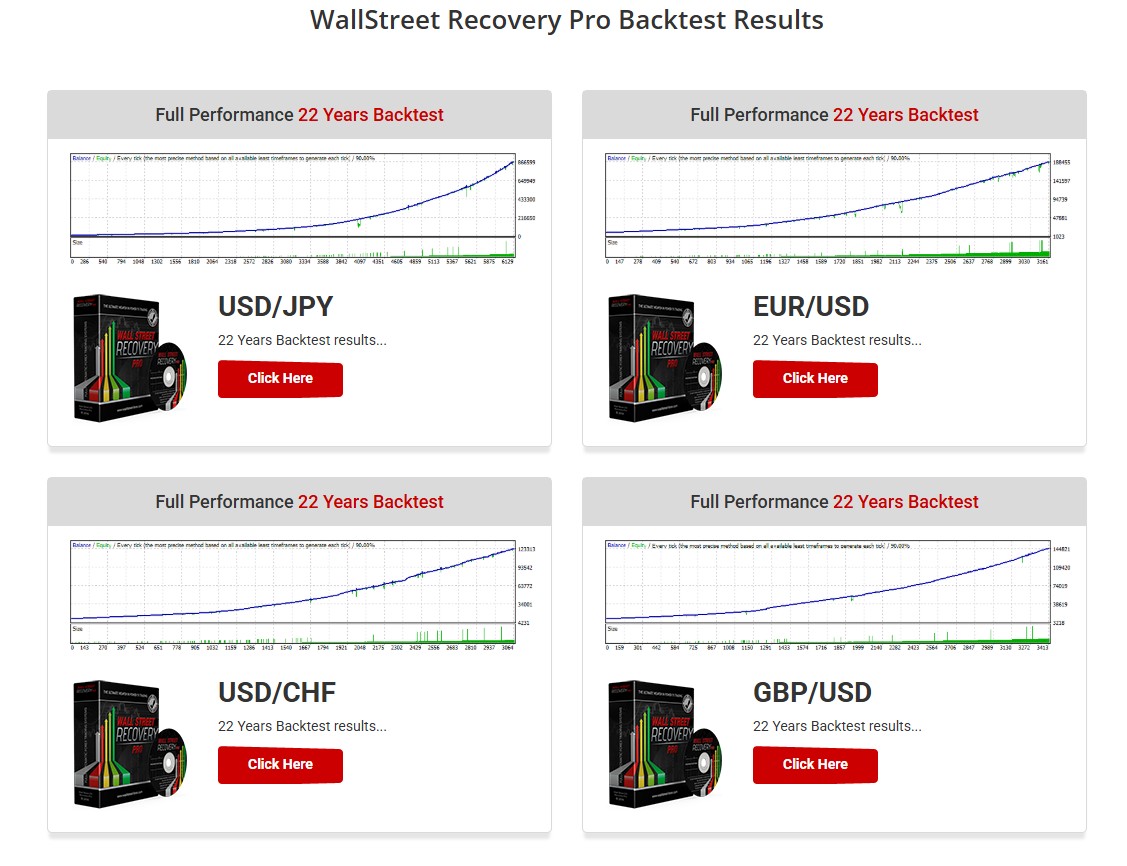
Historical testing covers extended data periods across all three supported pairs, giving a structured view of how the recovery logic performs under varying market conditions. Results include drawdown depth, recovery sequence frequency, and overall equity progression , providing a credible baseline before any live deployment is considered.
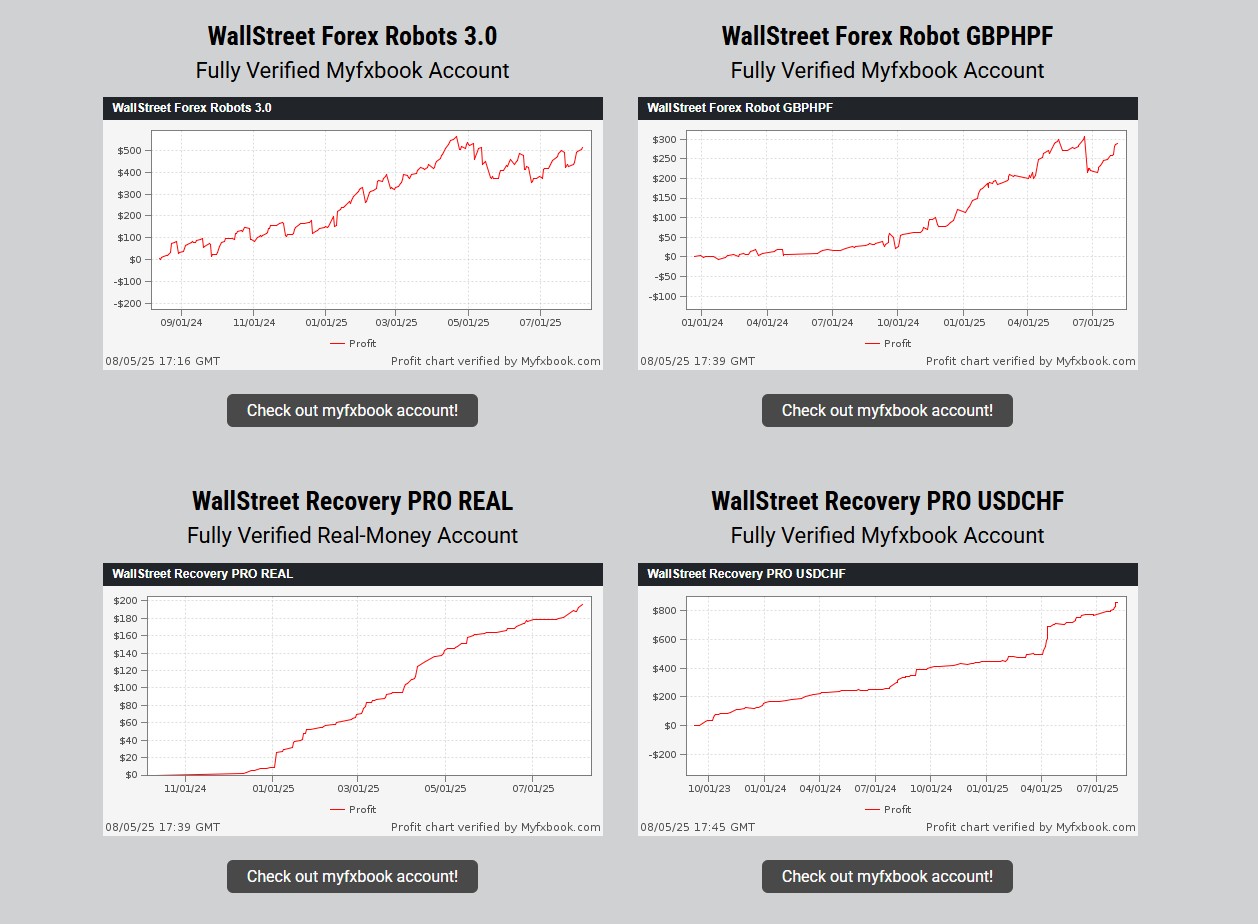
Backtests tell part of the story. Live performance data, tracked across real accounts, shows how the EA behaves under actual market conditions , including broker-specific execution, real spreads, and genuine volatility. Verified results carry more weight than historical simulations, and that distinction matters when assessing a recovery-based system.
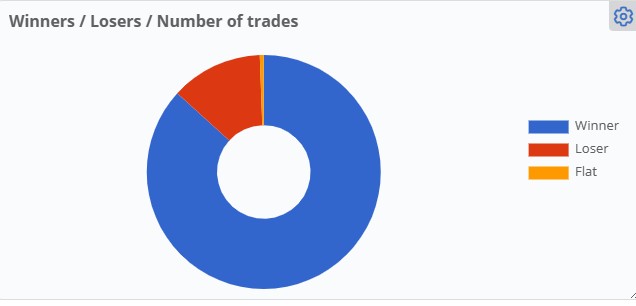
Performance transparency includes a clear breakdown of winning versus losing trade sequences , not just overall profit figures. Understanding the ratio of successful recoveries to closed losses gives a more honest picture of how the strategy performs across different market conditions, and where its limits realistically sit.


WallStreet Recovery Pro EA emphasizes capital protection and steady equity growth, especially when paired with primary EAs or during drawdowns.

Uses averaging, lot scaling, and progressive entry points to recover from losing trades.

Grid spacing and lot sizes adapt dynamically based on price action and risk parameters.
Includes partial hedging logic to minimize directional risk during volatile trends.
Slippage, spread, and time filters prevent poor execution on low-quality brokers.
Can operate as an independent EA or in sync with other WallStreet EAs.
Optimized for majors and compatible with brokers offering EUR/USD, GBP/USD, USD/JPY.
WallStreet Recovery Pro is built for traders who want a structured, rules-based recovery system, one that operates with defined logic rather than discretionary judgment. It is not designed for every trading profile, and being clear about that is probably more useful than overselling its reach.
If you already understand how grid and averaging systems work, including the risks they carry, this EA gives you a more controlled framework to operate within. The built-in safeguards address some of the more common failure points seen in simpler grid systems, making it a more considered option for traders who know the territory.
The parameter set is detailed enough to reward traders who take the time to understand what each setting does. Grid spacing, lot progression, and sequence limits all interact with each other in ways that benefit from informed configuration. This is not a plug-and-run system in the truest sense, thoughtful setup produces meaningfully better outcomes.
Running on M15 across three major pairs, the EA operates continuously without requiring manual trade management. Paired with a reliable VPS, it handles execution independently through standard market sessions. For professionals or traders with fixed commitments during trading hours, that degree of automation is genuinely practical.
The strategy is purpose-built for these three pairs. If your existing approach already centers on them, the EA's logic fits naturally into that focus , rather than attempting to apply a generic system across markets it was not designed for.
Perhaps the clearest signal that this EA suits you is a preference for defined exposure limits over uncapped upside. The lot caps, maximum trade counts, and spread filters reflect a conservative design philosophy. Traders who are more focused on capital preservation than aggressive growth will likely find that design sensible rather than restrictive.
Everything you need to know before adding WallStreet Recovery Pro EA to your trading strategy.
WallStreet Recovery Pro is built around a smart grid and averaging methodology, designed to recover from adverse price moves rather than simply closing losing trades at a fixed stop. When price moves against an open position, the EA places additional orders at calculated intervals, working to bring the overall basket to breakeven or profit as the market corrects. Advanced drawdown controls are built into this process to prevent sequences from extending beyond manageable limits.
The EA is optimized for three major currency pairs , EUR/USD, GBP/USD, and USD/JPY , all running on the M15 timeframe. These pairs were selected for their liquidity, trading volume, and relatively consistent technical behavior. M15 provides a practical balance between signal frequency and noise reduction, making it well-suited to a grid-based recovery system that benefits from regular price oscillation without being overwhelmed by short-term volatility spikes.
WallStreet Recovery Pro operates as a fully automated system. Once configured and attached to the relevant charts, it handles order placement, trade sequencing, and risk management without requiring ongoing input. This makes it a practical option for traders who cannot monitor positions throughout the session. That said, periodic review of open baskets and overall account equity remains a sensible habit , full automation does not remove the value of informed oversight.
Grid strategies do carry inherent risk, and it would be misleading to suggest otherwise. What separates WallStreet Recovery Pro from more aggressive grid systems is the set of built-in risk controls , including maximum trade counts, lot caps, and dynamic spacing logic , that prevent sequences from compounding without limit. These features don't eliminate risk entirely, but they do provide meaningful boundaries that standard grid EAs typically lack. Responsible capital allocation remains essential regardless.
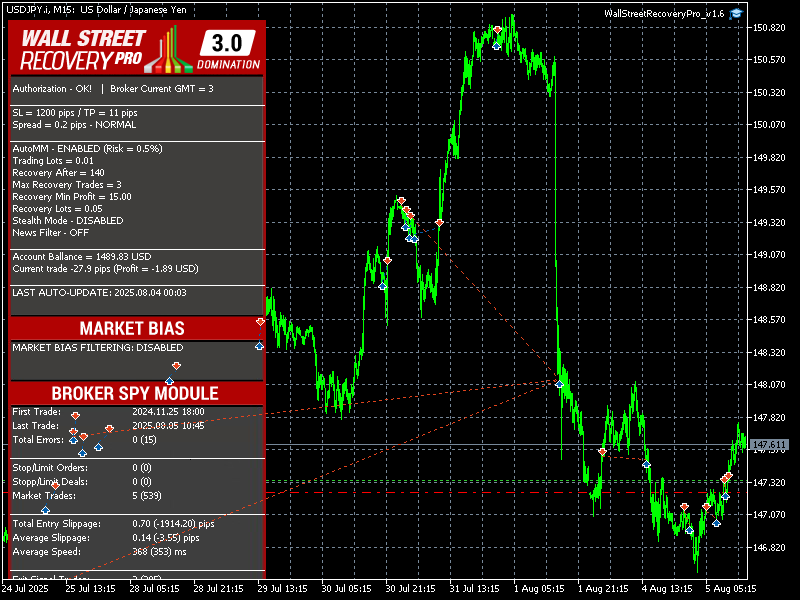
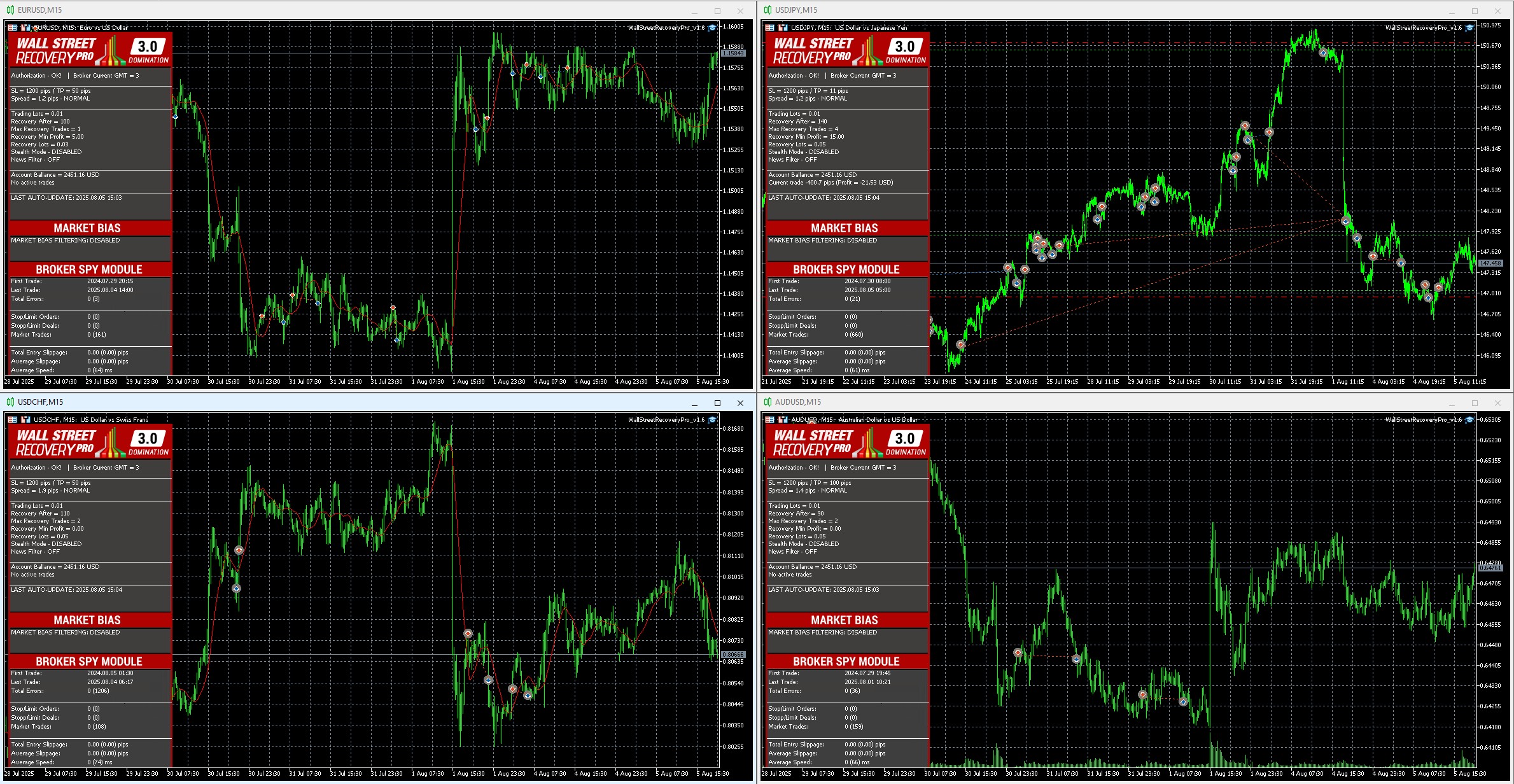
The EA includes spread limit filters, order retry logic, and broker-monitoring modules that help manage execution in less favorable conditions. If spreads exceed a defined threshold, the EA will hold off on placing new entries until conditions normalize. For rejected orders, the retry mechanism attempts re-execution within a set window. Testing on a demo account with your specific broker before going live is strongly recommended , execution quality varies more between brokers than most traders expect.
Volatility conditions directly influence when and how the EA opens positions. During periods of abnormally high volatility , often surrounding major news events or market opens , the entry logic applies additional caution, either widening grid spacing or delaying new entries until conditions stabilize. This prevents the system from initiating recovery sequences at points where price movement is erratic rather than structured. In practice, it means the EA tends to be more selective during volatile windows, which is generally a sound approach for grid-based systems.
Floating drawdown is managed through a combination of lot caps, maximum trade limits within a sequence, and dynamic spacing between grid levels. As a recovery basket grows, the EA monitors total floating exposure relative to account equity and applies predefined thresholds to prevent overextension. If the sequence reaches a defined boundary, new entries within that cycle are paused. This layered approach to drawdown management is one of the more important distinctions between this EA and simpler grid systems that run without structural limits.
Several settings have a direct impact on how recovery sequences unfold:rnGrid spacing determines how far the price must move before a new recovery order is placedrnLot multiplier controls whether position sizes increase across the sequence and by how muchrnMaximum trade count sets a hard cap on how many orders can be open within a single basketrnTake profit target defines the profit level at which the full sequence closesrnrnAdjusting these in combination allows traders to shape the recovery profile according to their risk tolerance and account size.
A recovery cycle begins when an initial trade moves into a loss beyond a specified threshold, triggering the first grid level. The decision to begin is not purely mechanical , entry filters assess current spread conditions, volatility state, and time-of-day restrictions before allowing a new cycle to open. This means not every adverse move automatically initiates a sequence. The filtering layer is there to prevent recovery cycles from starting in conditions that are statistically less favorable for the strategy.
It is technically possible, but running multiple recovery-based EAs on the same account simultaneously requires careful consideration. Each system will open its own trade baskets and manage its own drawdown independently, which means total account exposure can increase quickly if several sequences are active at the same time. If you do run multiple EAs together, reducing individual lot sizes and keeping a close eye on combined floating drawdown is essential. It is perhaps safer to test this on a demo account before attempting it with live capital.
Yes, though it requires some awareness of where the sequence stands. Manually closing individual trades within an active basket mid-sequence will affect the EA's internal position tracking, potentially causing it to misread the state of the cycle. Closing an entire basket at once , all trades simultaneously , is generally the cleaner approach if manual intervention is needed. The EA should then reset and be ready to begin a fresh cycle. Partial manual closures are possible but worth approaching with caution to avoid unintended behavior.
The built-in spread filter monitors live spread conditions continuously. If spreads widen beyond the defined maximum during an active session, the EA will suspend new order placement until conditions return to acceptable levels. Open positions already in the market are not closed , they remain active and are managed normally. This protects the account from entering new grid levels at inflated entry costs, which would distort the recovery math the strategy relies on. It is one of the more practical broker-protection features included in the system.
A few indicators are worth monitoring regularly:rnrnA growing basket size, more open trades than usual within a single cycle, can indicate that the price is trending strongly against the positionrnRising floating drawdown, if unrealized losses are climbing steadily without recovery, the sequence may be under pressurernSequence duration, cycles that remain open for an unusually long period without closing, suggest the take profit target is not being reachedrnEquity-to-balance gap, a widening difference between account balance and equity, is one of the clearest signals that intervention may be worth consideringrnrnChecking these periodically, rather than relying solely on automation, is a practical risk management habit.
If you're seeking a professional recovery solution that can mitigate trading losses and reinforce your main EA strategy, WallStreet Recovery Pro EA offers the right combination of smart grid logic and risk control. Whether you're a seasoned trader or managing client accounts, this tool adds a robust fallback to your trading arsenal.