


 Marin
Marin- 7/9/2026
Most expert advisors lock you into a single fixed approach. You get what the developer built, and that’s it. Architect Algo EA flips that model completely; it’s essentially a customizable framework that lets you build nearly any algorithmic trading system you can imagine through configuration rather than coding.
I’ve spent over a week exploring this EA, testing multiple pre-configured strategies on a Darwinex Zero account, and working through what might be the most extensive documentation I’ve ever seen for a trading robot. Almost 90 tutorial videos. That’s not a typo.
This isn’t your typical plug-and-play EA. Architect Algo requires time investment to understand, but the flexibility it offers is unlike anything else I’ve tested. Let me walk through what I found, including live results from seven different currency pairs running simultaneously.
What Makes Architect Algo Different
Architect Algo comes from Responsible Forex Trading, the same developer behind Sharpshooter, Vigorous, and several other systems in their Powerhouse bundle. But this isn’t just another pre-built EA from that lineup.
Think of it as a strategy builder. You get access to dozens of configurable inputs that control everything from indicator signals to trend filters, entry logic to position management. By adjusting these parameters, you can create scalping systems, grid-based approaches, trend-following strategies, or combinations of multiple methodologies.
The developer provides pre-configured set files for various approaches, complete strategies ready to deploy. But the real value is being able to modify these templates or build something entirely new based on your own trading ideas.
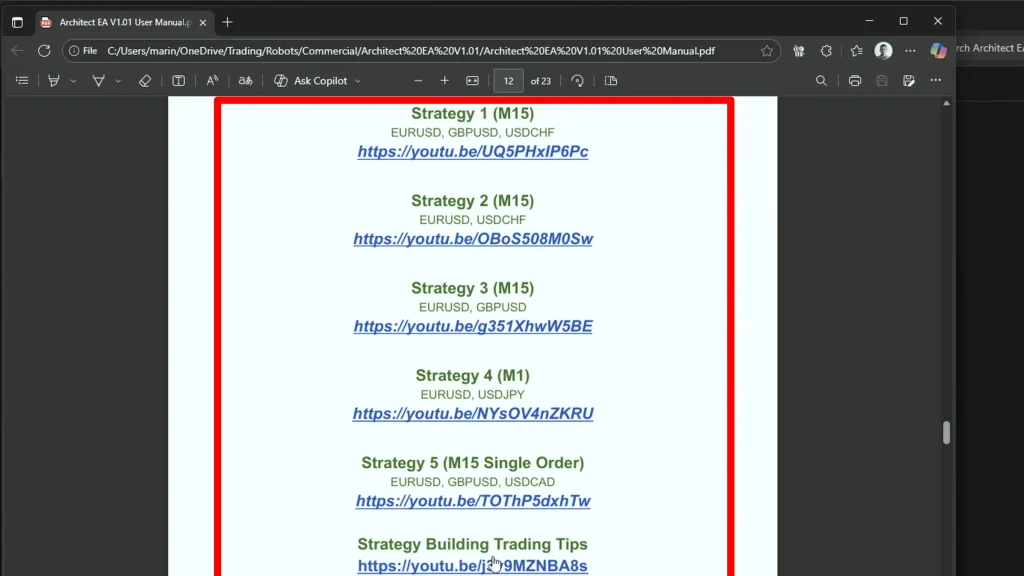
I’m currently testing Architect Algo across seven charts on my Darwinex account:
- EUR/USD M1 (Strategy 4)
- GBP/USD M15 (Strategy 3)
- USD/CHF M15 (Strategy 1)
- EUR/USD M15 (Additional strategy)
- Several other currency pairs with different configurations
Each chart runs a different configuration, and I’m tracking them separately to see which approaches work best under real trading conditions.
Testing Environment: Why Darwinex Zero
I chose Darwinex Zero for this test specifically because of the data quality and trading conditions. Darwinex provides historical data going back to 2017-2018 with real spreads, actual slippage, and genuine execution conditions.
This matters more than you might think. Many brokers offer demo accounts with unrealistic fills and tighter spreads than you’d get live. Darwinex Zero replicates real market conditions, which gives more accurate backtesting and forward testing results.
The account structure also works well for testing grid and martingale strategies, which several of the Architect Algo configurations use. I’m running a $100,000 account, which provides substantial margin to handle position scaling without constantly worrying about margin calls.
Darwinex Zero operates on a subscription model rather than requiring full capital. That makes it cost-effective for strategy testing while still competing for allocated capital if performance meets their standards.
Pre-Configured Strategies and Documentation
When you purchase Architect Algo, you receive access to a complete folder structure containing:
- The EA file itself
- Set files for multiple ready-to-use strategies
- Tutorial videos explaining every input parameter
- Documentation covering strategy concepts
- Example configurations from other Powerhouse EAs
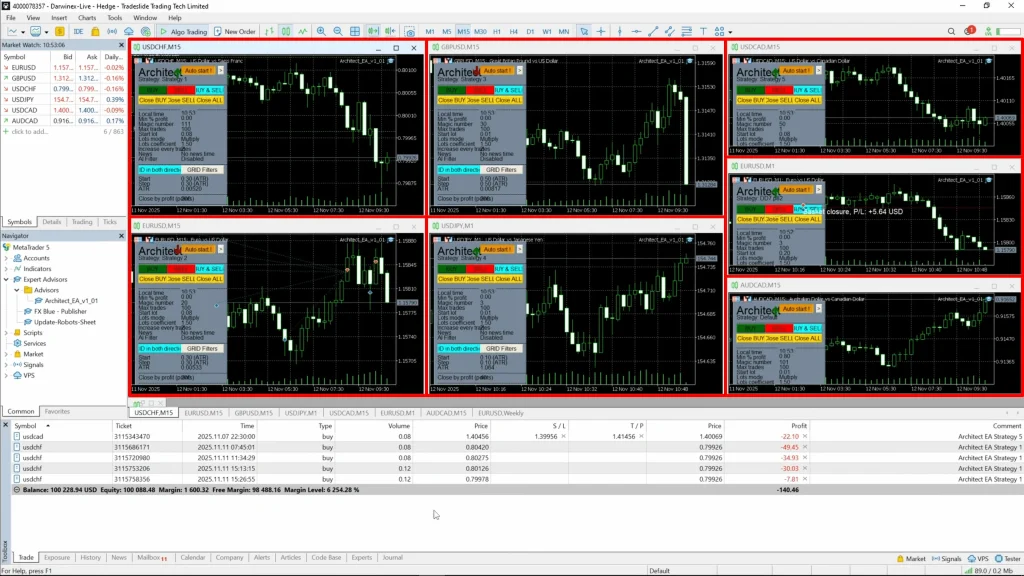
The strategy tutorials section provides detailed guides on different approaches you can implement. Each tutorial includes the set files, so you can load them directly without manual configuration.
I found strategies for various timeframes and currency pairs:
- Strategy 1: M15 timeframe trading EUR/USD, GBP/USD, USD/CHF
- Strategy 2: M15 timeframe for EUR/USD and USD/CHF
- Strategy 3: Multiple currency pairs with different configurations
- Strategy 4: M1 scalping approach for EUR/USD
Rather than testing every available configuration, I ran backtests on each and selected the ones showing the strongest historical performance. That’s how I ended up with my current seven-chart setup.
Backtest Analysis Using The Backtest Manager
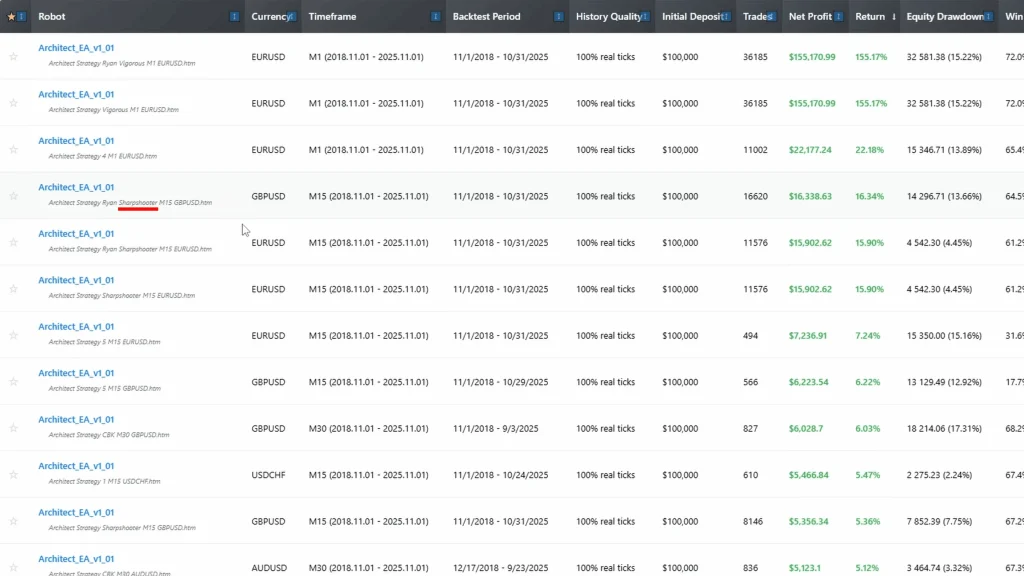
I used the Backtest Manager tool from Algo Trading Space to analyze all the different strategy configurations. This tool imports results from MetaTrader’s strategy tester and displays them in a much more readable format with sorting, filtering, and comparison capabilities.
After importing multiple backtest reports, I could sort strategies by return, drawdown, profit factor, or other metrics. This made it much easier to identify which configurations were worth testing live.
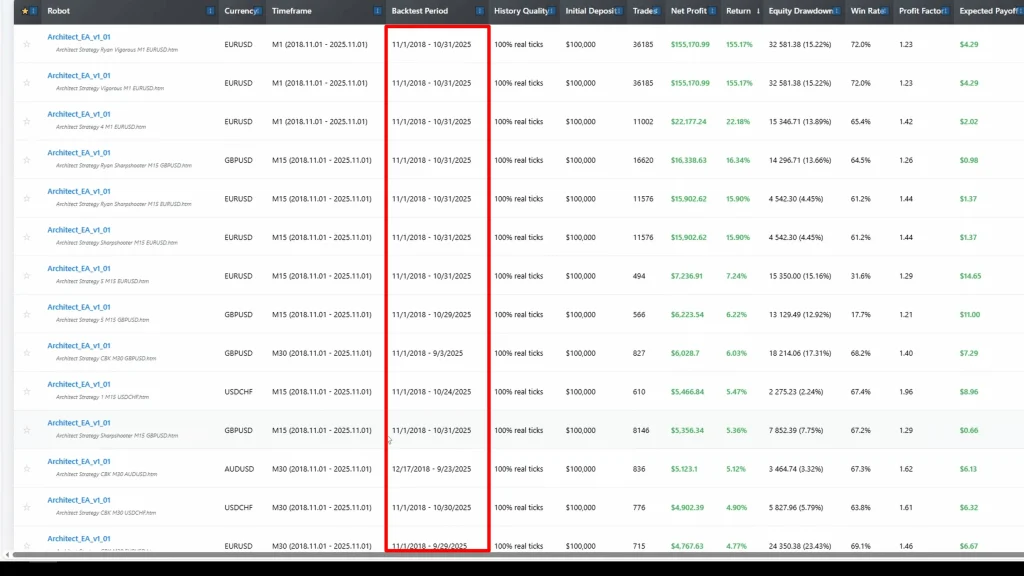
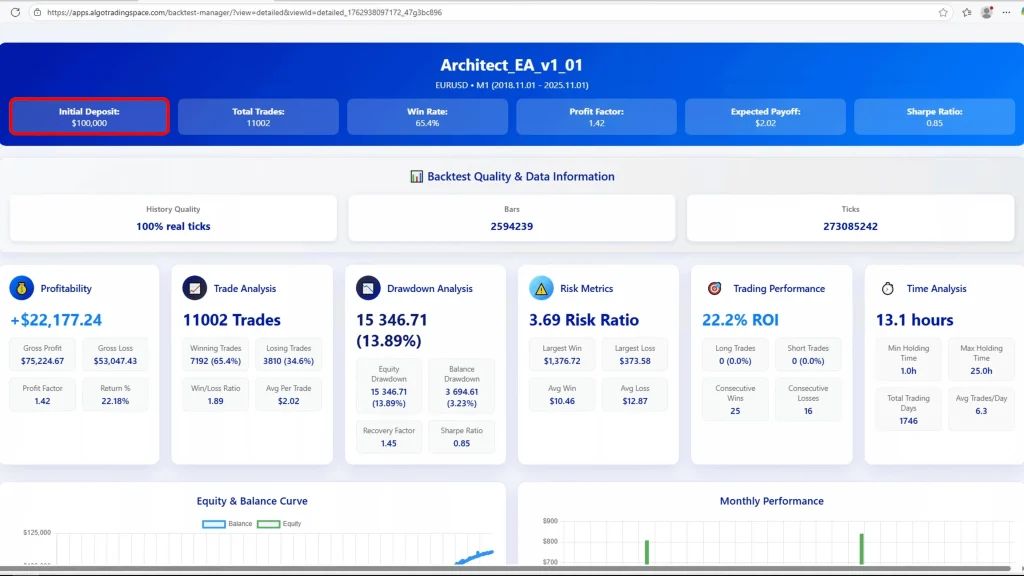
One strategy that caught my attention was the EUR/USD M1 scalping approach. Running backtests from the beginning of my available Darwinex data through the end of October (to maintain equal exposure across all tests), the results showed:
| Metric | Value |
| Account Size | $100,000 |
| Testing Period | ~7 years |
| Total Trades | High volume |
| Win Rate | Solid percentage |
| Profit Factor | Above 1.5 |
| Maximum Drawdown | ~14% |
That 14% drawdown over seven years is quite reasonable in my opinion, especially for a scalping system. The profit factor above 1.5 indicates wins substantially outweigh losses after costs.
What I particularly liked was the average trade duration of around 13 hours. That’s important for Darwinex’s risk engine, which evaluates trading behavior. Extremely short-duration scalping can sometimes trigger concerns, but 13-hour average holds are well within acceptable ranges.
The Configuration Complexity: Blessing and Curse
Opening the Architect Algo inputs panel reveals just how customizable this system is. There are dozens, maybe over a hundred, configuration options available.
You can adjust:
- Magic number and strategy name (for tracking multiple instances)
- Indicator signals and which indicators to use
- Trend filter settings and parameters
- Entry logic and timing
- Position sizing and money management
- Grid spacing and martingale multipliers
- Take profit and stop loss configurations
- Risk management limits
- And much more
This level of customization is powerful, but it’s also overwhelming. I spent more than a week going through the tutorial videos just to understand what each input does. Even then, I didn’t have time to create my own strategy from scratch, which was my original goal for this test.
Instead, I focused on using and slightly modifying the pre-configured set files. That’s honestly what most traders will probably do, start with working templates and adjust from there rather than building from zero.
Strategy Characteristics: Grid and Martingale Elements
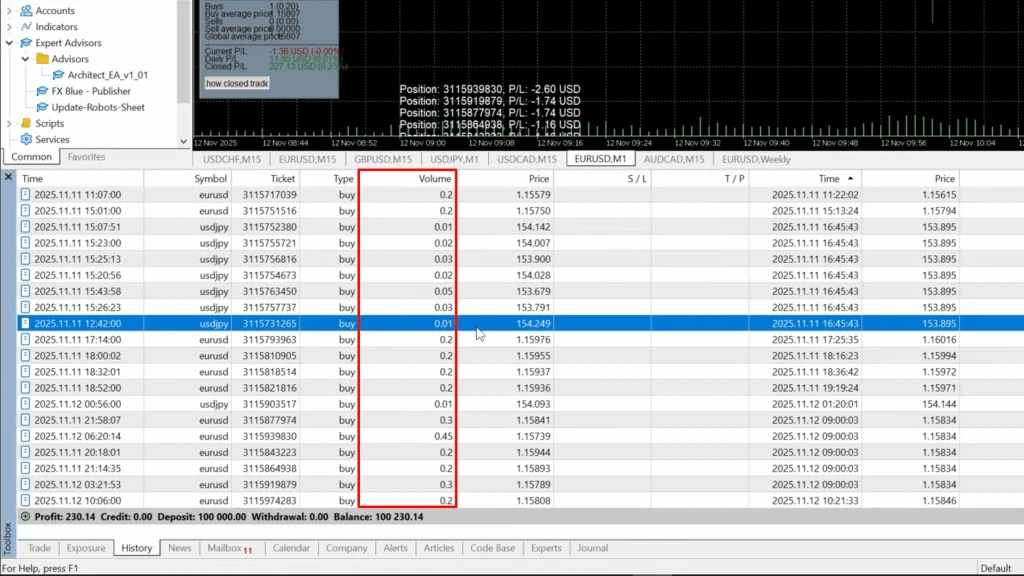
Looking at the order history on my Darwinex account, most of the Architect Algo strategies I’m testing employ grid trading with martingale position sizing. You’ll see position scaling where subsequent entries are larger than initial entries.
This is consistent with other strategies from the Powerhouse bundle. The approach works by averaging into positions when the price moves against you, using larger lot sizes at better prices to lower the overall breakeven point.
Grid and martingale systems require careful risk management. Without proper limits, they can deplete accounts during strong trending markets. The Architect Algo configurations include safeguards like maximum position limits and drawdown controls, but you still need sufficient capital to handle the position scaling.
That’s another reason I chose Darwinex Zero for testing: the $100,000 equity gives comfortable room for these strategies to operate without immediately hitting margin constraints.
Live Results So Far
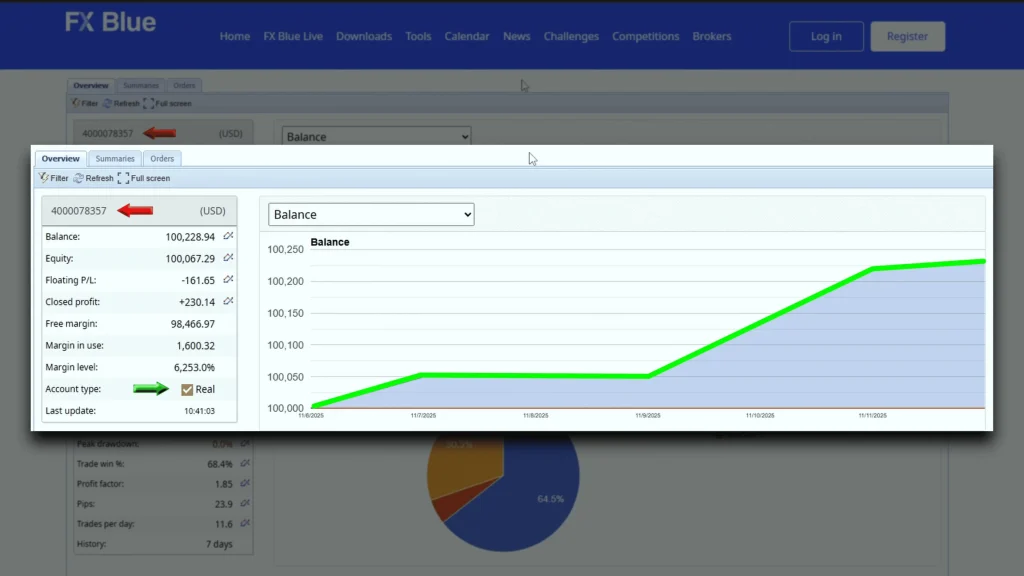
The account has been running for several weeks now, trading across seven different currency pairs with different strategy configurations. Looking at the current equity curve and trade history, performance has been steady without dramatic spikes or crashes.
I’m seeing profitable trades across most pairs, with the occasional losing sequence that gets recovered through the grid mechanism. That’s expected behavior for these types of systems.
Trade frequency varies by configuration. The M1 scalping strategy produces more frequent trades than the M15 approach. Different timeframes and different logic naturally create different trading patterns.
Win rates appear solid across the configurations I selected, though I need more data before making definitive conclusions. A few weeks of forward testing isn’t enough to declare anything certain. I’m looking for at least a few months of live performance to confirm backtest projections.
The Monthly Contest Feature
One interesting aspect mentioned in the documentation is a planned monthly contest where users can create their own strategy configurations and compete against others. If your configuration meets certain performance criteria and follows the contest rules, you can win monetary rewards.
Additionally, if your custom approach performs exceptionally well, it might get added to the official Powerhouse bundle of strategies. That’s a clever way to crowdsource strategy development while rewarding community members who contribute valuable configurations.
This contest concept hasn’t fully launched yet, based on the timeline, but it suggests the developer is building a community around Architect Algo rather than just selling a product and moving on.
Who This EA Is Actually For
Architect Algo isn’t for everyone. Let me be direct about that.
If you want a simple plug-and-play solution where you install an EA, press start, and forget about it, this probably isn’t your best choice. The learning curve is substantial, and understanding all the configuration options takes real time investment.
However, if you fall into any of these categories, Architect Algo could be valuable:
- Traders with specific strategy ideas: You have a particular approach in mind but lack coding skills to build it. Architect Algo might let you implement your concept through configuration.
- Experienced algo traders: You understand algorithmic trading principles and want flexibility to test variations without rebuilding entire systems from scratch.
- Learning-focused individuals: You’re willing to invest time studying the tutorials and documentation to expand your algorithmic trading knowledge.
- Template modifiers: You’re comfortable starting with working configurations and making incremental adjustments rather than building from zero.
If you’re completely new to algorithmic trading and don’t have a foundational understanding of indicators, risk management, and trading logic, the complexity will likely be frustrating rather than empowering.
The 90-Video Documentation Library
I mentioned earlier that there are almost 90 tutorial videos. I actually counted them. That’s an impressive amount of educational content covering different indicators, input parameters, strategy concepts, and implementation guides.
The documentation quality is high, and the vendor clearly invested significant effort into making the system accessible despite its complexity. Videos explain specific inputs, demonstrate how different settings affect behavior, and walk through example configurations.
Even with all this material, I still needed over a week to work through it. That’s not a criticism of the documentation; it’s just a reflection of how much there is to learn.
For someone willing to invest that time, the knowledge gained extends beyond just using Architect Algo. You’ll understand algorithmic trading concepts more deeply, which applies to evaluating and building other trading systems.
Pros and Cons Based on Real Testing
After weeks of testing and analysis, here’s my honest assessment:
What Works Well:
- Extreme flexibility, you can implement almost any algorithmic approach
- Excellent documentation with detailed video tutorials
- Pre-configured strategies provide working starting points
- Monthly contest creates community engagement and ongoing development
- Compatible with real trading conditions (tested on Darwinex)
The Challenges:
- An overwhelming number of configuration options for beginners
- Requires substantial time investment to understand fully
- Not suitable for traders wanting simple turnkey solutions
- Learning curve is steep, even with good documentation
- Creating custom strategies from scratch demands algorithmic trading knowledge
Perhaps the biggest limitation is time. I wanted to build a completely custom configuration for this review, but between studying the inputs, running backtests on provided strategies, and setting up the live test, I simply didn’t have bandwidth to also design something original.
That might change as I become more familiar with the system, but initial implementation definitely requires dedicated effort.
The Future Direction of Algorithmic Trading
Architect Algo represents what I think is a growing trend in algorithmic trading, moving away from black-box systems toward configurable frameworks where traders maintain more control without needing programming expertise.
Instead of choosing between “buy this specific EA” or “learn to code your own,” Architect Algo offers a middle path. You get the power of customization through a configuration interface rather than writing code.
As the community develops more configurations and the monthly contests generate new approaches, the value of owning Architect Algo should increase over time. You’re not just buying a static product; you’re getting access to an evolving ecosystem of strategies.
Whether that vision fully materializes depends on community adoption and ongoing vendor support, but the foundation seems solid based on what I’ve tested so far.
Where to Access Architect Algo and Additional Resources
Architect Algo EA is available through Algo Trading Space, which provides access to the system along with additional algorithmic trading resources and educational materials. Full disclosure: we may earn a small commission if you purchase through our links, though this doesn’t affect the price you pay or the honest assessment in this review.
For traders serious about building and testing multiple strategies, the Algo Trading Space VIP club offers exclusive access to verified trading results across various EAs, early insights into new systems, and priority support. If you’re managing a portfolio of algorithmic strategies and want ongoing performance data and community access, it’s worth exploring.
I’ll continue running Architect Algo on my Darwinex account with public tracking, so you can follow the results as they develop beyond this initial review period.
Frequently Asked Questions
Do I need programming knowledge to use Architect Algo EA effectively?
No programming skills are required to use Architect Algo, but you do need an understanding of algorithmic trading concepts like indicators, trend filters, grid systems, and risk management. The EA works entirely through configuration; you adjust inputs rather than writing code.
However, if you’re completely new to trading systems, the sheer number of options will be overwhelming. Starting with the pre-configured set files and gradually learning what each parameter does is the recommended approach for beginners.
How long does it realistically take to create a custom approach from scratch?
Creating a completely original configuration requires substantial time investment. After spending over a week studying the documentation and tutorial videos, I still hadn’t built a custom approach. I focused on testing the provided strategies instead. If you’re experienced with algorithmic trading, you might develop something custom within 10-20 hours of learning the system.
For newcomers, expect several weeks of study before attempting original configurations. Most users will likely modify existing templates rather than build from scratch.
Can Architect Algo work with any broker, or are there specific requirements?
Architect Algo functions on standard MetaTrader 4 platforms, so it’s compatible with most brokers. However, strategies using grid and martingale elements require brokers with sufficient margin allowances and reasonable spreads.
I chose Darwinex Zero specifically for quality execution and real trading conditions. Brokers with wide spreads or poor execution will degrade performance compared to backtests. Test any configuration on demo accounts with your specific broker before deploying real capital.
What’s the difference between Architect Algo and the other Powerhouse bundle EAs?
Architect Algo is a framework for building strategies, while other Powerhouse EAs like Sharpshooter and Vigorous are specific pre-built systems. With Architect Algo, you receive set files that can replicate those other EAs’ approaches, plus the ability to create entirely different configurations.
Think of it as buying the engine that powers multiple cars versus buying one specific car. The tradeoff is complexity. Architect Algo requires more setup and understanding, while dedicated EAs work immediately out of the box.
How much capital do I need to run Architect Algo safely, given the grid and martingale elements?
Capital requirements depend entirely on which configuration you’re running and your risk settings. I’m testing on a $100,000 Darwinex account to comfortably handle grid position scaling without margin stress.
For personal accounts, I’d suggest a minimum of $5,000-$10,000 if you’re running configurations with martingale elements, though you could operate on $2,000-$3,000 with very conservative lot sizing.
The key is ensuring your margin can handle multiple scaled positions simultaneously. Always backtest your specific configuration with your intended account size before going live.


