

- 7/9/2026


 Marin
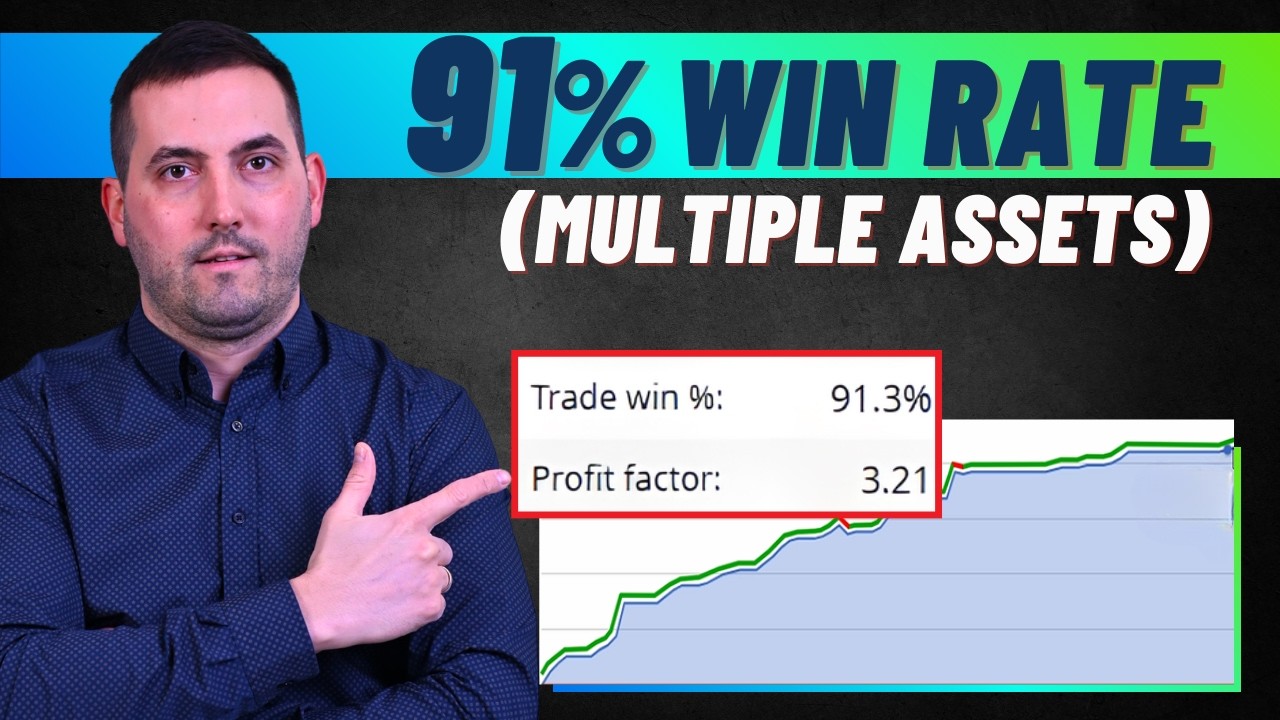
MarinI almost blew a $200 live account testing Happy Frequency EA. Not because the system doesn’t work, it does, but because I made critical mistakes with account sizing and currency pair selection. After three months of live trading, extensive backtesting across 28 currency pairs, and watching my floating loss hit minus 40%, I finally figured out what this EA needs to succeed.
Happy Frequency comes from the same developer behind Happy Forex and Happy Gold, systems I’ve tested successfully. This EA is extremely active, targeting 7 pips per trade across multiple currency pairs on the M5 timeframe. The vendor’s track record shows 340% profit since July 2023 on a $2,000 account.
Let me walk through my live results, explain the mistakes that nearly destroyed my account, show you the backtest data across 28 pairs, and reveal what I’m changing going forward.
Live Account Performance: The Good and the Ugly
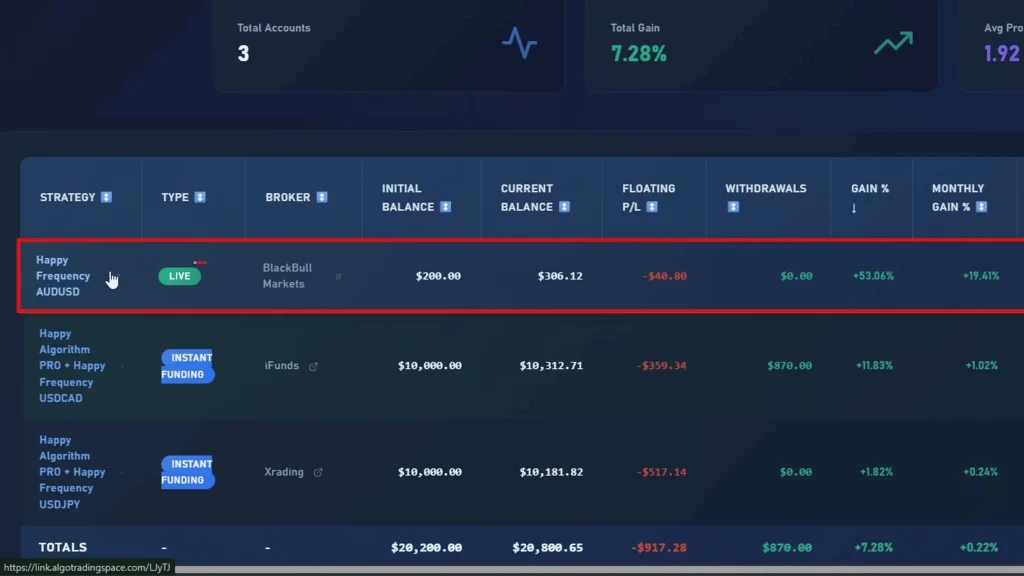
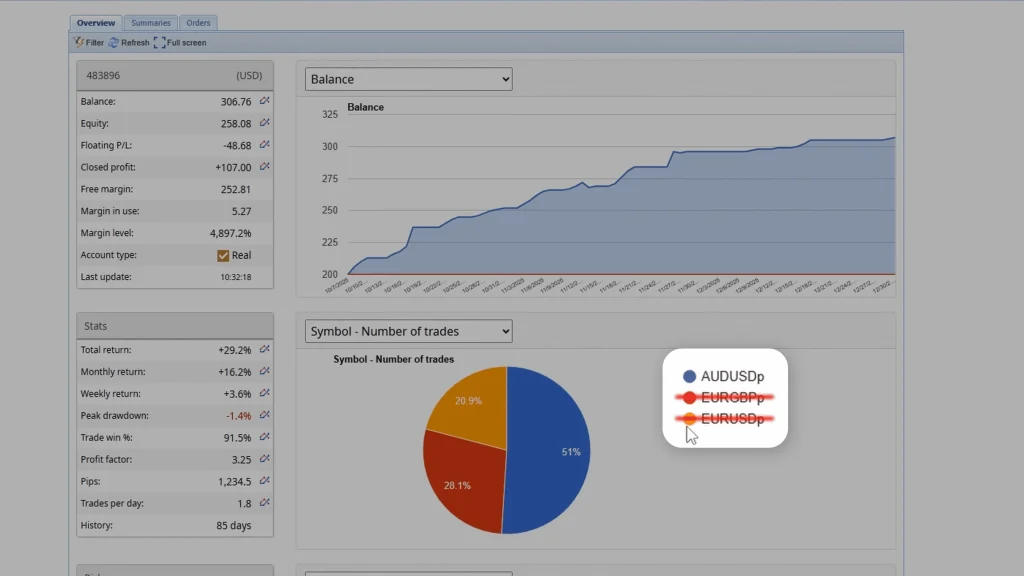
My BlackBull Markets account started with $200 on October 7th. After nearly three months, the balance sits at $306, a 53% gain with a profit factor of around 3.5.
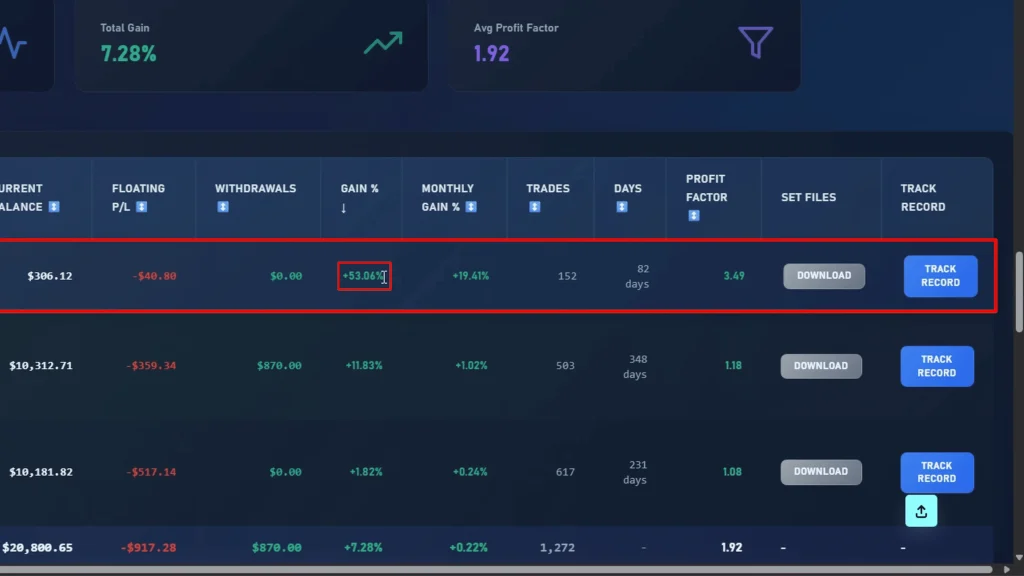
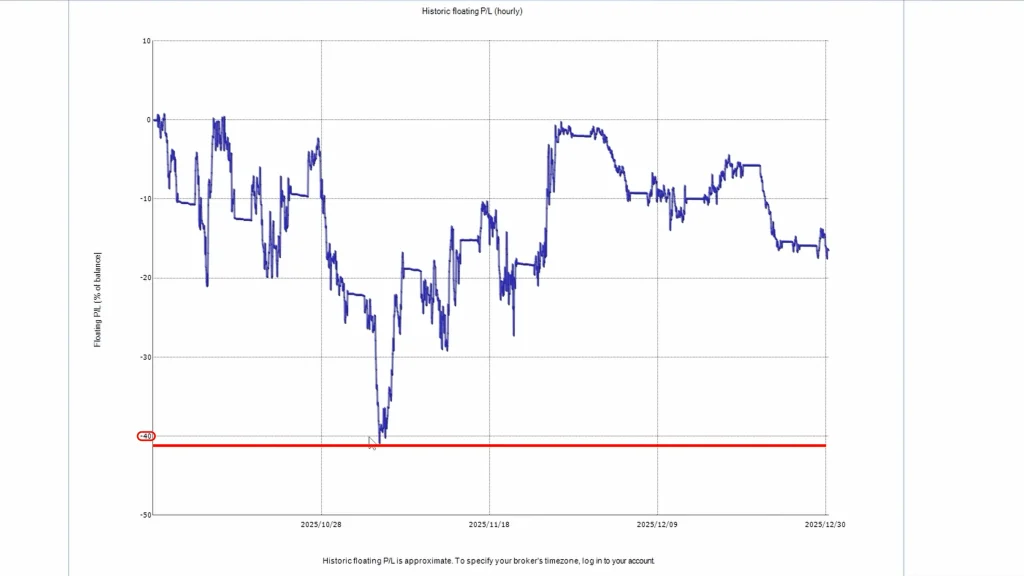
That sounds great until you look at the floating loss history. At one point, I was down 40% in unrealized losses. On a $200 account, that’s $80 in the red while waiting for trades to recover.
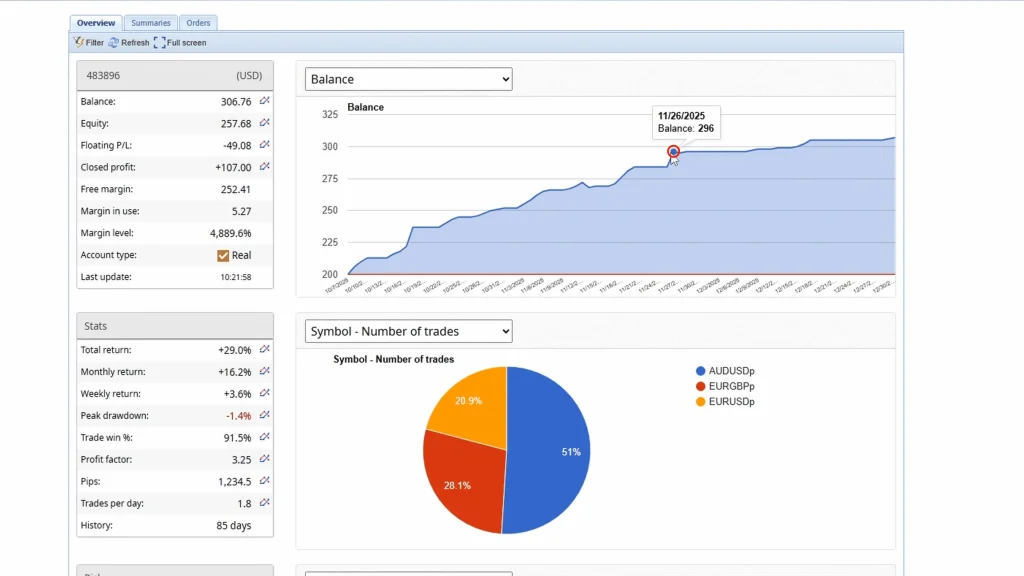
The equity curve tells the story visually. Rapid growth from October through late November, then a noticeable slowdown after November 26th, when I made a critical adjustment. The balance line continued upward, but at a much more measured pace.
What happened on November 26th? I removed two currency pairs from the EA configuration after realizing my setup was unsustainable for the account size.
The Currency Pair Mistake
Initially, I ran Happy Frequency on three pairs simultaneously:
- AUD/USD
- EUR/GBP
- EUR/USD
Each pair operated independently with its own grid, all on a $200 account with 0.01 lot sizing. The problem became obvious when I examined the floating profit/loss chart; the account spent most of its time carrying unrealized losses across multiple open grid positions.
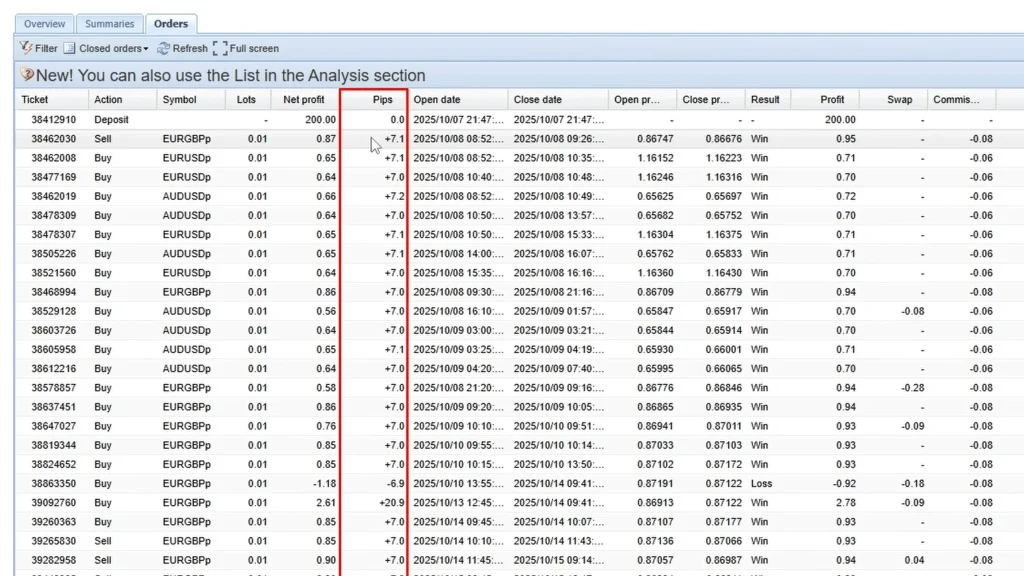
Looking at the trade history, you can see the pattern clearly. Single trades closing for 7 pips profit. Then sequences where two trades opened days apart, both at 0.01 lots, closing simultaneously for a combined 14 pips (7 pips per trade maintained).
That’s the core mechanic: Happy Frequency targets 7 pips profit per trade. If it needs to open a second position to average down, the combined target becomes 14 pips. Three positions? 21 pips total. The per-trade target remains constant at 7 pips.
How Happy Frequency Actually Trades
Happy Frequency operates on an M5 timeframe, which means it’s scanning for setups every five minutes. This creates high trade frequency, easily 5+ trades per day across all pairs you’re running.
The system doesn’t use a martingale. When it adds to a position, it uses the same lot size as the initial entry. If you started with 0.01 lots, additional positions are also 0.01 lots. No doubling, no exponential scaling.
This is critical to understand. It’s still a grid/averaging system (which carries inherent risk), but without the catastrophic exposure that a martingale creates.
Looking through closed orders reveals the typical pattern:
- Single trade opens and closes the same day for 7 pips → Ideal scenario
- Two trades open 3 days apart, close together for 14 combined pips → Grid recovery
- Multiple positions accumulate until price reverses enough to hit profit target → Extended recovery
The win rate is impressively high. Most individual trades close profitably. The challenge is when adverse moves trigger multiple grid levels simultaneously across different pairs on an undercapitalized account.
The $200 Account Problem
After running three pairs on $200 for several months, I had to face the reality that the account size couldn’t handle three independent grid systems.
Each currency pair can potentially open multiple positions. If AUD/USD opens 3 trades, EUR/GBP opens 2 trades, and EUR/USD opens 3 trades, you’ve got 8 simultaneous positions on a $200 account. Even at 0.01 lots each, the combined exposure becomes problematic.
I finally closed out EUR/GBP and EUR/USD positions on November 26th and removed those pairs from the EA. Only AUD/USD remained active.
The current open trades confirm this: four AUD/USD positions dating from November 26th through late December. They’re sitting in small floating losses, but the EA continues taking new single trades that close profitably while waiting for the grid to recover.
That’s actually one strength of the system, it doesn’t stop trading just because open positions exist. If new setups appear, it takes them. Many of those close for 7 pips while the grid positions wait for their profit target.
Vendor Track Record Analysis
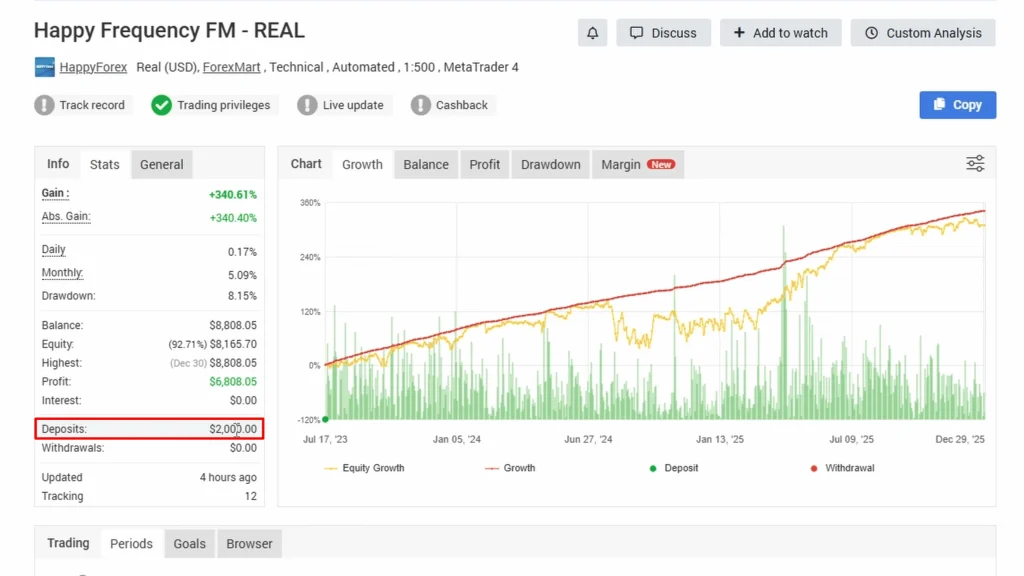
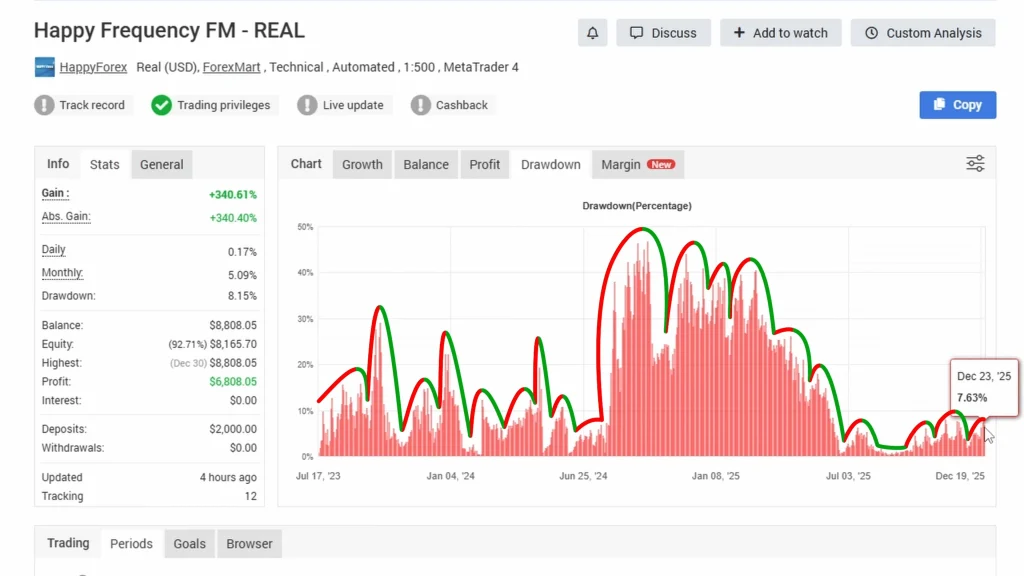
The developer maintains a verified MyFXBook account that started in July 2023 with $2,000. Current results show 340% profit, turning $2,000 into roughly $8,800.
The daily and monthly gain charts show consistent profitability, though the account also experiences periodic floating drawdowns. Looking at the drawdown graph, they’ve hit similar temporary unrealized loss situations but recovered successfully.
Examining their traded pairs reveals:
- AUD/USD (I’m trading this)
- EUR/GBP (I removed this)
- EUR/USD (I removed this)
- GBP/USD (Profitable on their account)
- USD/JPY (Also profitable)
Sorted by profit, GBP/USD and EUR/USD show strong performance. But here’s the key difference: they’re running on a $2,000 account. That’s 10x my initial capital, which provides substantially more margin for grid systems to breathe.
What works on $2,000 doesn’t necessarily scale down to $200. That was my fundamental error.
The 28-Pair Backtest Analysis
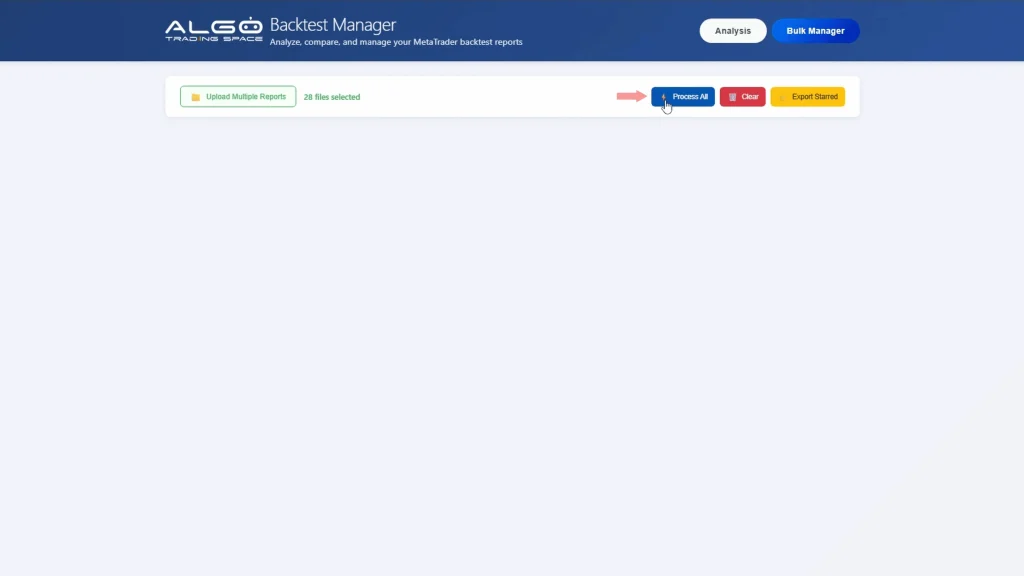
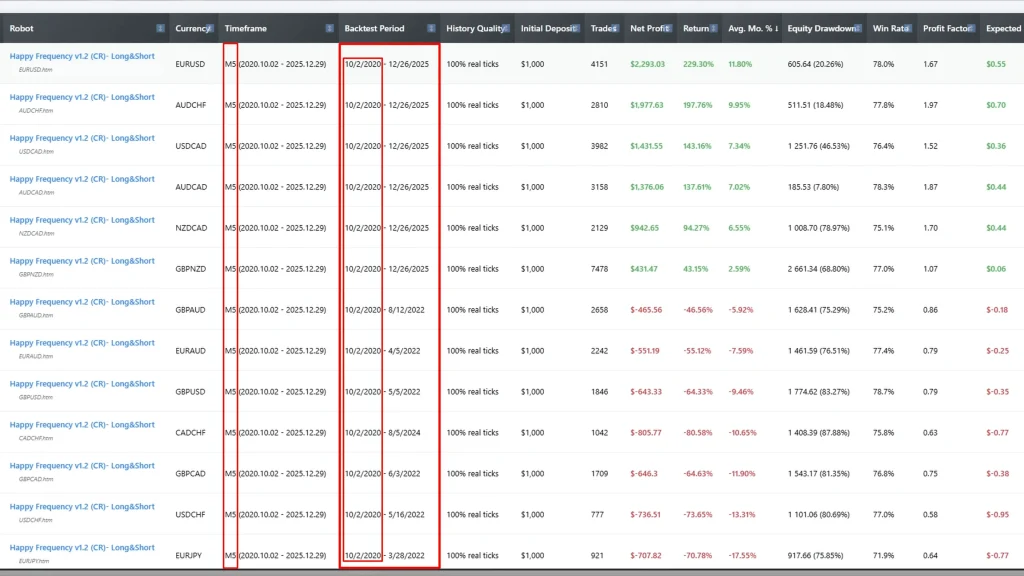
I wasn’t satisfied relying solely on the vendor’s pair selection. I wanted to know which currencies actually performed best historically, so I ran backtests on 28 different pairs using the Algo Trading Space Backtest Manager tool.
Testing parameters:
- Period: Late 2020 through present (roughly 4 years)
- Timeframe: M5
- Account sizes: Both $1,000 and $200 simulations
- All major and several minor pairs
The Backtest Manager allowed me to upload all 28 strategy tester reports simultaneously and compare them side-by-side. Sorting by average monthly profit revealed which pairs produced the most consistent returns.
Key Findings From Backtests
EUR/USD showed the most stable performance in terms of return consistency. But I already have other EAs trading EUR/USD, and I wanted portfolio diversification across different currencies.
NZD/CAD emerged as an interesting option. The backtests showed solid performance, and I don’t currently have any systems trading that pair. Perfect for diversification.
Here’s where it gets interesting: NZD/CAD isn’t one of the developer’s recommended pairs. It doesn’t appear in their track record. They designed Happy Frequency for specific currencies, and NZD/CAD wasn’t in that list.
But my backtest data suggested it could work. So I made the decision to experiment with a non-standard pair based on historical testing rather than blindly following the vendor’s configuration.
Account Size Matters: The Critical Lesson
The vendor’s track record spans all their pairs profitably since July 2023. My backtests, which started earlier (late 2020), showed some pairs failing during certain periods before recovering.
What does this tell us? The pairs aren’t inherently bad. They work fine on properly capitalized accounts. But on smaller accounts, you need to be extremely selective because there’s no margin for error.
A $200 account running three grid systems is asking for trouble. A $1,000 or $2,000 account can handle that exposure comfortably. A $5,000 or $10,000 account? You’ve got even more breathing room for the grids to work through adverse periods.
This isn’t about the EA being flawed. It’s about matching system requirements to available capital.
The Recovery Plan: Adding Capital and Changing Pairs
After analyzing the situation, I made two decisions:
Decision 1: Increase account size from $200 to $1,000
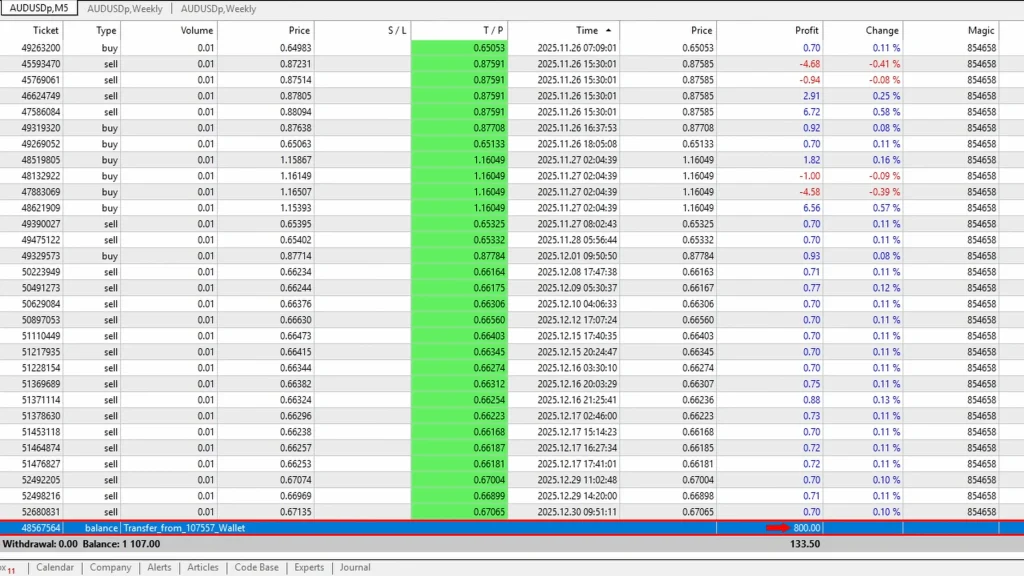
I transferred $800 from my BlackBull wallet to the trading account via internal transfer. This took seconds; the funds appeared immediately. Now the floating loss that looked problematic at 40% of $200 became manageable at ~5% of $1,000.
Decision 2: Replace underperforming pairs with NZD/CAD
I removed the charts running EUR/USD and GBP/USD. Added NZD/CAD M5 chart. Attached Happy Frequency with identical settings. Within seconds, the EA placed its first NZD/CAD trade.
This is an experiment. The backtests suggest NZD/CAD should perform well, but backtests aren’t guarantees. I’m testing a non-standard pair based on my own research rather than the developer’s recommendations.
Will it work? Time will tell. The beauty of public FXBlue tracking is that you can follow along and see the results as they develop.
Configuration Settings and Limitations
Happy Frequency offers minimal customization, which is both a strength and a weakness.
Available settings:
- First lot size
- Equity stopout toggle (closes all trades if equity drops below threshold)
- News avoidance option
- License key entry
What you cannot control:
- Profit target (fixed at 7 pips)
- Grid spacing
- Maximum positions per pair
- Indicator parameters
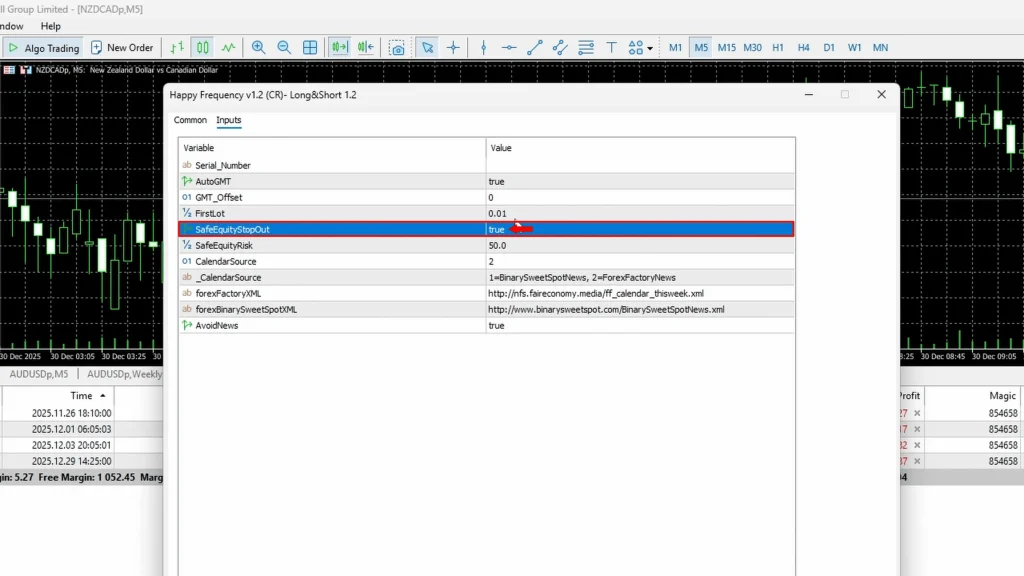
For traders who want extensive customization, this limited control feels restrictive. Personally, I’d prefer being able to adjust the pip target or set maximum grid levels per currency.
But there’s an argument for simplicity. Less configuration means fewer ways to break things. The default settings work; the developer’s 340% gain proves that. Your main decisions are account size and which pairs to trade.
I enabled the equity stopout at 50% for the newly funded $1,000 account. I don’t want equity dropping below $500 even temporarily. If that threshold hits, the EA closes everything automatically.
BlackBull Markets: Why I’m Using Them
Happy Frequency requires tight spreads and reliable execution given its 7-pip profit targets. BlackBull Markets provides both through their ECN Prime account:
- Spreads from 0 pips
- Commission: $3 per side
- Leverage: Up to 1:500
- Fast execution without requotes
On a system targeting 7 pips, spread differences matter enormously. A 2-pip spread costs you 28% of your target profit before you even start. BlackBull’s zero-pip spreads with transparent commission structure preserve more of that edge.
The 1:500 leverage helps grid systems by providing margin flexibility. When you have multiple positions open simultaneously, higher leverage means less equity tied up in margin requirements.
What I Like About Happy Frequency
After three months of live testing, here’s what stands out positively:
- Developer credibility: The same team created Happy Forex and Happy Gold, both of which I’ve tested successfully. There’s established reliability here.
- High activity: This EA trades frequently. If you’re the type of trader who wants to see action daily rather than waiting weeks between positions, Happy Frequency delivers.
- Multiple pair compatibility: You can experiment across many currencies. The vendor trades 5+ pairs. My backtests showed 28 pairs with varying performance. There’s flexibility to find what works for your strategy.
- Proven long-term results: The vendor’s 340% gain over 18+ months isn’t theoretical; it’s verified by MyFXBook data.
What Concerns Me
No system is perfect. Here are the legitimate negatives:
- Grid system risks: Despite not using a martingale, this is still grid-based averaging. Strong trending markets can accumulate multiple losing positions before recovery. Account undercapitalization amplifies this risk significantly.
- Limited customization: You can’t control pip targets, grid levels, or many other parameters. For traders who want fine-tuning capability, this feels restricting.
- Capital requirements unclear: The vendor doesn’t explicitly state minimum account sizes for different pair combinations. I learned through painful experience that $200 can’t handle three pairs. That information should be prominently disclosed.
- Non-standard pairs untested: My NZD/CAD experiment is exactly that, an experiment. The vendor hasn’t verified this pair, so I’m operating outside their tested parameters.
Where to Access Happy Frequency and Additional Resources
Happy Frequency EA is available through Algo Trading Space, which provides access to the system along with additional automated trading resources. Full disclosure: we may earn a small commission if you purchase through our links, though this doesn’t affect the price you pay or the honest assessment in this review.
Algo Trading Space currently runs a free EA campaign where you can receive a complimentary Happy Frequency license by opening an account with partner brokers. Check the campaign page for current offers.
For traders building portfolios across multiple expert advisors, the Algo Trading Space VIP club offers exclusive access to verified trading results from various systems, early insights into new EAs, and priority support. If you want ongoing performance data and community access beyond individual reviews, it’s worth exploring.
I’ll continue running Happy Frequency on my now-$1,000 account with public FXBlue tracking, so you can follow the NZD/CAD experiment and see whether adding capital solves the floating loss issue.
Frequently Asked Questions
How much capital do I realistically need to run Happy Frequency EA safely on multiple currency pairs?
Based on my experience, $200 is insufficient for running more than one currency pair. The vendor successfully trades 5 pairs on a $2,000 account, suggesting roughly $400 per pair minimum. For conservative operation with 2-3 pairs, I recommend $1,000 minimum.
If you want to trade 4-5 pairs like the vendor, $2,000+ provides an appropriate margin for the grid system to handle temporary drawdowns without equity stopout triggers. Smaller accounts should stick to single pairs only.
Why does Happy Frequency target only 7 pips per trade, and can this be adjusted?
The 7-pip target is hardcoded into Happy Frequency’s logic and cannot be adjusted through user settings. This conservative profit target allows the EA to close trades quickly in favorable conditions while maintaining high win rates.
When grid positions accumulate, the total target scales proportionally (14 pips for two trades, 21 for three, etc.) while maintaining the 7-pip-per-position consistency. The developer designed this around M5 timeframe volatility characteristics, though personally, I’d prefer customization capability for different market conditions.
What’s the difference between Happy Frequency and other Happy EAs like Happy Forex and Happy Gold?
Happy Frequency trades extremely actively on the M5 timeframe across multiple currency pairs, targeting 7 pips per trade with high frequency. Happy Forex (which I’ve also tested) trades less frequently with different profit targets and position management. Happy Gold is a scalping system specifically for gold with distinct logic.
All three come from the same developer but serve different portfolio roles: Happy Frequency for active currency trading, Happy Forex for moderate-frequency currency exposure, Happy Gold for metals scalping.
Can I run Happy Frequency on currency pairs not recommended by the vendor?
You can experiment with non-standard pairs as I’m doing with NZD/CAD, but proceed cautiously. The vendor optimized Happy Frequency for specific currencies shown in their track record. My 28-pair backtesting revealed that some untested pairs performed well historically, but backtests don’t guarantee future results.
If you test alternative pairs, start with small position sizes, run thorough backtests across multiple years, and monitor closely in demo or small live accounts before scaling up. You’re operating outside verified parameters.
How does the equity stopout feature work, and should I enable it?
The equity stopout automatically closes all Happy Frequency trades when the floating drawdown reaches your specified threshold (default 50%). On my upgraded $1,000 account, I enabled this at 50%, meaning if equity drops to $500, the EA liquidates everything to prevent further losses.
For small accounts or risk-averse traders, this provides essential protection against catastrophic grid accumulation. However, some traders prefer manual control. The vendor’s track record shows they’ve recovered from substantial floating losses, so the stopout would have prematurely closed profitable sequences. Your risk tolerance determines whether to enable it.