

- 7/29/2026


 Petko Aleksandrov
MetaTrader 4 remains the most widely used trading platform for retail gold traders in 2026. It is available through most regulated brokers that offer XAUUSD, and it supports everything from basic manual order placement to fully automated Expert Advisor strategies. Getting set up is straightforward once you understand a few gold-specific details that generic MT4 guides tend to skip over.
To trade gold on MT4, open a broker account that offers XAUUSD, log in to MetaTrader 4, add the gold symbol from Market Watch, open an XAUUSD chart, analyze the price using indicators or price action, then place a buy or sell order through the New Order window. Before trading live, check your broker’s XAUUSD spread, contract size, tick value, margin requirement, swap fees, and minimum lot size, then set a stop-loss and position size based on your risk limit.
This guide covers the full setup process, XAUUSD contract details that vary between brokers, lot size and risk calculation, indicator use, common mistakes, and how Expert Advisors work for gold trading on MT4.
What Is XAUUSD on MT4?
Most retail traders will trade gold as a CFD (contract for difference) rather than through the physical gold market or futures exchanges. On MT4, gold is accessed through the XAUUSD symbol, which represents the price of one troy ounce of gold measured in US dollars.
The symbol name can vary by broker. Common variations include:
- XAUUSD
- XAU/USD
- GOLD
- XAUUSD.m (micro lot variant)
- GOLDs or similar broker-specific suffixes
If you cannot find gold in MT4, the most likely cause is that your broker uses a different symbol name. The XAUUSD step to resolve this is covered in the setup section below.
Unlike trading gold futures on exchanges like the CME, XAUUSD CFDs do not involve physical delivery. You are speculating on price movements. Brokers regulated by the FCA, ASIC, CFTC, NFA, and ESMA are required to publish risk disclosures for CFD products, which makes checking their documentation an important first step before funding a gold account.
The 10-Step Process to Trade Gold on MT4
| Step | Action | Why It Matters |
| 1 | Choose a regulated broker offering XAUUSD on MT4 | Gold symbols and contract specifications vary significantly between brokers |
| 2 | Download MT4 from your broker or from MetaQuotes directly | Ensures the platform connects to your broker’s server |
| 3 | Open a demo or live trading account | Demo testing reduces beginner execution mistakes before real capital is at risk |
| 4 | Log in with your server credentials | Connects MT4 to your specific broker account and data feed |
| 5 | Open Market Watch and select Symbols | Lets you find the XAUUSD symbol or your broker’s gold equivalent |
| 6 | Add XAUUSD to Market Watch | Makes gold available for charting and order placement |
| 7 | Open an XAUUSD chart | Allows technical analysis, indicator application, and trade planning |
| 8 | Check spread, lot size, margin, and swap values | Prevents cost miscalculation and oversized risk exposure |
| 9 | Place a buy or sell order with stop-loss set | Controls execution and caps downside on each trade |
| 10 | Review the trade in Terminal and Journal | Tracks performance, spots execution errors, and supports ongoing review |
How to Add XAUUSD to MT4

This is the step that catches most new traders off guard. Gold is not always visible in MT4 by default; it depends on the broker’s configuration.
Here is the process:
- Open MT4 and locate the Market Watch window on the left side (or press Ctrl+M to open it)
- Right-click anywhere inside the Market Watch window
- Select Symbols from the context menu
- In the Symbols window, browse or search for your broker’s gold symbol (XAUUSD, GOLD, XAU/USD)
- Select the symbol and click Show
- Close the window; the symbol should now appear in Market Watch
- Right-click the symbol in Market Watch and select Chart Window to open an XAUUSD chart
If the symbol still does not appear, contact your broker’s support team. Some brokers require account type upgrades to access metals; others have specific server configurations that affect symbol availability.
Understanding XAUUSD Contract Specifications
This section is where most gold trading guides fall short. The contract details for XAUUSD differ between brokers, and getting them wrong leads to position sizing errors with real financial consequences.
Broker Specification Checklist
| Broker Detail | What to Check |
| Symbol name | XAUUSD, XAU/USD, GOLD, or a broker-specific variant |
| Contract size | Typically 100 troy ounces per standard lot, but must be verified |
| Minimum lot size | Commonly 0.01 lots (micro), but varies by broker |
| Tick size | Broker-specific; affects pip value calculation |
| Tick value | Required for accurate risk-per-trade calculation |
| Typical spread | Especially during London/New York overlap sessions |
| Margin requirement | Depends on your leverage and account type |
| Swap/overnight fees | Important for any trade held beyond the daily rollover |
| Trading hours | Gold CFDs may close briefly around rollover time |
| Execution type | Market execution or instant execution affects fill behavior |
Why does this matter practically? On a standard 100-ounce contract, a 1-point move in gold equals roughly $1 per 0.01 lot. At 0.10 lots, a 10-point adverse move costs $10. At 1.0 standard lot, the same move costs $100. Knowing your broker’s exact tick value before placing any trade is not optional; it is basic execution safety.
How to Place a Gold Trade on MT4
Once XAUUSD is visible in your Market Watch and chart is open, placing a trade involves these steps:
Opening the New Order Window
- Right-click on the chart and select Trading, then New Order; or press F9
- Alternatively, double-click the XAUUSD symbol in Market Watch
Completing the Order
The New Order window contains the following fields:
- Symbol: confirm XAUUSD is selected
- Volume: enter your lot size (calculated based on your risk; see the position sizing section below)
- Stop Loss: enter the price level at which the trade closes at a loss automatically
- Take Profit: enter the price level at which the trade closes in profit
- Type: choose Market Execution for immediate fill at current price, or Pending Order for entry at a future price level
- Comment: optional field for labeling the trade
- Buy/Sell buttons: click Buy for a long position (expecting gold to rise) or Sell for a short position (expecting a price decline)

After placing the trade, it appears in the Terminal window at the bottom of MT4. The Journal tab in Terminal records every action, which is useful for reviewing what happened if an order behaves unexpectedly.
Pending Order Types
MT4 supports four pending order types for gold trading:
- Buy Limit: buy at a lower price than current (expecting price to pull back before rising)
- Sell Limit: sell at a higher price than current (expecting price to rally before falling)
- Buy Stop: buy at a higher price than current (breakout entry above resistance)
- Sell Stop: sell at a lower price than current (breakout entry below support)
How to Calculate Lot Size and Risk for XAUUSD
Position sizing is arguably the most important skill in gold trading, and it is rarely explained clearly in platform guides.
The standard approach is to risk a fixed percentage of your account balance per trade, typically 1-2%. Here is how the calculation works for XAUUSD:
Example:
- Account balance: $5,000
- Risk per trade: 1% = $50
- Stop-loss distance: 20 points (pips) on XAUUSD
- Tick value: $1 per 0.01 lot per point (verify this with your broker)
Calculation:
- $50 risk divided by 20 points = $2.50 allowed risk per point
- $2.50 divided by $1 per 0.01 lot = 2.5 units of 0.01 lot = 0.025 lots
- Round down to 0.02 lots for conservative sizing
This calculation changes with every trade because stop-loss distance changes. Traders who use a fixed lot size regardless of stop distance are not actually applying consistent risk management; they are taking different sized risks on every trade without realizing it.
A gold account with proper sizing looks controlled even through losing streaks. One without it can destroy a significant portion of capital in just a few trades if gold makes a sharp directional move, which it does regularly.
Best Indicators for Trading Gold on MT4
MT4 includes all major indicators as standard, as documented in MetaQuotes’ platform resources. For XAUUSD specifically, these are the most practically useful:
Moving Averages (EMA)
The 50 EMA and 200 EMA are the most widely referenced for gold direction. Price above the 200 EMA is generally bullish context; below it is bearish. For shorter timeframes, the 20 EMA and 50 EMA provide dynamic support and resistance levels.
RSI (Relative Strength Index)
Period 14 is standard. RSI above 70 suggests overbought conditions; below 30 indicates oversold. Gold can remain in overbought territory for extended periods during strong safe-haven rallies, so RSI is most useful as a confirmation tool rather than a standalone reversal signal.
ATR (Average True Range)
ATR measures current volatility and is invaluable for stop-loss placement on XAUUSD. A stop set at 1.5-2x ATR below the entry point is generally more logical than an arbitrary pip distance that ignores how much gold is actually moving at that moment.
ADX (Average Directional Index)
ADX measures trend strength. Values above 20-25 suggest a trending environment. Many traders use ADX as a filter: only taking directional signals when ADX confirms enough momentum to support the trade.
MACD
Useful for confirming momentum direction and identifying divergence. Like most lagging indicators, MACD signals on gold can arrive after the bulk of a move has already occurred on short timeframes. It works better as confirmation than as a primary entry trigger.
Indicator Settings by Gold Trading Style
| Indicator | Scalping (M1-M5) | Day Trading (M15-H1) | Swing Trading (H4-Daily) |
| EMA | 9 / 21 | 20 / 50 | 50 / 200 |
| RSI | 7 or 14 | 14 | 14 |
| ATR | 14 | 14 | 14 |
| MACD | 12, 26, 9 | 12, 26, 9 | 12, 26, 9 |
| ADX | 9 | 14 | 14 |
These are starting points rather than fixed rules. Session conditions, broker spreads, and current gold volatility all affect how these settings perform in practice.
Trading Gold on MT4 Manually vs With Expert Advisors
Most traders on MT4 approach gold in one of two ways: manual chart-based trading or automated Expert Advisor (EA) systems.
Manual Trading on MT4
Manual gold trading involves monitoring the XAUUSD chart, applying your chosen indicators, and placing orders when your conditions are met. It gives full flexibility to read context, pause around news events, and adapt when market conditions change.
The main challenge is consistency. Applying the same rules every session, without emotional deviation, is harder than it sounds. Gold’s volatility can provoke impulsive decisions in ways that slower-moving forex pairs do not.
Expert Advisors for Gold CFD Trading
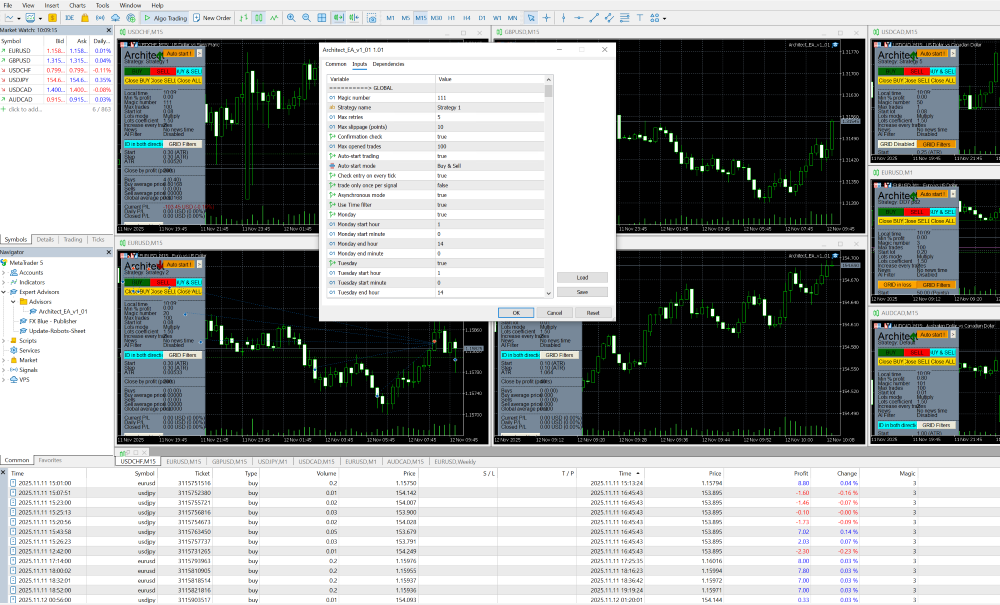
Expert Advisors are automated programs coded in MQL4 that run within MT4. Once an EA is attached to the XAUUSD chart, it monitors price continuously and places trades according to its coded logic without manual input.

For gold CFD trading, EAs are particularly useful for:
- Applying consistent entry and exit rules without emotional interference
- Running through London and New York sessions without requiring constant screen time
- Backtesting a strategy on XAUUSD historical data through MT4’s strategy tester

The important caveat: most retail traders will trade gold with an EA that they did not build themselves, which means they may not fully understand how it works. An EA that makes money in backtesting does not always perform the same way in live conditions, particularly if backtest assumptions about spread and slippage differ from the broker’s actual execution behavior.
How to Backtest a Gold Strategy on MT4

MT4’s built-in strategy tester allows backtesting of EAs on XAUUSD historical data. Here is how to access it:
- Go to View in the top menu and select Strategy Tester (or press Ctrl+R)
- Select your Expert Advisor from the dropdown
- Set the symbol to XAUUSD
- Choose the timeframe (M5, M15, H1, etc.) based on the strategy
- Set a date range that covers different market conditions: trending periods, ranging markets, and high-volatility events
- Select the modeling quality: “Every tick” provides the most accurate results but runs slower
- Set your initial deposit and leverage to match your live account conditions
- Click Start and review the results
What to Check in Backtest Results
| Metric | What It Tells You |
| Net profit | Total result over the test period |
| Maximum drawdown | Largest peak-to-trough loss during testing |
| Profit factor | Gross profit divided by gross loss; above 1.5 is generally considered meaningful |
| Number of trades | Whether the sample size is large enough to draw conclusions |
| Win rate | Percentage of profitable trades |
| Average trade | Average profit or loss per trade |
A gold backtest that only covers a period of strong trending conditions may look excellent but fail in sideways or choppy markets. Testing across multiple different periods gives a more realistic picture.
XAUUSD-Specific Risk Factors on MT4
| Risk | Why It Matters | What to Do |
| Spread widening | XAUUSD spreads expand during news events and thin liquidity periods | Apply a maximum spread filter before executing |
| Slippage | Fast gold price moves can fill orders at worse prices than expected | Avoid high-impact events unless specifically tested for that condition |
| Over-leverage | Gold volatility creates large account swings at high exposure levels | Risk a fixed percentage per trade; verify broker margin requirements |
| Wrong lot size calculation | XAUUSD contract values differ between brokers | Calculate from tick value and stop-loss distance, not intuition |
| Swap and overnight fees | Holding gold CFD positions overnight carries cost | Check long and short swap fees before planning multi-day trades |
| News-driven volatility | CPI, NFP, Fed decisions, and USD strength data all move gold sharply | Use an economic calendar from the BLS or Federal Reserve FOMC schedule |
Gold CFDs accessed via MT4 involve leverage and carry risk of losses beyond your initial deposit. Regulators including the FCA, ASIC, CFTC, and ESMA require brokers to publish this disclosure prominently.
Common Mistakes When Trading Gold on MT4
These are the issues that come up repeatedly when traders start using MT4 for XAUUSD:
- Using the wrong lot size: XAUUSD is not like EUR/USD. The pip value is different. Traders who assume standard forex lot sizes apply to gold can take on several times more risk than intended without realizing it until a loss occurs.
- Ignoring swap fees: a trade held overnight on XAUUSD carries a swap cost. On a large position held for several days, these fees can meaningfully affect the net result of what appeared to be a profitable trade.
- Trading around news without preparation: gold reacts sharply to USD-related data releases. Spreads widen, slippage increases, and stops placed too close to current price can be triggered by the spike before the market finds direction. Most experienced gold traders check the economic calendar daily.
- Over-optimizing the backtest: an EA that looks extraordinary in backtesting but was tuned specifically to that historical period is unlikely to perform similarly in live trading. Testing on data not used during optimization is the only reliable way to check whether a strategy is genuinely robust.
- Not checking the broker’s XAUUSD specifications: minimum deposit requirements, leverage limits, symbol names, and contract specifications differ enough between brokers that assumptions based on other platforms can lead to real errors.
Manual vs EA Gold Trading on MT4: Which to Choose?
| Factor | Manual Gold Trading | EA-Based Gold Trading |
| Flexibility | Full real-time adaptation | Fixed rules; requires code change to adapt |
| Emotional control | Depends on the trader | Executes rules without hesitation |
| Consistency | Can drift under pressure | Consistent by design |
| Backtesting | Limited to manual review | Full MT4 strategy tester access |
| Screen time required | High; active monitoring needed | Lower once running, but monitoring still needed |
| Development time | Lower to start | Higher; coding and testing required |
| Best for | Discretionary, context-based strategies | Rule-based, systematic approaches |
A hybrid approach is practical for many traders: using MT4’s tools and indicators to generate trading signals manually, then applying strict position sizing and stop-loss rules that function as a semi-automated risk control layer. This is not fully automated, but it brings some of the consistency benefits of EAs to manual trading.
Further Resources
Traders interested in automated XAUUSD strategies can review documented EA configurations and backtest results at algotradingspace.com/premium. Before running any EA on a live account, verify its drawdown history, spread assumptions, broker compatibility, position sizing logic, and forward performance on a demo account. The VIP club gives members access to actual trading results, priority support, and early visibility on strategies in active development.
Frequently Asked Questions
Why can’t I find XAUUSD on MT4?
If XAUUSD does not appear in Market Watch, the symbol may be hidden or named differently by your broker. Right-click inside Market Watch, select Symbols, and search for XAUUSD, XAU/USD, GOLD, or a broker-specific variant. If the symbol is not available at all, your account type may not include metals, or your broker may not offer gold CFD trading on that server. Contact your broker’s support team for the exact symbol name and how to activate it on your account.
What is the gold symbol on MT4?
The gold symbol on MT4 varies by broker. The most common version is XAUUSD, representing gold (XAU) priced in US dollars (USD). Some brokers label it XAU/USD, GOLD, or add suffixes like .m for micro accounts. The underlying instrument is the same: the spot price of one troy ounce of gold in dollars. Always confirm the exact symbol with your broker before attempting to place trades, as entering the wrong symbol can result in unintended positions.
What lot size should I use for XAUUSD on MT4?
Lot size should be based on your account balance, risk percentage per trade, and stop-loss distance. A common starting approach is to risk 1-2% of account equity per trade. For XAUUSD, calculate the lot size from your broker’s tick value and the distance between your entry and stop-loss price. Because XAUUSD contract specifications vary between brokers, the same lot size can represent different dollar amounts on different platforms. Always verify your broker’s tick value for gold before calculating position size.
Can I trade gold on MT4 with a demo account?
Yes. Most regulated brokers offer MT4 demo accounts that include XAUUSD. A demo account is strongly recommended for anyone new to gold trading on MT4 because it allows you to practice finding the symbol, placing orders, setting stop-loss and take-profit levels, and reviewing trades in the Terminal, all without risking real capital. The main limitation is that demo conditions may not fully replicate live spread and execution behavior, so some transition period after moving to a live account is normal.
What is the best timeframe for trading gold on MT4?
There is no universal best timeframe; it depends on your trading style and available screen time. Scalpers commonly use M1 to M5, requiring rapid execution and tight spread management. Day traders typically work on M15 to H1, balancing signal frequency with enough chart structure for reliable analysis. Swing traders use H4 to Daily charts for larger directional moves held over days. Each timeframe demands different indicator settings, stop-loss distances, and time commitments, so selecting the right one starts with being realistic about how much time you can actively monitor trades.
Can I use Expert Advisors to trade gold on MT4?
Yes. MT4 fully supports Expert Advisors for XAUUSD trading. EAs can monitor price automatically, place orders when conditions are met, and manage positions according to coded rules without manual input. This is particularly useful for consistent execution during active sessions or for strategies running overnight. To use an EA, attach it to the XAUUSD chart and ensure AutoTrading is enabled in the MT4 toolbar. Always test any EA on a demo account with realistic spread assumptions before running it on a live gold account.
Why is my XAUUSD spread high on MT4?
XAUUSD spreads widen for several reasons: low-liquidity periods such as the Asian session or market close, major economic news events including CPI, NFP, and Fed announcements, and broker-specific pricing models. Spreads are typically tightest during the London and New York overlap session from approximately 13:00 to 17:00 GMT. If your spread is consistently high regardless of session, consider whether your account type (standard, ECN, raw spread) affects pricing, or whether switching brokers to one offering tighter gold CFD spreads would reduce transaction costs meaningfully.

