 Marin
MarinThis article is educational and based on my own trading accounts. It is not financial advice, and the same recovery process may not fit every trader, broker, prop firm, or funded account rule set.
The best way to recover from a trading loss is to stop trying to recover quickly. Fast recovery almost always requires larger position sizes, and larger positions increase the chance of a second, deeper drawdown. A better approach: reduce risk, review the cause of the loss, validate any replacement strategy through backtesting, and rebuild the account gradually over weeks or months.
Most traders do the opposite. They increase lot sizes, trade more frequently, and try to get the money back in days. The result is almost always a trading blowup that turns a manageable loss into something much worse.
One of my funded accounts dropped more than 6% not long ago. What I did next was the exact opposite of what most traders instinctively do. I cut the risk, took a small break from active decisions, backtested a replacement robot using the account’s current balance as the starting point, and only then re-entered the market. Both accounts are now recovering. One has already passed its starting point. The other is close.

This article covers the full process, including specific robot settings, backtest data, and the platform context. It also covers what manual traders should do, because the same principles apply whether you are running an EA or placing trades by hand.
The 5-Step Process to Recover From a Trading Loss
Before going into the account details, here is the framework I used. It applies to both algorithmic and manual traders.
| Step | Action | Purpose |
| 1 | Stop trading temporarily | Prevent emotional, reactive decisions |
| 2 | Review the loss honestly | Separate normal drawdown from a broken strategy |
| 3 | Reduce risk before re-entering | Avoid compounding the damage |
| 4 | Backtest or validate the next setup | Re-enter with data, not emotion |
| 5 | Recover slowly and monitor weekly | Protect the account before chasing profit |
The recovery process changes depending on whether the account is personal, funded, or instant-funded. A personal account gives more flexibility. A funded account has hard drawdown limits that can remove the account entirely before the strategy has time to work.
Why Most Traders Fail to Recover Loss
There is a concept in behavioral finance called loss aversion. First described by Daniel Kahneman and Amos Tversky in their prospect theory research, it refers to the tendency to feel the pain of a loss roughly twice as intensely as the pleasure of an equivalent gain. When traders hit a drawdown, that emotional weight pushes them toward irrational decisions. They abandon strategies that still have statistical merit. They double their lot size to “speed up” recovery. They switch assets chasing volatility.
Here are seven ways that mindset destroys accounts:
- Increasing risk after a loss, which compounds the drawdown
- Abandoning a tested strategy based on a short losing streak
- Switching to an unfamiliar market without backtest data
- Removing stop losses to avoid being “stopped out again”
- Trading during high-impact news to chase big moves
- Ignoring the maximum drawdown rules on funded accounts
- Measuring recovery progress daily instead of across a proper sample size
Every one of these is a coping strategy that feels logical in the moment and produces worse outcomes over time. The first step in recovering from trading losses is recognizing which of these patterns you are currently following.
Trading Psychology After a Loss
The psychological side of recovery is often harder than the technical side. A few patterns worth naming specifically, because knowing the name helps you catch the behavior before it causes real damage:
Revenge trading is the impulse to immediately re-enter after a loss to “get it back.” The trade is placed not because the setup is valid, but because the loss feels unacceptable. These trades tend to be oversized, rushed, and taken without proper setup confirmation.
Fear of the next valid trade is the opposite problem. After a bad loss, some traders become paralyzed and miss genuinely good setups because they are waiting to feel more confident. That feeling rarely arrives on its own.
Strategy hopping happens when a trader abandons a working system after a losing streak that falls entirely within the strategy’s normal parameters. They switch to something new, take another loss during its learning curve, and repeat the cycle.
Recency bias causes traders to weight recent losses too heavily when assessing a strategy’s overall merit. A system with a 60% win rate will still produce four or five consecutive losses periodically. That is not a sign the system is broken.
Over-monitoring open trades during a recovery period creates the urge to close positions early or move stop losses manually. Both interventions usually reduce performance compared to letting the strategy run to its defined exits.
A written recovery checklist, reviewed before each trading session, is one of the most practical tools for managing these patterns. It forces a moment of deliberate reflection before the market opens.
The Two Accounts I Recovered: What the Numbers Looked Like
Rather than describing a hypothetical process, here is what happened on two real accounts tracked publicly on the Algo Trading Space funded results page.
Both accounts are marked as “replacement” accounts, meaning the original robot was replaced after a significant loss. Three accounts carry this label total: one with Forex Gold Investor, one with Dark Gold, and one with Dark Nova. The focus here is on the first two.

Forex Gold Investor Account
This account started at $10,000 on the xrading instant funding platform. The original robot performed reasonably for a period, then suffered a significant loss. Around the start of 2026, I placed the Forex Gold Investor with adjusted risk settings, specifically fixed lot sizing and money management disabled.

Four months later, the account had recovered and moved into profit. The MetaTrader 5 backtest (MT4 lacked sufficient historical data) showed an 11-12% return over the prior twelve months with a maximum equity drawdown of 6.26%. On xrading, the static drawdown limit is 10%, so that backtest result fit cleanly within the account rules.
Dark Gold Account
This one was more challenging. By the end of 2025, the balance had dropped to $9,268 on a $10,000 starting account. That is a 7.5% loss, uncomfortably close to the 10% drawdown limit.

Before deciding on the Dark Gold, I reviewed several robots and settings. The main reason for choosing it: another live account had been running Dark Gold for nearly a year with a maximum floating loss under 15% on a $1,000 balance. Scaled up proportionally to a $10,000 account, it would still stay within the platform’s limit.
Since February 17 of this year, the Dark Gold account has gained approximately $600, bringing the balance to nearly $9,900. Not fully recovered yet, but on a clear upward path.
| Account | Starting Balance | Balance at Worst Point | Loss % | Robot Placed | Recovery Gain to Date |
| Forex Gold Investor | $10,000 | Below $10,000 | Significant | Forex Gold Investor | Recovered and in profit |
| Dark Gold | $10,000 | $9,268 | ~7.5% | Dark Gold | +~$600 (to ~$9,900) |
The Methodology: How to Recover From Trading Losses Without Blowing the Account
Step 1: Stop and Take a Small Break From Active Decisions
Not a break from monitoring. A break from making new position decisions under emotional pressure. When I realized the Dark Gold account was down 7.5%, the first instinct was to do something immediately. That instinct was the problem, not the loss itself.
Taking even a few days away from the charts before making changes allowed me to review the situation from a less reactive place. This sounds simple. After a bad loss on a funded account, it genuinely is not.
Step 2: Review Your Mistakes Without Judgment
Going back through the trade history, I identified what the original robot was doing that led to the drawdown. Was it a strategy failure? A settings issue? Market conditions the robot was not designed for? Or just normal variance within a sound strategy?
This distinction matters enormously. If it was a structural problem, replacing the robot makes sense. If the drawdown was within expected parameters, replacement might actually interrupt a recovery that was already beginning.
In both accounts, the review showed the original robots had been exposed to market conditions they were not optimized for. Replacement was the right call.
Step 3: Backtest From the Current Account State
This is perhaps the most important technical step. I did not backtest replacement robots from a clean $10,000 starting balance. Testing started from the actual current balance with the same fixed lot settings planned for live use.
For the Forex Gold Investor, that meant loading the exact set file into a MetaTrader 5 demo account and running a one-year backtest. Result: approximately 11-12% profit with a 6.26% maximum equity drawdown. That confirmed the robot could recover the account within the 10% static drawdown limit.


For the Dark Gold, the MT4 backtest was insufficient: only 48% of historical data was available, which makes the model quality unreliable. Switching to MetaTrader 5, loading the set file from the Algo Trading Space VIP Club, and running the test there gave a usable result.
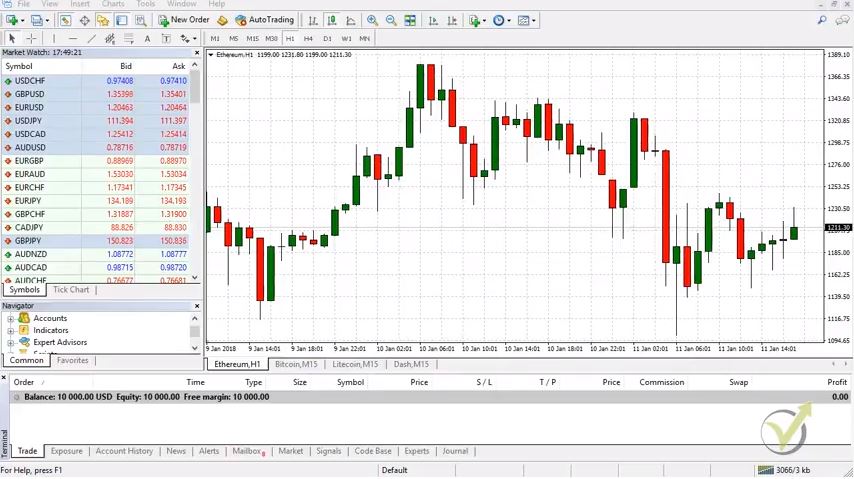
A note on MetaTrader 4 vs MetaTrader 5 for backtesting: MT4 frequently lacks sufficient historical tick data, particularly for longer test windows. Anything below 90% modeling quality should prompt a switch to MT5 for a more dependable result.

Step 4: Fix Lot Sizing and Disable Money Management
On both recovery accounts, money management is disabled and fixed lots are used. Percentage-based risk management scales position size proportionally to account balance, which means a drawdown account automatically trades smaller than a fresh one. That is normally the right behavior.

In a recovery situation, full manual control over exactly how much risk is taken per trade removes any dynamic scaling surprises. The lot sizes chosen were conservative, prioritizing staying within the drawdown limit over achieving the fastest possible gain.
Step 5: Monitor Without Intervening
Once the replacement robot was running, I left it alone. Checking the account twice a week rather than daily made a real psychological difference. Daily monitoring during a recovery phase invites unnecessary interference.
The Dark Gold account had periods of flat or slightly negative equity during recovery. On a daily view, those would have felt like the robot was failing. On a weekly view, the upward direction was clearly visible.
What Not to Do After a Trading Loss
| Mistake | Why It Makes Recovery Harder |
| Doubling lot size | Increases the chance of a deeper drawdown |
| Removing stop losses | Turns defined risk into unlimited risk |
| Chasing news trades | Adds volatility during emotional decision-making |
| Switching strategies daily | Prevents a proper sample size from developing |
| Checking results every hour | Increases the urge to interfere with open trades |
| Trying to recover in one week | Requires oversized positions that compound losses |
| Abandoning a robot after three losing trades | Short streaks are normal within a working strategy |
Trading Loss Recovery Plan: What to Write Down Before Re-Entering
A trading loss recovery plan should include the current account balance, the maximum remaining drawdown, allowed risk per trade, maximum trades per week, strategy validation rules, and the exact condition that allows trading to resume. Without a written plan, most traders improvise under emotional pressure, and improvisation after a loss tends to make things worse.
| Recovery plan item | Example |
| Current balance | $9,268 |
| Maximum drawdown limit | $9,000 (10% of starting balance) |
| Remaining drawdown buffer | $268 |
| Maximum risk per trade | Fixed 0.01 lot |
| Strategy validation method | MT5 backtest from current balance |
| Monitoring schedule | Twice per week |
| Recovery timeline | Multiple months |
| Condition to increase lot size | Account back above $10,000 with verified backtest support |
What Manual Traders Should Do After a Trading Loss
Most of the examples in this article involve trading robots, but the same principles apply to manual trading. A few adjustments for traders placing orders by hand:
- Reduce trade size immediately after a significant loss, below what feels comfortable
- Stop revenge trading by requiring a defined setup checklist before any entry
- Review screenshots and journal notes from recent trades to identify patterns, not just outcomes
- Trade only the clearest setups for a defined period, perhaps two weeks, before returning to normal volume
- Avoid switching markets impulsively after a stock loss, for example, moving to Forex because it “feels different”
- Set a maximum number of trades per day during recovery; three is a reasonable ceiling for most styles
- Write the recovery plan before markets open, not while a losing position is open
Manual traders are more exposed to in-session emotional decisions than algo traders. The robot does not care how it feels after a loss. You do. That is why the written plan matters even more for discretionary trading.
Risk Management During Recovery: What to Adjust and What to Leave Alone
Recovery risk management is stricter than standard risk management.
| Parameter | Standard Approach | Recovery Approach |
| Lot sizing | Percentage of account balance | Fixed lots, set conservatively |
| Money management | Dynamic, scales with balance | Disabled; full manual control |
| Maximum daily loss | Standard platform limit | Treat as a hard ceiling, not a guideline |
| Robot or strategy selection | Best performing in current conditions | Backtested from current account state |
| Monitoring frequency | Daily or real-time | Weekly; less interference |
| News trading | Based on strategy rules | Avoided unless the strategy is designed for it |
| Recovery timeline | Not specified | Realistic: months, not days |
The timeline point is worth repeating. The Forex Gold Investor account took approximately four months to recover. The Dark Gold account has been recovering since mid-February and is not yet fully back. Anyone expecting to recover a 7% loss in a week by increasing lot sizes will almost certainly make the position worse, not better.
The xrading Platform Context
Both accounts described here run on xrading, an instant funding platform where a one-time deposit is multiplied to create a larger trading balance. A $1,000 deposit becomes a $10,000 trading account through $9,000 in credit. The static drawdown limit is 10%, and the profit target is 20%.

That structure shapes everything about the recovery approach. With a 10% static drawdown on a $10,000 balance, there was roughly $268 of additional drawdown space left on the Dark Gold account when the replacement robot was placed. That is a very narrow margin. It required a robot with a verified drawdown history well below that threshold.
If you are considering an instant funding platform, the combination of a conservative robot, fixed lot sizing, and a realistic timeline is not optional. The profit targets are achievable, but not across a few aggressive trades.
Where to Find the Set Files and Results
The full set files for both recovery accounts, including the Forex Gold Investor and Dark Gold configurations, are available through the Algo Trading Space VIP Club. VIP members get access to live trading results, set files for all active accounts, early insights on new robots, and priority support. It is where I share everything currently running, not just the successful outcomes.
For those looking at a complete trading setup including specific configurations for funded accounts and recovery scenarios, the Algo Trading Space Premium Setup covers the full framework.
Both are relevant specifically if you want to see what is actually being traded, not just read about it.
FAQ
What is the fastest way to recover from a trading loss?
There is no genuinely fast recovery that does not also increase the risk of a deeper loss. The most reliable method is to reduce position sizing, review or replace the strategy through backtesting, and allow the recovery to happen over weeks or months rather than days. Traders who increase lot size after a bad loss to recover quickly statistically tend to compound the drawdown. The accounts documented in this article took between two and four months to recover using conservative fixed-lot sizing throughout.
Should I keep trading after a significant loss?
It depends on whether the loss came from a structural strategy failure or from normal drawdown variance. If the strategy was fundamentally flawed, continuing with it will likely produce further losses. If the drawdown fell within the strategy’s historical parameters, stopping may interrupt a natural recovery. The key step is reviewing the trade history honestly before any decision. Taking a short break from active trading decisions while doing that review is almost always worthwhile.
How do I know when to replace a robot after a trading blowup?
Replace a robot when the backtest data shows its current settings cannot recover the account within the platform’s drawdown limits, or when market conditions have structurally changed in a way the robot was not designed for. Do not replace it based solely on a short losing streak during normal variance. The decision should come from a backtested comparison of the current strategy versus a proposed replacement, run from the actual current account balance, not a hypothetical clean start.
What risk settings should I use during a trading account recovery?
Fixed lot sizing with money management disabled is the approach used in the accounts documented here. This provides full predictability over how much risk is taken per trade, regardless of the current account balance. Position sizes should be conservative enough that the maximum historical drawdown of the replacement robot stays within the account’s drawdown limits. On xrading’s 10% static drawdown, a robot with a verified maximum floating loss under 15% on a proportionally smaller account was the selection threshold.
How does behavioral finance explain why traders struggle to recover losses?
Loss aversion, described by Kahneman and Tversky in prospect theory research, refers to the tendency to feel the pain of a loss roughly twice as intensely as the pleasure of an equivalent gain. In trading, this pushes toward irrational recovery behavior: increasing position sizes, abandoning tested strategies, or making impulsive changes under pressure. Recognizing the bias does not eliminate it, but it creates enough distance for more deliberate decisions. A written recovery checklist reviewed before each session is a practical tool for managing it.
Can a funded account recover from a near-maximum drawdown?
Yes, but the margin for error is very small. The Dark Gold account described in this article was within approximately 2.7% of its maximum drawdown limit when the replacement robot was placed. That required a robot with a proven drawdown history low enough to stay within the remaining buffer, fixed lot sizing to prevent any scaling surprises, and a realistic multi-month timeline. Funded accounts can recover from near-maximum drawdown positions, but the process requires more caution than a fresh account, not less.
How long does trading loss recovery typically take?
Recovery time depends on the size of the loss, the risk settings used, and the market conditions during the recovery period. The Forex Gold Investor account took approximately four months to recover and move back into profit. The Dark Gold account has been recovering since February 17 and is still in progress at the time of writing. Realistically, a 5-10% drawdown on a funded account with conservative fixed lot sizing should be expected to take two to five months to recover, not days or weeks.