 Petko Aleksandrov
The account example referenced below comes from a single live-account session run by the article’s original author. It’s included as an illustration, not as proof that either style is generally superior.
Neither a scalping robot nor a day-trading robot is universally better. Scalping robots trade more frequently and are highly sensitive to spread, commission, slippage, and latency. Day-trading robots usually hold positions longer and may be somewhat less exposed to individual execution costs, but they can face larger intraday price swings and event risk instead. The better choice, honestly, comes down to which robot produces stronger risk-adjusted results after realistic costs, tested on real data, not which category it technically falls into.
Is Scalping Actually a Type of Day Trading?
Here’s something worth clearing up before comparing anything else: scalping and day trading aren’t really two separate, mutually exclusive categories. Scalping is usually a high-frequency, short-holding-period form of intraday trading, meaning most scalping activity is technically a form of day trading too, since positions open and close within the same session.

A more useful distinction than “scalping vs. day trading” as opposing camps:
- Scalping robots target very short holding periods, often seconds to minutes, and trade frequently
- Day-trading robots may hold positions for minutes or hours but still typically close everything before the session ends
So really, this comparison is less “two different worlds” and more “two points on the same intraday spectrum.” Worth keeping that framing in mind as we go.
Main Operational Differences
| Factor | Scalping robot | Day-trading robot |
| Typical holding time | Seconds to minutes | Minutes to hours |
| Trade frequency | High | Low to moderate |
| Typical target size | Small | Larger |
| Spread sensitivity | Very high | Moderate |
| Latency sensitivity | Very high | Lower |
| Commission impact | High relative to expected profit per trade | Lower relative to expected profit per trade |
| Slippage impact | High | Moderate |
| Market exposure | Short but frequent | Longer per individual trade |
| Overnight exposure | Usually none | Usually none, if genuinely intraday |
| Data requirement for testing | High-quality tick data | Tick data or high-quality bar data |
| Broker dependence | Very high | Moderate to high |
| Operational complexity | High | Moderate |
Why “Quick Profits” Isn’t the Right Framing
A common way to describe this comparison goes something like: scalping seeks quick profits, day trading seeks bigger profits. That framing is a little misleading, honestly, because neither outcome is guaranteed by the style itself. A scalping robot targets smaller price movements and usually trades more often. A day-trading robot may target larger intraday moves and trade less frequently. Either approach can make money or lose it, depending entirely on the strategy’s actual edge, not on which category it belongs to.
The Overnight Risk Question, Corrected
You’ll often hear that holding a position overnight is risky because of a market gap “at midnight.” That’s not quite accurate; forex doesn’t gap simply because the clock hits midnight in some particular time zone. What actually creates risk around holding positions past the trading session includes:
- Weekend closures, where price can reopen meaningfully different from where it closed Friday
- Holiday closures, with similar gap potential
- Illiquid rollover periods, when spreads can widen noticeably
- Sudden, unexpected news hitting outside normal hours
- Financing or swap charges for holding overnight
- Broker maintenance windows
Day traders generally close positions before rollover specifically to sidestep overnight financing, thinner liquidity, and the wider spreads that tend to show up during those transition periods, not because of anything special about the stroke of midnight itself.
Two Real Robots, With Full Specifications
To make this comparison concrete rather than abstract, here’s how two actual EAs, one built for EUR/USD and one for GBP/USD, were structured. I’m including exact settings so this is actually reproducible, not just a general description.
EUR/USD Robot (the day-trading robot in this comparison)
| Attribute | Setting |
| Pair | EUR/USD |
| Execution timeframe | M15 |
| Entry indicator | Stochastic, K period 22, D period 7, slowing 30 |
| Entry condition (short) | Stochastic line crosses the signal line downward |
| Entry condition (long) | Stochastic line crosses the signal line upward |
| Exit indicator | Envelopes, period 12, deviation 0.40% |
| Exit condition | Price closes outside the Envelope, then a new bar opens back inside it |
| Stop loss | 100 pips |
| Take profit | 60 pips |

GBP/USD Robot (the scalping robot in this comparison)
| Attribute | Setting |
| Pair | GBP/USD |
| Execution timeframe | M1 |
| Confirmation timeframes | M30 and H1 |
| M1 entry indicators | Moving Average (period 10), RSI (period 30) |
| M1 entry condition (long) | RSI crosses above the 50 level, and price reaches the Moving Average |
| M30 confirmation | Fast MA (period 15) above Slow MA (period 50), and MACD line above signal line |
| H1 confirmation | MACD line above signal line |
| Stop loss | 40 pips |
| Take profit | 60 pips |
A quick note on that stop and target: 40 pips and 60 pips is fairly wide for something described as a scalping robot. Scalping strategies more typically use tighter distances. That’s a genuine inconsistency worth being upfront about, rather than pretending the labels line up perfectly with textbook definitions.

One detail worth understanding if you’re trying to reproduce this kind of setup: the robot only needs to be attached to the M1 chart. It reads the M30 and H1 data on its own through the code, without requiring you to manually place indicators on those higher timeframes. You’d still want to load enough historical data on M30 and H1 (commonly done by pressing Home on each chart to pull in more bars) so indicators like MACD have enough history to calculate correctly.
What a Live Test Actually Showed, and What It Doesn’t Prove
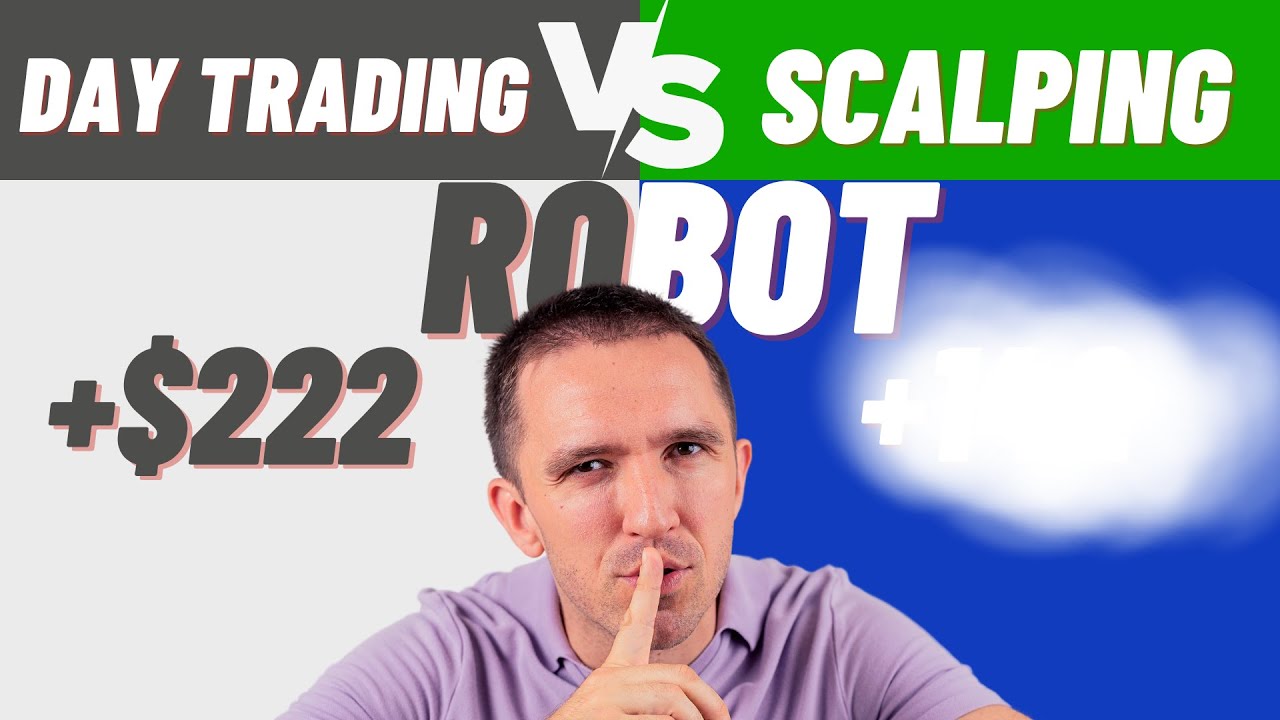
In one documented live-account session, both robots ran on a $1,000 account with the same broker. Over the observed period, the EUR/USD robot closed 4 trades for a combined profit of $222.20, while the GBP/USD robot’s closed trades produced $142.60. One GBP/USD position remained open at a loss when the comparison was recorded, which is why only closed-trade results were used for the comparison; an open position could still move in either direction.

I want to be direct about what this actually shows, and what it doesn’t:
- It shows that, during this specific period, on this specific account, with these specific settings, the EUR/USD robot’s closed trades outperformed the GBP/USD robot’s closed trades.
- It does not show that day-trading robots are generally better than scalping robots.
- It does not account for normalized risk, meaning both robots weren’t necessarily risking the same percentage of the account per trade.
- It’s a small sample, just a handful of trades, over a short window, which isn’t enough to draw a statistically meaningful conclusion either way.
- Position sizing, exact commission, and swap costs for both robots weren’t fully documented alongside these figures, which limits how much can be concluded from the raw dollar amounts alone.
In this test period, the EUR/USD day-trading robot produced the stronger result under the stated account and settings. That’s a fair, specific statement. “Day-trading robots are better than scalping robots” is not a fair statement to draw from it, and any article claiming otherwise is overreaching.
Why a Fair Comparison Needs Normalized Risk
A $1,000 account running two robots side by side isn’t automatically a fair test, even with good intentions behind it. If one robot risks a larger percentage per trade, or trades in bigger lots, raw dollar profit tells you very little about which strategy is actually more efficient. A proper comparison would normalize for:
- The same percentage risk per trade, or the same volatility-adjusted exposure
- The same test period, so both robots experience identical market conditions
- The same broker, account currency, and leverage
- The same treatment of spread, commission, and swap
Without that normalization, comparing raw profit numbers is a bit like comparing two runners’ finish times without checking whether they ran the same distance.
How to Actually Backtest Each Type
This is where a lot of scalping-EA testing goes wrong. A robot making decisions purely at the open of a new bar, like the EUR/USD example above, can reasonably be backtested using an “open prices only” model, since its logic doesn’t depend on what happens between the open and close of each candle.

A robot that can trade inside the bar, reacting to conditions before a candle closes, like the GBP/USD scalping example, needs considerably more precision. Using a coarse model for that kind of robot can materially distort entries, exits, spread effects, and stop execution, since the backtest simply doesn’t have visibility into what happened moment-to-moment within each bar.
For genuinely intrabar strategies, aim for the highest-resolution data your platform supports:
- Tick data, or real-tick modeling where your platform offers it
- Bid and ask history, not just a single price stream
- Variable spread modeling, not a fixed assumption
- Commission
- Realistic slippage and execution-delay assumptions
MT4 and MT5 don’t handle this identically either. Their testers use different data models, spread handling, and tick modes, so instructions for one platform shouldn’t be assumed to transfer directly to the other. If you’re testing on MT5’s real-tick mode versus MT4’s tick-simulation approach, expect somewhat different results even from the same underlying strategy logic.
Execution Quality Matters More for Scalping
Low spread gets mentioned a lot in scalping discussions, and fairly so, but it’s really just one piece of the execution stack that determines whether a scalping strategy survives contact with live trading. The fuller list includes:
- Spread, both typical and during volatile periods
- Commission per lot or per round trip
- Slippage
- Latency between your EA and the broker’s server
- Requotes
- Order rejections
- Minimum stop distance requirements
- VPS location relative to the broker’s server
- The broker’s execution model (market maker vs. ECN/STP, for example)
- Liquidity conditions around major news releases
A strategy with a small average profit per trade can turn unprofitable fast once realistic costs are layered on top of the raw price movement it’s trying to capture. This is exactly why scalping robots are, generally speaking, more broker-dependent than day-trading robots. The same strategy can look profitable on one broker’s execution and lose money on another’s, purely because of spread and latency differences.
A Simple Scalping Viability Check
Before trusting any scalping EA with real capital, it’s worth breaking down where the edge actually comes from:
| Item | What to check |
| Gross average profit per trade | Before any costs |
| Spread cost | Average cost paid per trade |
| Commission | Average cost per trade |
| Slippage | Estimated or measured average |
| Net average profit per trade | What’s actually left after the above |
If execution costs consume most of the gross edge, the system is fragile, even if the backtest looked strong. This single check catches a surprising number of strategies that look great on paper and struggle in live conditions.
Broker Considerations
Since execution quality genuinely matters more for scalping, broker selection deserves real scrutiny rather than a passing mention. Worth checking before committing to any broker for automated trading:
| Check | Why it matters |
| Regulator and legal entity | Determines what protections actually apply to your account |
| EA and scalping policy | Some brokers restrict certain automated strategies |
| Typical spread | Affects every single entry and exit |
| Commission structure | Especially critical for high-frequency strategies |
| Execution statistics | Relevant to how much slippage you’ll actually experience |
| Minimum stop distance | Can prevent genuinely tight exits from being placed |
| VPS location options | Affects latency to the broker’s server |
| Swap rates | Relevant for anything held past rollover |
| Symbol specifications | Determines tick value and available lot sizes |
Higher available leverage, something brokers often advertise prominently, isn’t automatically an advantage either. It increases the exposure you can take on relative to your capital, which can just as easily magnify losses as gains. Leverage limits also vary meaningfully by jurisdiction and regulator, so what’s available on one account type or region may not match another.
When a Scalping Robot Might Suit You
- You have access to a broker with genuinely tight, consistent spreads and low latency
- You’re comfortable with a strategy that trades frequently and needs closer monitoring
- You’ve tested with real-tick data and confirmed the net edge survives realistic costs
- You’re prepared for a higher sensitivity to broker-specific execution conditions
When a Day-Trading Robot Might Suit You
- Your strategy targets larger moves where individual execution costs matter proportionally less
- You’d rather monitor fewer, less frequent trades
- You’re comfortable holding positions for minutes to hours within a session
- You want somewhat lower dependence on ultra-low latency infrastructure
Common EA Evaluation Mistakes
- Buying an EA without knowing its exact entry, exit, and risk rules. If a seller won’t tell you what actually triggers a trade, that’s a real problem, not a minor detail to overlook.
- Assuming automation removes risk. Automation executes rules consistently, but it doesn’t make bad rules profitable, and it can just as easily automate oversized positions or duplicate orders as it can automate a genuine edge.
- Backtesting a scalping EA with a coarse data model that can’t actually see what happened inside each bar.
- Comparing raw profit between two robots without normalizing for risk per trade.
- Drawing broad conclusions (“scalping is worse,” “day trading is better”) from one short test period.
- Ignoring commission and slippage until after going live, rather than building them into the backtest from the start.
Final Verdict
Neither style wins by default. Scalping robots can work well with the right broker, tight execution, and rigorous tick-based testing, but they’re fragile if any part of that execution stack is weak. Day-trading robots tend to be somewhat more forgiving of execution imperfections, since their targets are larger relative to spread and slippage, but that doesn’t make them inherently more profitable. The honest answer to “which is better” is: whichever one, after realistic costs and proper testing, actually shows a positive, reproducible edge for your specific broker and account. That’s not a satisfying answer if you wanted a clean winner, but it’s the accurate one.
This article is for educational purposes and does not constitute financial or trading advice. Automated trading, including scalping and day-trading robots, involves substantial risk, and results referenced here come from a single documented account and should not be treated as representative or guaranteed. This content may reference a broker the author has used personally; any such mention should be treated as a disclosed relationship, not an independent endorsement.