

Updated for 2026: Prop firm rules change frequently. Before using any EA, confirm whether the firm allows automated trading, copy trading, news trading, weekend holding, lot scaling, and third-party robots.
The best EA for a prop firm challenge is not the one with the highest return. It is the one that controls daily drawdown, respects news restrictions, uses fixed risk per trade, and can pass challenge rules without martingale or grid exposure.
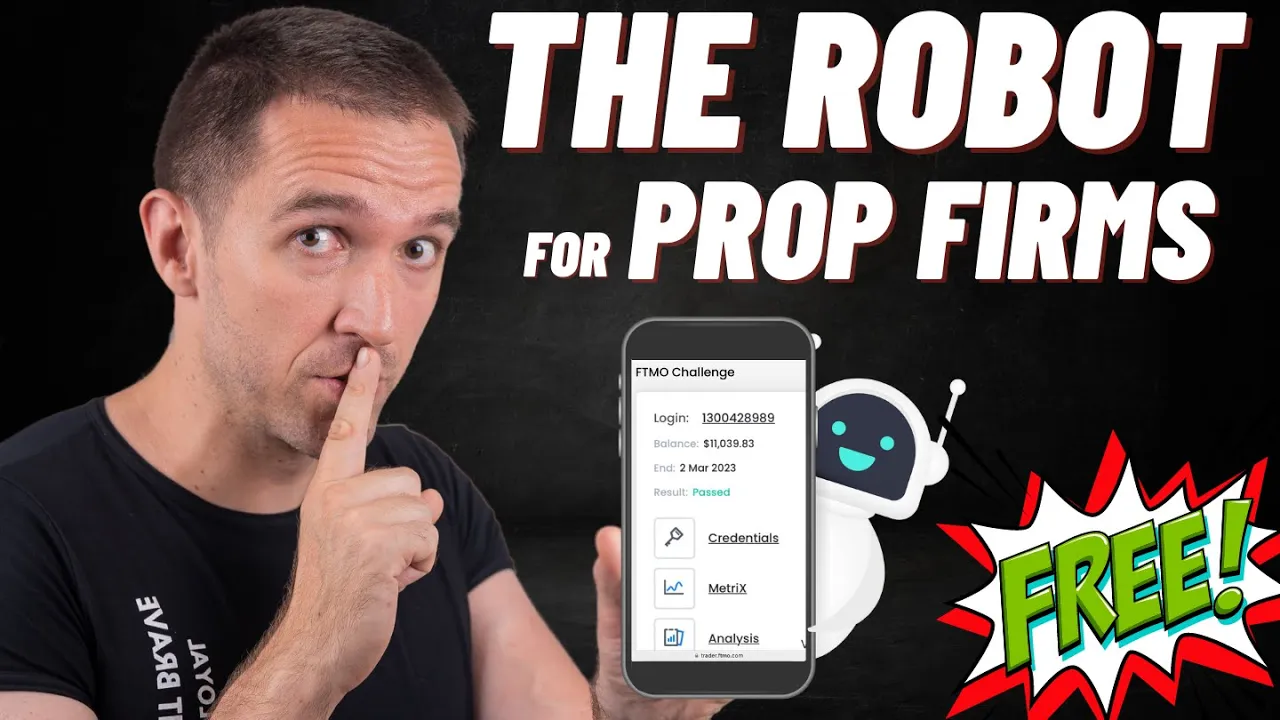
My preferred prop firm EA for this purpose is a EURUSD envelope-based robot running on MetaTrader, with a 30-pip stop loss, a 75-pip take profit, and a maximum risk of 1% per trade. I used it to pass an FTMO-style challenge, had a free retake confirmed by FTMO itself, and then passed on the retake with just two trades. Final balance: $11,039 on a $10,000 account, which is over 10% — enough to clear the profit target.
That is the short version. Everything below explains the setup, the risk logic, the mistakes I made, and what to look for if you are choosing an EA to pass your own challenge.
Are Forex EAs Allowed in Prop Firm Challenges?
This is probably the first thing worth clarifying, because plenty of traders search for the best EA to pass a prop firm challenge and never stop to check whether the firm actually allows it.
Most major prop firms do permit automated trading, including FTMO and The Trading Pit. But there are restrictions. Specifically, watch out for:
- Grid and martingale strategies: Most firms flag or ban these outright because of the exposure they create to drawdown limits
- Latency arbitrage and tick scalping: Almost universally banned
- Copy trading and shared third-party strategies: Some firms will not fund accounts running known commercial EAs
- News trading windows: FTMO, for example, restricts trading 2 minutes before and 2 minutes after major news releases on funded accounts (not necessarily during the challenge phase itself)
The rule set can differ between the challenge phase and a funded account. What is permitted during evaluation rules may not carry over once you are a funded trader. Always read both sets of terms.
What Makes an EA Suitable for Prop Firms?
Most traders think about this the wrong way. They ask, “which EA makes the most money?” That is the wrong question for a prop firm context. The better question is: which EA is least likely to violate the rules?
Prop firm evaluation rules are built around protection, not performance. Daily loss limits, maximum drawdown, profit targets that cannot be rushed, minimum trading days. An EA that swings for huge gains with aggressive sizing is almost guaranteed to blow a daily loss limit before it ever hits the profit target.
A good prop firm EA should:
- Use a real, fixed stop loss on every trade
- Have no martingale or grid recovery logic
- Keep risk per trade between 0.5% and 1% of account balance
- Work cleanly on MT4 or MT5
- Trade liquid pairs like EURUSD where spreads are tighter
- Have a mechanism to pause or be removed during high-impact news
- Produce consistent, explainable trade logic that can be reviewed if the firm flags your account
That last point matters more than people realize. If you pass a challenge and the firm audits your trades, you want a strategy that is easy to explain. An envelope-based system with clear entry and exit rules is far easier to justify than something with 14 overlapping indicators and no obvious logic.
My EURUSD Prop Firm EA: Setup and Logic
The EA I use on prop firm challenges trades EURUSD on the H1 chart. The core logic is straightforward:
- Long trade: Opens when the current bar opens below the Envelopes indicator
- Short trade: Opens when the current bar opens above the Envelopes indicator
- Envelopes settings: Period 25, Deviation 0.35
- Stop loss: 30 pips
- Take profit: 75 pips
- Risk per trade: 1% of account balance
The risk-to-reward ratio is 2.5:1. That is important for prop firm math. If you lose one trade (1%), the next winner at 2.5% puts you ahead. There is no need for a win rate above 50% to be profitable over time.
The simplicity is deliberate. There are no trailing stops, no partial closes, no complex filters. One signal, one entry, fixed stop loss, fixed take profit. That kind of transparency holds up under scrutiny.
EA Settings at a Glance
| Feature | Why It Matters for Prop Firms | This EA Setup |
| Market | Spread and liquidity affect results | EURUSD |
| Strategy type | Must be explainable and rule-based | Envelope-based entries |
| Stop loss | Required for drawdown control | 30 pips |
| Take profit | Defines reward-to-risk ratio | 75 pips |
| Risk per trade | Protects daily loss limits | 1% maximum |
| News filter | Avoids rule violations during volatility | Manual pause before major releases |
| Platform | Must work with common prop firm setups | MT4 and MT5 |
| Challenge use case | Must fit funding evaluation rules | FTMO and The Trading Pit tested |
The Scaling Method I Used
This is where things get a bit more interesting, and where I think the experience is genuinely different from generic EA guides.
I do not trade flat lot sizes throughout the challenge. Instead, I use a compounding method:
- First trade: 0.3 lots on a $10,000 account, risking 1%, targeting 2.5%
- If take profit is hit: The next trade reinvests that 2.5% profit plus the original 1% risk, meaning the second trade risks 3.5% of the starting balance
- At 2.5:1 risk-to-reward: The second trade targets roughly 8.75% if the take profit is reached
So in theory, two consecutive winning trades produce just over 10%, which clears the FTMO profit target. That is exactly what happened on the free retake. Two trades back to back, first long, then short, both hitting take profit, challenge passed with a $11,039 balance.
Obviously, this is not a guarantee. The original challenge attempt involved several losing trades before I got the right sequence. But the point is: the math works, and it works without ever exceeding 1% risk on any single trade.
Real Challenge Results: What Actually Happened

Let me be specific here, because vague “I passed the challenge” claims do not help anyone.
First challenge attempt:
| Detail | Value |
| Prop firm | FTMO-style |
| Account size | $10,000 |
| Phase | Challenge (Phase 1) |
| Starting balance | $10,000 |
| Outcome | Did not pass (profit target not reached) |
| Reason | Several stop losses hit, including one after scaling up lot size |
| Maximum drawdown | Under 5% |
| Qualifying for free retake | Yes, all other trading objectives met, account in profit |
FTMO confirmed the free retake by email. The key condition: you need to have passed the first three trading objectives and be in profit, even by a single cent. That was the case here.

Free retake:
| Detail | Value |
| Account size | $10,000 |
| Final balance | $11,039 |
| Profit | Over 10% |
| Number of key trades | 2 |
| Trade 1 | Long, take profit reached |
| Trade 2 | Short, take profit reached |
| Additional trades | Several 0.01 lot trades to meet minimum trading days |
| Outcome | Passed, moved to verification |
After the two main trades hit take profit, I opened small 0.01 lot positions across consecutive days just to satisfy the minimum trading days requirement. That is a perfectly valid approach, and FTMO allows it.

Prop Firm Rule Compatibility
| Prop Firm Rule | Recommended EA Setting |
| Daily drawdown limit | Risk 0.5% to 1% per trade |
| Maximum drawdown limit | Stop trading after 2 to 3 consecutive losses |
| News trading restrictions | Remove EA from chart before high-impact releases |
| Minimum trading days | Use small manual trades if targets are hit early |
| Profit target | Avoid oversized lots just to accelerate passing |
| Consistency rules | Keep lot sizing stable across similar setups |
| EA and automation rules | Confirm the firm permits automated trading before starting |
When to Pause the EA
This is genuinely important. The EA itself has no built-in news filter, which means you need to manage it manually. That might sound inconvenient, but I think it is actually the right call. Automated filters that detect news events are sometimes unreliable, and a manual approach gives you full control.
News events I pause before:
- Non-Farm Payrolls (NFP): Probably the most volatile release for EURUSD. On a Friday when NFP dropped during my original challenge, the price on the M1 chart spiked enough to take out a 30-pip stop loss within seconds before continuing in the original direction.
- FOMC Meeting Minutes: A major driver for USD pairs. I personally pause the EA at least 2 hours before FOMC releases.
- Federal Funds Rate and Statement
- Advanced GDP
- CPI (Consumer Price Index)
- Manufacturing PMI (relevant for EUR and USD both)
On FTMO funded accounts specifically, automated trading is restricted in the 2-minute window around major news events. During the challenge phase, the restriction is less strict, but volatility alone is enough reason to pause.
The practical rule: if the news event is high-impact on Forex Factory or Investing.com, take the EA off the chart and enjoy your Friday.
FTMO vs The Trading Pit: Key Differences
Both firms accept this EA setup and both run on MT4 and MT5. But there are some meaningful differences worth knowing.
FTMO:
- 10% profit target (Phase 1), 5% target (Phase 2)
- Daily loss limit: 5%, maximum drawdown: 10%
- Minimum 10 trading days required across both phases
- Free retake available if objectives are met and account is in profit
- Funded accounts restrict trading during major news windows (2 minutes before and after)
The Trading Pit:
- Phase 1 target: 6% (around €3,000 on a €50,000 account)
- Phase 2 target: 4%
- Minimum 7 trading days required
- Leverage up to 1:30
- Funding up to €5 million with up to 80% profit split
- 10K challenge priced at approximately €99, which is around 40% cheaper than FTMO’s equivalent entry point
I purchased The Trading Pit 50K challenge at €400 and found the 7-day minimum trading day requirement notably more manageable than FTMO’s requirements. If you hit your targets quickly, you are not forced to keep placing filler trades for as long.
Common Mistakes When Using EAs for Prop Firms
A few things I have seen go wrong, either in my own attempts or from watching other traders:
- Increasing lot size after a loss. This is effectively martingale behavior, and it is how people blow daily loss limits. If the EA loses, the next trade should use the same or smaller lot, not a larger one.
- Leaving the EA running during NFP or FOMC. Even if the challenge rules technically allow it, the volatility is a risk to your drawdown limits that is just not worth taking.
- Not checking whether the firm allows third-party robots. Some firms will void a funded account if they determine you are using a widely distributed commercial EA. Verify this before you start.
- Scaling too aggressively. The compounding method I described works, but only if you have consecutive winners. If you compound after a loss, you are digging a deeper hole.
- Ignoring the minimum trading days requirement. It is easy to focus on the profit target and forget that you need enough calendar trading days. Small 0.01 lot trades on low-volatility days can satisfy this requirement without exposing meaningful capital.
Who This EA Is Best For
This approach works well for:
- Traders using FTMO, The Trading Pit, or similar two-phase evaluation challenges
- Traders who want fixed-risk automation without grid or martingale exposure
- Traders who prefer EURUSD and understand its behavior around USD news
- Traders who can monitor an economic calendar and pause the EA manually
- Traders who have tested the EA on a demo account first and understand its losing streaks
It is probably not the right fit for:
- Traders expecting a guaranteed path to funding
- Traders who plan to run the EA 24/7 without oversight
- Traders using firms that ban third-party or shared EAs
- Traders who do not have a clear understanding of drawdown limits and what triggers them
More Prop Firm EAs Worth Exploring
If you want to compare multiple EA options designed specifically for prop firm challenges, including tested configurations for different firms and account sizes, take a look at the Prop Firm App EAs page. It covers a range of robots that have been evaluated against common challenge rules, which saves a significant amount of time if you are still deciding which direction to go.
Frequently Asked Questions
Can I use an EA for prop firm challenges?
Most major prop firms, including FTMO and The Trading Pit, allow automated trading during both the challenge and funded phases. However, rules vary significantly by firm and account type. Always check whether your specific firm permits automated trading, third-party robots, news trading, and lot scaling before running any EA. What is allowed during evaluation rules may differ from funded account terms.
What is the safest EA setup for a prop firm challenge?
The safest setup uses a fixed stop loss on every trade, a defined take profit, conservative position sizing of 0.5% to 1% per trade, and no martingale or grid recovery. Running on EURUSD via MT4 or MT5, with the EA manually paused before high-impact news events, gives the best balance between staying within daily drawdown limits and generating consistent forward progress toward the profit target.
Is martingale dangerous for prop firm accounts?
Yes. Martingale strategies increase position size after losing trades, which means a short losing streak can easily trigger the daily loss limit or maximum drawdown limit set by the firm. Most serious prop firms either ban martingale explicitly or will void a funded account if they identify it during an audit. Fixed risk per trade is a much more reliable approach to staying compliant.
What risk per trade should I use with a prop firm EA?
A conservative range is 0.5% to 1% per trade. On a $10,000 account with a 5% daily loss limit, risking 1% per trade gives you up to five losing trades in a single day before hitting the limit. In practice, you should stop trading well before that. Keeping risk at 1% also allows for the compounding method, where reinvesting a winning trade’s profit into the next position can produce the 10% profit target in as few as two consecutive winning trades.
Should I run an EA during major news events?
For prop firm challenges, pausing automated trading before high-impact news is strongly advisable. Events like Non-Farm Payrolls, the FOMC rate decision, and CPI can produce spreads and slippage large enough to trigger a 30-pip stop loss instantly, even if the underlying direction is correct. On FTMO funded accounts, automated trading is also restricted in the 2-minute window around news events. Manually removing the EA 2 hours before major releases and restoring it afterward is the safest approach.
What is the difference between challenge rules and funded account rules?
Challenge evaluation rules are typically more permissive than funded account terms. News trading, for example, is often allowed during the challenge phase but restricted once you become a funded trader. Some firms also apply stricter consistency rules, daily loss calculations, or EA restrictions after funding. Always read both sets of terms before you start. Passing a challenge does not automatically mean your trading style is approved for the funded account.
Can this EA pass any prop firm, or just FTMO?
The envelope-based EA described in this article has been used on FTMO-style challenges and is compatible with The Trading Pit. Because it runs on MT4 and MT5, it is technically compatible with any prop firm that supports those platforms. That said, each firm has its own profit target, drawdown limits, minimum trading days, and rule set. Settings may need to be adjusted depending on the account size and specific challenge parameters. Always test on a demo account with the same balance and conditions as your target challenge first.
This article is for educational purposes only. Past challenge results do not guarantee future outcomes. Trading foreign exchange carries significant risk and may not be suitable for all traders. Always assess your own risk tolerance before using any automated trading system.
Further Reading
- What Is Prop Firm Trading
- What Is the Consistency Rule in Prop Firms
- How To Pass Prop Firm Challenges
- Darwinex Zero vs Prop Firms
- Prop Firm vs Live Accounts
- Prop Firm vs Personal Capital
- Best EA For Prop Firm Challenges
- Prop Firm Robots App Complete Guide
- Best Prop Firms
- How The Top 10 Robots App Works
- How To Manage Multiple Prop Firm Accounts


Comments
No comments yet. Be the first to comment!
Leave a Comment
Your email address will not be published. Required fields are marked with *