

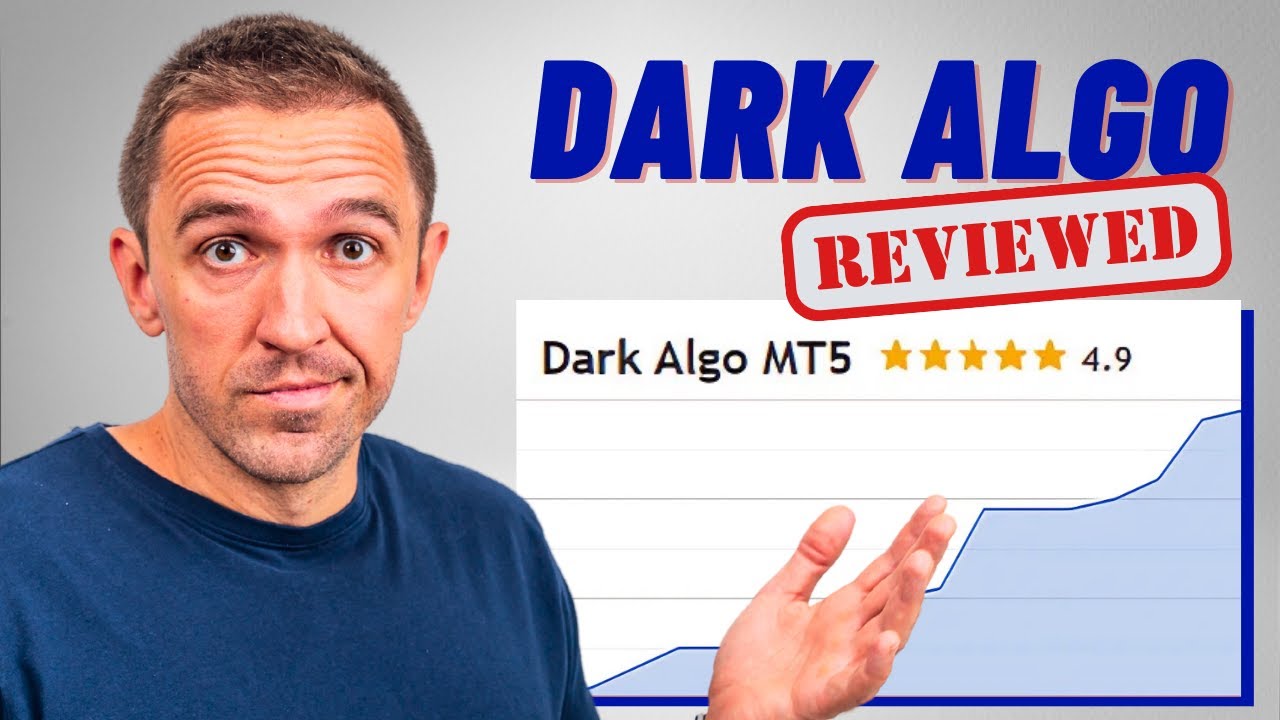
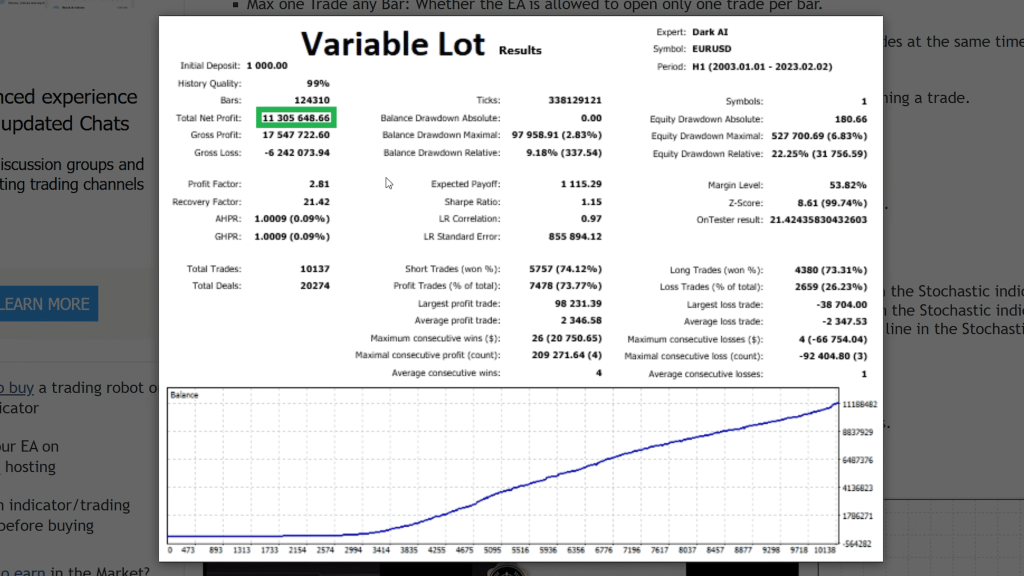
The Dark Algo EA vendor shows a backtest that turned $1,000 into over $11.3 million. That’s the kind of number that makes you skeptical immediately, either it’s completely curve-fitted nonsense, or there’s something genuinely interesting happening that deserves investigation.
I don’t review expert advisors I haven’t personally tested with real money. So I’ve been running Dark Algo on two accounts for the past few weeks: a $100,000 Darwinex Zero account and a $2,000 live account. Both are publicly tracked, both show real trades with real spreads and real slippage.
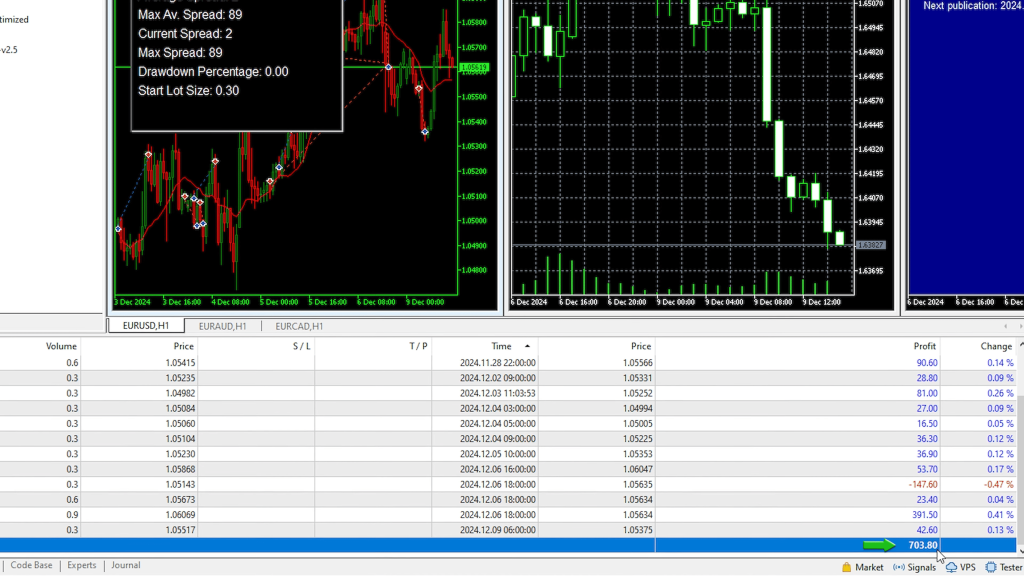
After two weeks of live trading, the Darwinex account is up $703 in gross profit ($675 after costs). The live account gained $21, which represents 1% return. Not millions, obviously, but consistent enough to warrant serious analysis.
Let me walk through exactly how Dark Algo operates, show you the actual trade sequences I’ve observed, explain the recovery mechanism that creates both opportunity and risk, and reveal whether this EA justifies its $399 price tag.
MQL5 Marketplace Presence and Popularity
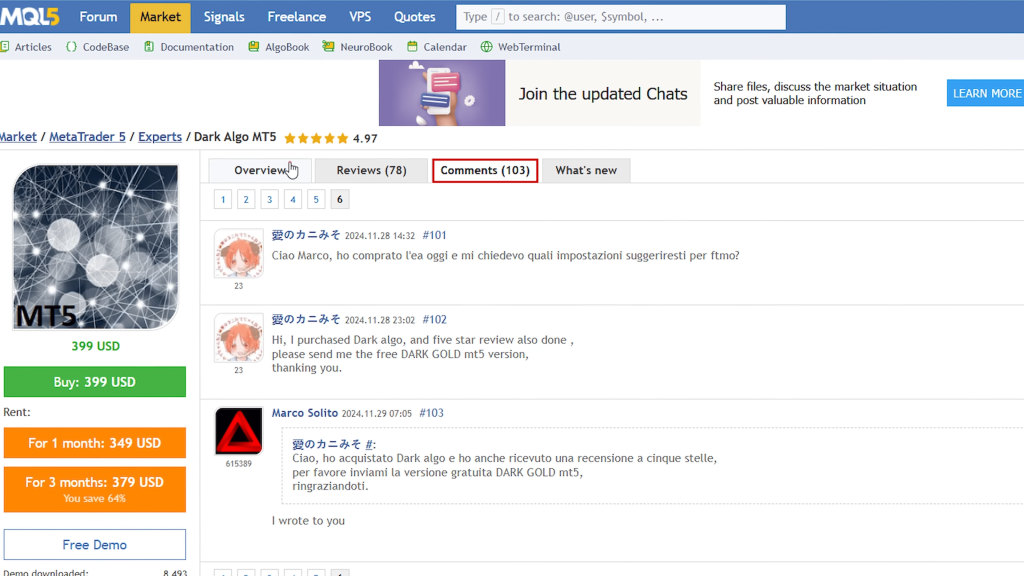
Dark Algo has established solid credibility on the MQL5 marketplace with 78 reviews at the time I’m writing this and over 103 comments from users. That level of engagement suggests genuine interest rather than a flash-in-the-pan system that disappears after initial sales.
The vendor’s backtest is prominently displayed: starting balance of $1,000 growing to $11,347,000. Yes, you read that correctly, over eleven million dollars from one thousand. My immediate reaction was deep skepticism. Backtests like that usually indicate either unrealistic settings, cherry-picked time periods, or optimization so aggressive the strategy will fail immediately in live markets.
But the marketplace reviews are predominantly positive, and the comment section shows active discussion rather than complaints about blown accounts. That combination warranted further investigation despite my doubts about the backtest claims.
Core System Specifications
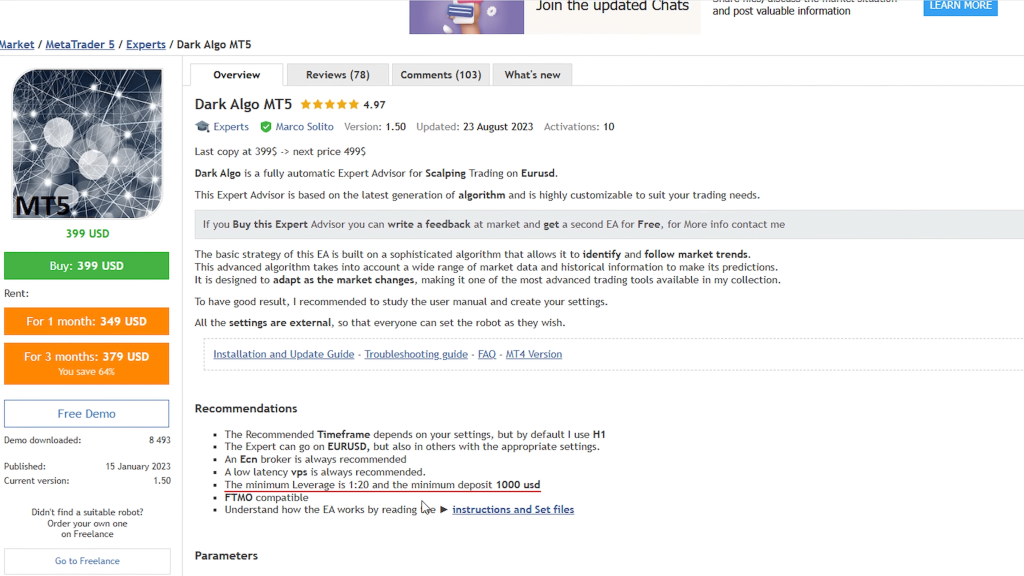
Dark Algo is described as a fully automatic scalping system designed specifically for EUR/USD. Here are the key specifications from the vendor:
Timeframe: H1 (hourly charts)
Minimum deposit: $1,000
Recommended leverage: Minimum 1:20
Broker type: ECN brokers recommended
VPS requirement: Yes, for 24/7 operation
Prop firm compatibility: Claims FTMO and prop firm compatibility
The system uses several technical indicators in its decision-making:
- Stochastic oscillator
- Average True Range (ATR)
- Additional proprietary indicators (details not publicly disclosed)
Set files and detailed instructions come included with the purchase, and the vendor provides clear descriptions of available settings. At $399, it’s positioned in the mid-to-upper price range for MQL5 expert advisors.
Darwinex Zero Account: Two Weeks of Performance
I started testing Dark Algo on my Darwinex Zero account on November 27th with $100,000 equity. After approximately two weeks, the last trade closed on December 9th with an accumulated profit of $703.80 gross, or $675.80 after costs.
Darwinex Zero operates differently from standard live accounts. You pay a €38 monthly subscription for access to $100,000 virtual capital. If you trade profitably and pass their calibration phase, you can receive allocated capital from Darwinex itself, then potentially attract investor capital.
The beauty of this setup for testing aggressive or recovery-based systems is simple: you’re not risking your own money. If Dark Algo’s grid mechanism goes wrong and drawdown escalates, you lose the €38 monthly fee, not your life savings.
Position Sizing and Risk Configuration
On the $100,000 account, Dark Algo started trading with 0.3 lots. The risk factor setting is configured at 3, which translates to 0.01 base lots per $1,000 in the account. That’s conservative for the account size.
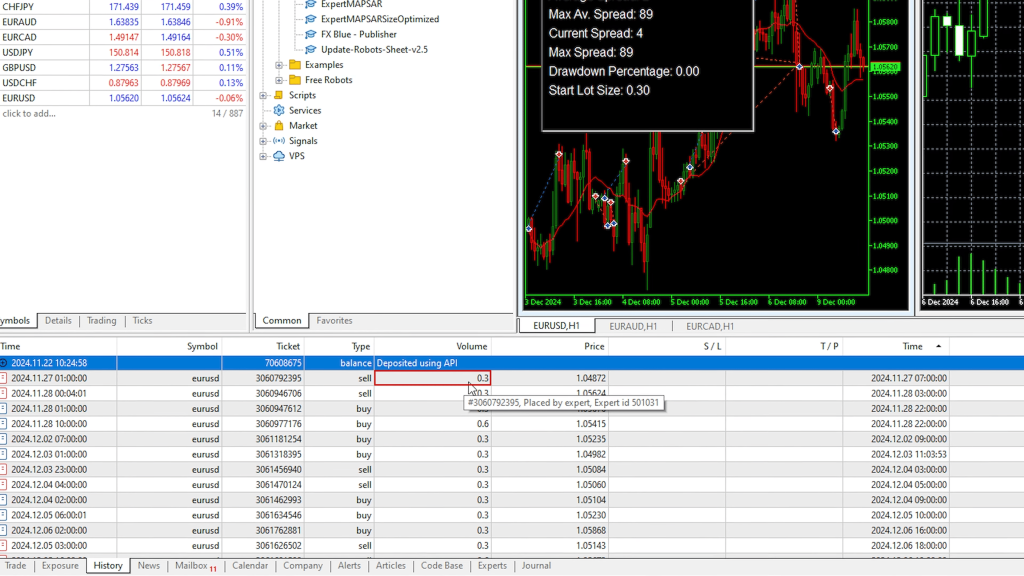
But here’s where it gets interesting: the lot sizes don’t stay fixed. I’ve observed trades where position sizing doubled from 0.3 to 0.6 lots, and sequences where three positions accumulated at 0.3, 0.6, and 0.9 lots, respectively.
This is a grid/recovery system. When the initial trade moves against you, Dark Algo opens additional positions in the same direction with increasing lot sizes. The multiplier setting controls this scaling.
How Dark Algo Actually Trades: Observed Patterns
Let me walk through specific trade sequences I’ve documented to show exactly how this system operates.
Example 1: Dual Long Position Recovery
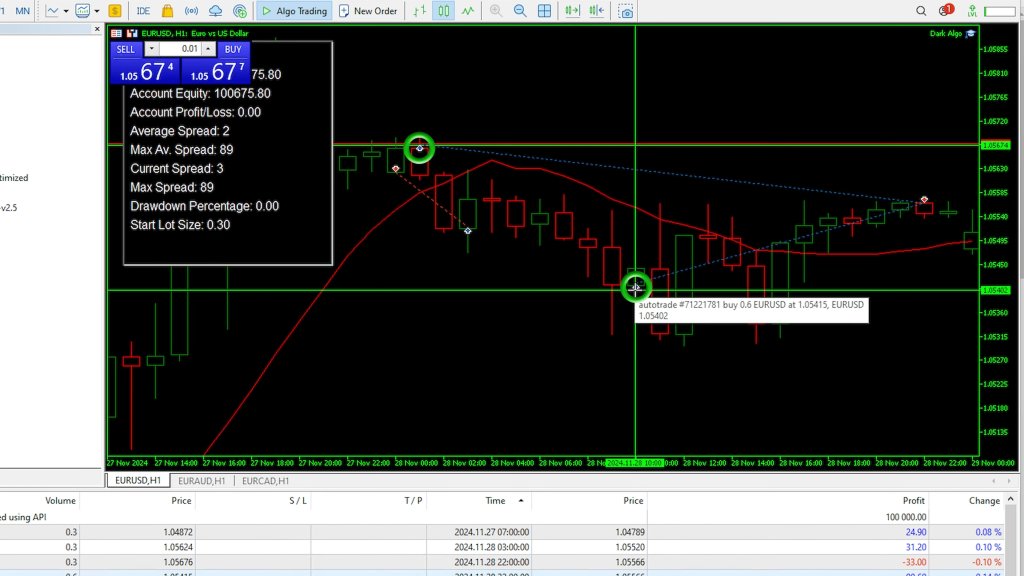
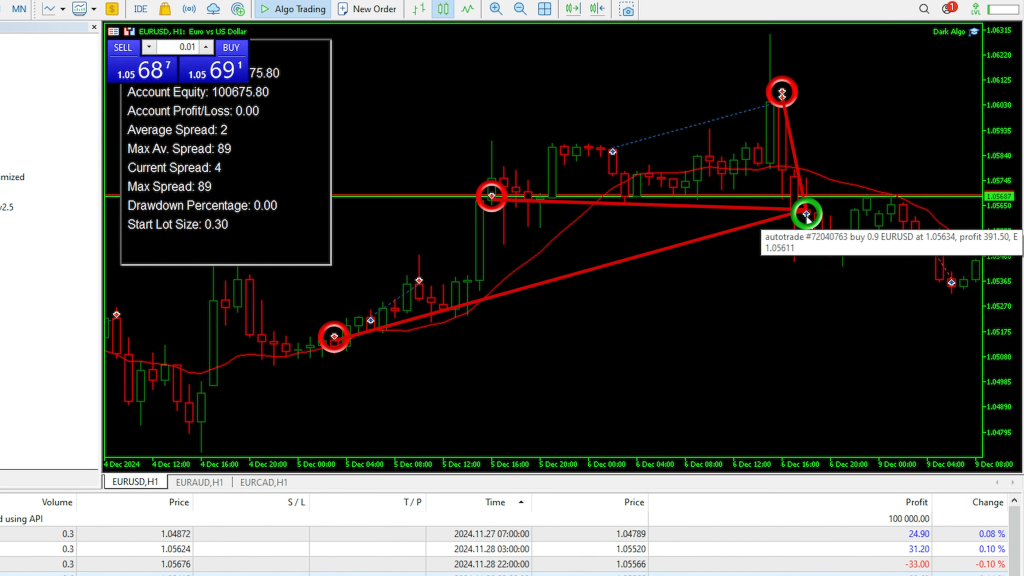
On November 28th at 1:00 AM, Dark Algo opened a long EUR/USD position at 0.3 lots. Nine hours later, at 10:00 AM, it opened a second long position at 0.6 lots (doubled).
Both positions closed simultaneously at 10:00 PM that evening for combined profit.
Looking at the price chart, I can see what happened. The first long at 1 AM anticipated an upward movement. Instead, the price initially moved down or sideways. At 10 AM, with the first position underwater, the EA opened the second long at 0.6 lots, twice the original size.
By 10 PM, the price had moved up sufficiently that both positions hit their profit target and closed together.
Example 2: Simultaneous Long and Short Positions
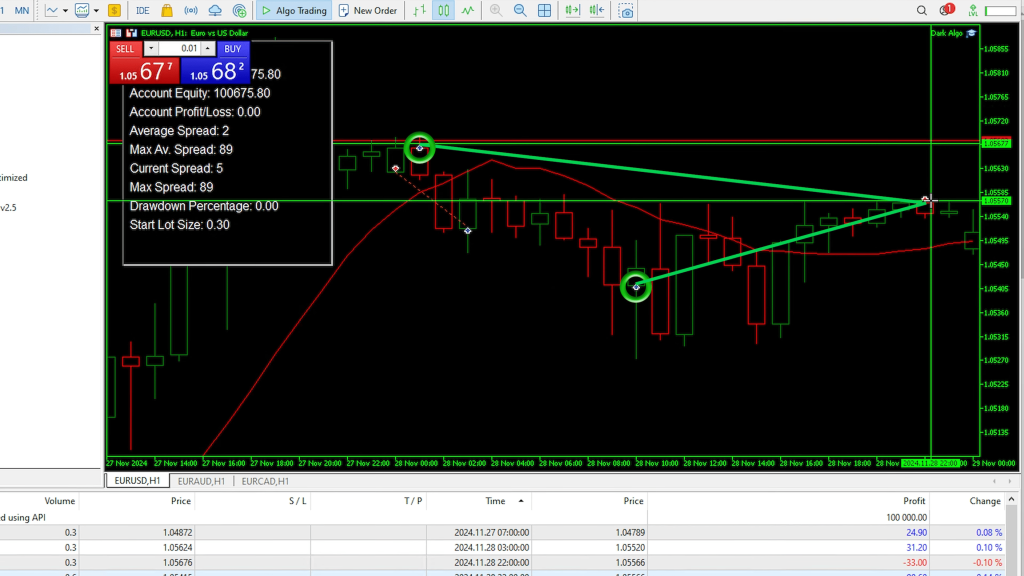
Dark Algo can hold long and short positions on EUR/USD at the same time. I’ve observed sequences where a short position was already open, then a long position triggered. The short closed profitably at one price level while the long remained open, later closing at a different price point.
This capability to trade both directions simultaneously adds flexibility but also increases exposure. You can have capital tied up in opposing positions, which feels counterintuitive but serves the EA’s recovery logic.
Example 3: Triple Position Accumulation
The most aggressive sequence I’ve witnessed involved three short positions:
- Position 1: 0.3 lots
- Position 2: 0.6 lots (opened when position 1 moved against)
- Position 3: 0.9 lots (opened when positions 1 and 2 both underwater)
All three closed simultaneously when the price finally reversed to hit the combined profit target.
On a $100,000 account, this level of position accumulation is manageable. The combined 1.8 lots (0.3 + 0.6 + 0.9) represents reasonable exposure. But scale this down to a $1,000 account, and the same relative position sizing becomes much more aggressive.
Configuration Settings Explained
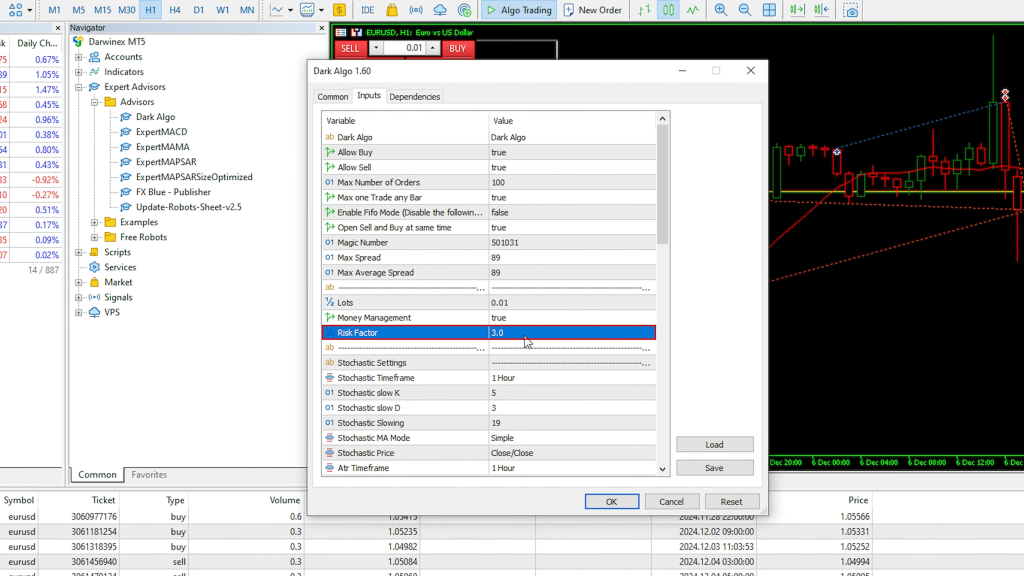
Let me show you the actual settings I’m using and what they control.
Risk Factor: 3
This determines base lot sizing. Setting of 3 equals 0.01 lots per $1,000 equity. On my $100,000 account, this translates to initial positions around 0.3 lots.
Multiplier: 1
Controls how much each subsequent grid position increases. A multiplier of 1 doesn’t actually multiply; it appears to double based on observed behavior (0.3 → 0.6 → 0.9 pattern).
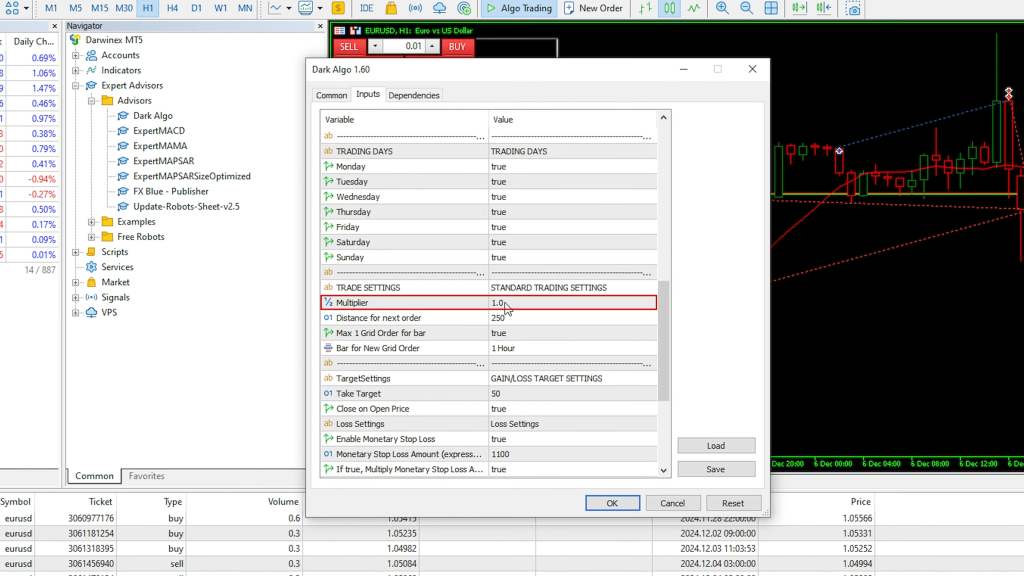
Distance for Next Order: 250 points
This determines how far the price must move against the current position before the EA opens an additional recovery trade.
Grid Orders Per Bar: 1
Limits the EA to opening only one grid position per hourly candle, preventing excessive position accumulation in rapidly moving markets.
Minimum Time Between Grid Orders: 1 hour
An additional safeguard is ensuring at least 60 minutes between recovery positions.
Take Profit: 50 pips
The profit target for the combined position basket.
Close on Open Price: Enabled
Positions close when the combined unrealized P&L hits the profit target, regardless of where individual positions stand.
These are the vendor’s recommended settings, which I’m using without modification on the Darwinex account. My live account uses different settings that I’ll explain shortly.
Live Account Results: Conservative Approach
My live account started on November 27th with a $2,000 deposit. This is real money from my pocket, not virtual capital, so I configured Dark Algo more conservatively.
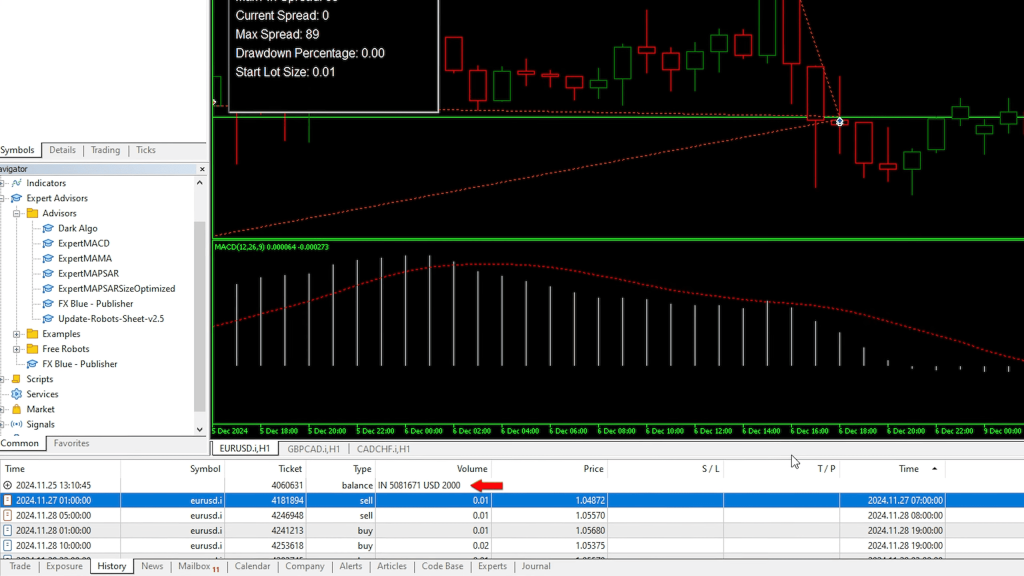
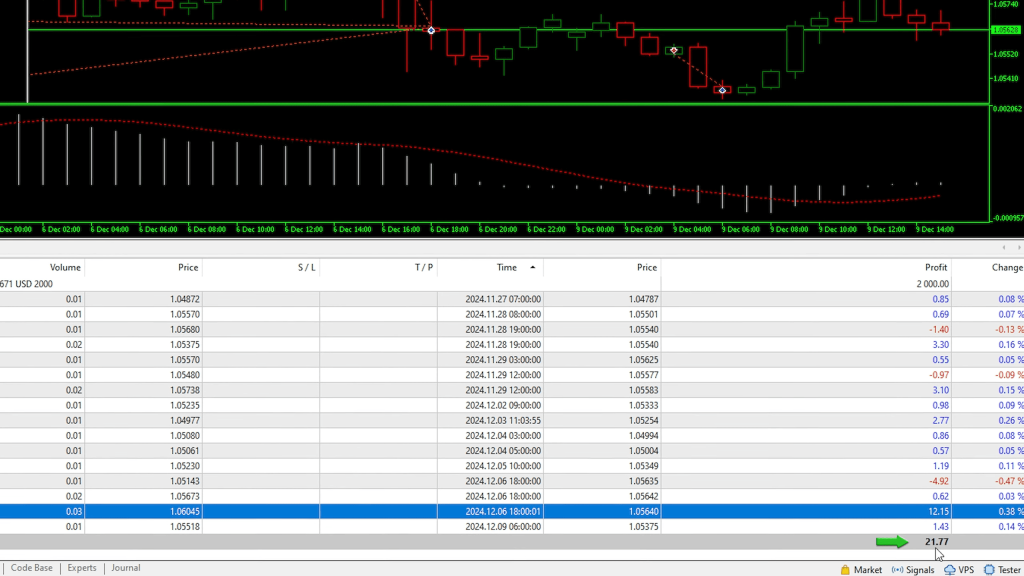
After two weeks, the account shows $21 profit, 1% return. Not spectacular, but the equity curve is smooth, and the drawdown has been minimal.
Position Sizing on Smaller Account
On the $2,000 live account, initial positions are 0.01 lots. When the grid recovery mechanism triggers, positions scale to 0.02 lots, then 0.03 lots if a third level activates.
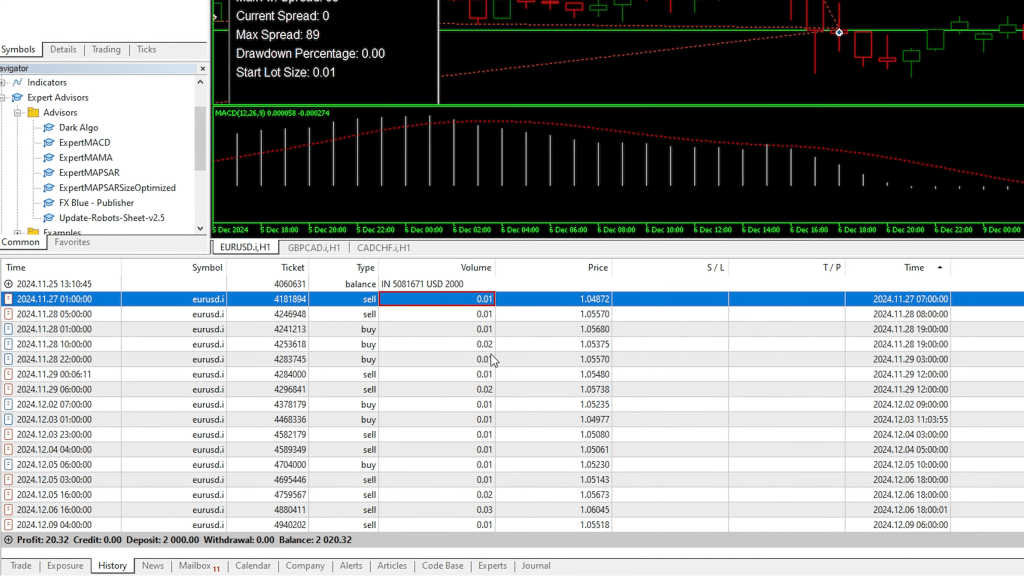
I’ve observed sequences with two recovery positions (0.01 + 0.02 = 0.03 total exposure) and one instance with three positions (0.01 + 0.02 + 0.03 = 0.06 total exposure).
Even at maximum observed exposure of 0.06 lots on a $2,000 account, the risk remains manageable. This is 3% of account equity in combined position size, conservative by most standards.
Performance Comparison: Darwinex vs Live
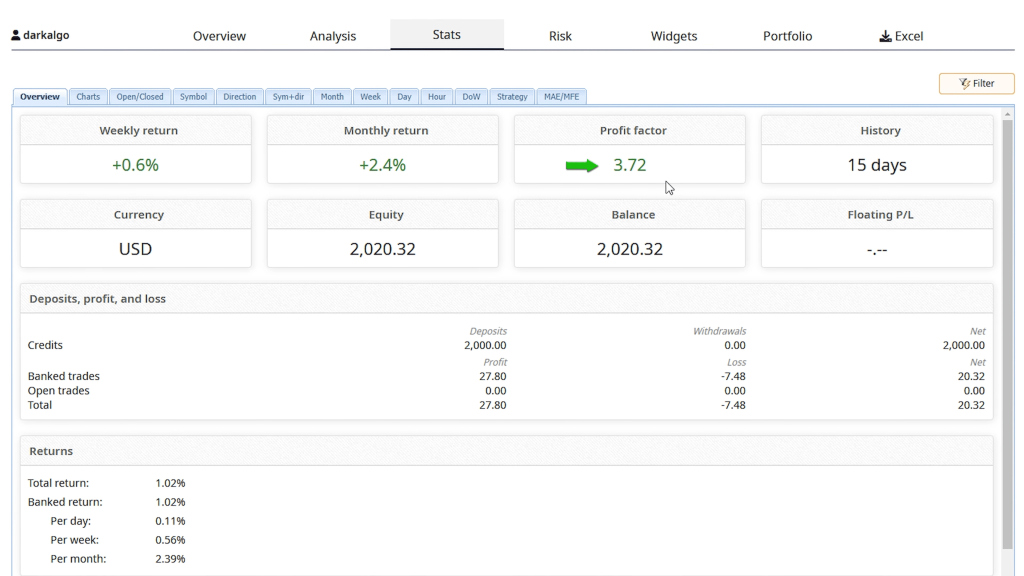
The FXBlue tracking for my live account shows:
- Monthly return: 2.4% (projected based on two weeks)
- Profit factor: 3.72
- Equity curve: Steady upward with minimal deviation
The Darwinex account shows similar balance line progression but slightly different statistics:
- Monthly return: Slightly lower than live
- Profit factor: Slightly higher than live
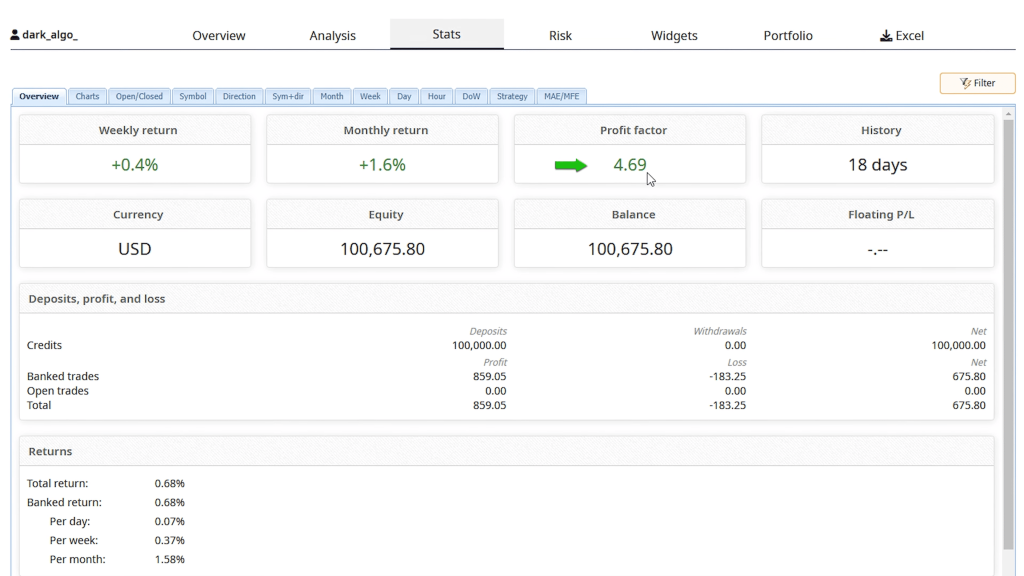
These differences stem from broker execution quality, spread variations, and commission structures. Darwinex Zero provides excellent conditions, but different brokers will always produce slightly different results even with identical EA settings.
Both accounts remain publicly tracked via FXBlue, so anyone can verify these results in real-time rather than relying solely on my word.
The Recovery Mechanism: Opportunity and Risk
Dark Algo’s core strength and primary risk both stem from the same mechanism, grid-based position averaging with increasing lot sizes.
How it works:
- EA identifies the entry signal and opens the initial position
- If price moves favorably, position closes at take profit (50 pips)
- If the price moves unfavorably past the threshold (250 points), EA opens a second position with a larger lot size
- Process repeats up to the configured maximum grid levels
- When combined, unrealized P&L reachesthe profit target, all positions close simultaneously
Why this works (when it works):
The doubling of lot sizes means you need fewer price reversals to recover. If your first position is 0.3 lots and your second is 0.6 lots, the larger position profits faster when the price finally moves in your favor. This accelerates recovery compared to adding equal-sized positions.
The 50-pip profit target is realistic for EUR/USD on the H1 timeframe. You’re not asking for 200-pip moves that might take days or weeks.
Why does this carry risk?
Grid systems depend on mean reversion. They assume the price will eventually reverse after moving against you. During strong trending markets, especially unexpected breakouts from consolidation, the price can continue moving in one direction far longer than the grid can sustain.
If EUR/USD trends 500+ pips without meaningful retracement, and your grid spacing is 250 points, you could accumulate multiple positions all underwater simultaneously. Even with proper position sizing, the combined drawdown becomes uncomfortable.
The increasing lot sizes amplify this risk. Your third position at 0.9 lots (on the Darwinex account) is three times larger than your first. If all three are losing, you’re carrying 1.8 lots of negative exposure.
Indicator Usage and Entry Logic
Dark Algo uses the Stochastic oscillator and ATR (Average True Range) among its indicators, though the exact entry criteria aren’t publicly disclosed; that’s proprietary to the developer.
Based on observed trade timing and price action, I can make educated guesses:
Stochastic likely identifies overbought/oversold conditions for counter-trend entries or momentum confirmation for trend-following positions.
ATR probably determines grid spacing dynamically based on current volatility. The 250-point setting might adjust in high or low volatility environments.
Additional proprietary indicators remain unknown, but the EA clearly isn’t randomly entering positions. There’s logic triggering specific entry points during specific market conditions.
The H1 timeframe choice makes sense for this approach. Lower timeframes like M5 or M15 would generate too many signals and potentially excessive grid accumulation. Higher timeframes like H4 or D1 would reduce trade frequency to unacceptable levels for a system marketed as active scalping.
Why I’m Using Darwinex Zero for This Test
Let me explain the Darwinex Zero model more thoroughly because it’s ideal for testing recovery-based systems like Dark Algo.
The Structure:
- Monthly cost: €38 (approximately $40 USD)
- Initial allocation: $100,000 virtual equity
- Calibration phase: Trade profitably to prove consistency
- DarwinIA Silver: Receive allocated capital from Darwinex
- DarwinIA Gold: Attract investor capital to your trading strategy
Why this works for grid systems:
Recovery-based EAs carry inherent blowup risk. No matter how well-designed, there’s always a scenario where the grid depletes your capital before recovery occurs. With Darwinex Zero, that scenario costs you €38 monthly subscription, not your entire trading account.
If Dark Algo performs well, I progress through calibration and potentially receive real allocated capital to trade. If it fails catastrophically, I lose the subscription fee and move on to testing other systems.
For traders wanting to test Dark Algo (or any grid-based EA) without risking substantial personal capital, this model provides perfect testing grounds. You get real market conditions, real spreads, real execution, everything except risking your own money.
Discount Available:
Using the coupon code PETKO at Darwinex Zero checkout reduces the monthly cost. If you select the 3-year plan and achieve profitability, you receive permanent allocation even if subsequent months lose money, you keep the funded account.
I’ve included the coupon link in the description for anyone interested in this testing approach.
Price Considerations and Discount
Dark Algo retails for $399 on the MQL5 marketplace. That’s mid-to-upper range pricing for forex expert advisors, not cheap, but not outrageous for a system with genuine development effort.
However, the vendor launched a dedicated website at darkeas.com where they offer additional information about Dark Algo and other systems in their lineup.
I contacted the developer and secured a discount code for readers: PETKO10 reduces the price by 10% at checkout on darkeas.com. That brings the cost down to approximately $359, which is more palatable.
At $399, you need to decide if the system justifies the cost based on expected returns. At 2-3% monthly (what I’m seeing on my live account), you’d need roughly $13,000-$20,000 in trading capital to recoup the EA cost in the first year through profits.
At $359 with the discount, that threshold drops slightly. Still a meaningful investment that requires proper capital to generate returns that justify the purchase.
Account Size Requirements Reality Check
The vendor states a $1,000 minimum deposit. Based on my testing, I’d refine that recommendation:
$1,000 minimum: Technically possible but provides minimal margin for grid recovery. You’d need very conservative risk settings (lower than what I’m using) to avoid margin issues during extended drawdowns.
$2,000 recommended: This is what I’m using on my live account, and it feels appropriate for the conservative settings I’ve configured. Three-level grid accumulation at 0.01/0.02/0.03 lots doesn’t threaten the account.
$5,000+ optimal: If you want to use more aggressive risk settings similar to what I’m running on the Darwinex $100K account (scaled appropriately), you’d want at least $5,000 to handle potential drawdowns comfortably.
The $11 million backtest presumably used very aggressive risk settings on a much longer timeframe. Without seeing the exact parameters, I can’t replicate it, nor would I recommend attempting to do so with real money.
Prop Firm Compatibility Claims
Dark Algo markets itself as compatible with FTMO and other prop firms. I’m skeptical of this claim based on how most prop firms operate.
Typical prop firm rules:
- Maximum daily drawdown limits (often 5%)
- Maximum overall drawdown limits (often 10%)
- Prohibition or restriction on grid/martingale strategies
- Minimum trading days before payout requests
Dark Algo’s grid recovery mechanism can create temporary drawdowns exceeding 5% on a bad sequence. If you’re running this on a prop account with strict daily limits, one adverse day could violate rules and terminate the account.
Perhaps with extremely conservative settings and single-pair focus, you could operate within prop firm parameters. But the system’s design, accumulating positions with increasing lot sizes, inherently conflicts with the low-drawdown requirements most prop firms enforce.
My honest opinion: Dark Algo is better suited for personal live accounts or Darwinex Zero allocation than traditional prop firm challenges. The grid mechanism needs room to work, and the prop firm rules don’t provide that flexibility.
What I Like About Dark Algo
After two weeks of live observation, here are the genuine positives:
- Consistent incremental gains: Neither account has experienced catastrophic losses. Both show steady upward progression with manageable temporary drawdowns.
- Transparent operation: I can see exactly what the EA is doing, which positions opened when, at what lot sizes, and why they closed together. There’s no black-box mystery.
- Reasonable profit targets: The 50-pip take profit is achievable on the EUR/USD H1 timeframe without requiring perfect market conditions.
- Configurable risk: You can adjust settings to match your account size and risk tolerance rather than being locked into one aggressive configuration.
- Active developer: The vendor maintains the MQL5 marketplace presence, responds to comments, and launched a dedicated website with ongoing support.
What Concerns Me
No system is perfect. Here are the legitimate concerns:
- Grid recovery risk: Despite conservative settings, the fundamental mechanism remains grid-based position averaging. Strong trends can overwhelm this approach regardless of how carefully you configure it.
- Limited pair diversification: Dark Algo only trades EUR/USD. If you want portfolio diversification across multiple currencies, you need additional EAs.
- Backtest credibility gap: The $11 million backtest claim damages credibility even if the system performs decently in live trading. Extreme backtest results usually indicate overfitting.
- Proprietary entry logic: Without knowing the exact indicator parameters and entry criteria, you’re trusting the developer’s optimization. If market conditions shift away from what the EA expects, performance could degrade.
- Capital requirements unclear: The $1,000 minimum feels optimistic. Realistic capital requirements depend heavily on chosen risk settings, but the vendor doesn’t provide detailed guidance on this relationship.
Performance Tracking and Transparency
Both my Darwinex and live accounts are publicly tracked via FXBlue with links provided in the description. This isn’t selective reporting or cherry-picked good trades; it’s complete transparency showing every position Dark Algo opens.
Whenever you’re reading this review, you can click through and see the current performance. If the EA has blown up spectacularly, you’ll know. If it continues generating a steady 2-3% monthly, that’s also visible.
This level of transparency serves two purposes:
- Verification: You don’t have to trust my written claims. Check the live data yourself.
- Time savings: Rather than risking your own money to test Dark Algo, observe how it performs on my accounts first. If results remain positive after several months, that’s more convincing than two weeks of data.
I’ll continue running both accounts indefinitely (unless catastrophic failure occurs) to provide ongoing performance data for the community.
Where to Access Dark Algo and Additional Resources
Dark Algo EA is available through the MQL5 marketplace and also through Algo Trading Space, which provides additional resources and trading insights. Full disclosure: we may earn a small commission if you purchase through our links, though this doesn’t affect the price you pay or the honest assessment in this review.
Remember to use the coupon code PETKO10 at darkeas.com for 10% discount on your purchase.
For traders building portfolios across multiple expert advisors, the Algo Trading Space VIP club offers exclusive access to verified trading results from various systems, early insights into new EAs, and priority support. If you want ongoing performance data and community access beyond individual reviews, it’s worth exploring.
I recommend testing Dark Algo on demo accounts or Darwinex Zero before risking substantial personal capital, regardless of how promising the results appear.
Frequently Asked Questions
What’s the realistic monthly return expectation for Dark Algo EA based on actual trading rather than backtests?
Based on my two weeks of live trading across two accounts, realistic monthly returns appear to be 2-3% with conservative risk settings. My $2,000 live account shows 2.4% projected monthly return with a 3.72 profit factor, while the Darwinex $100K account shows a similar progression.
These results align with sustainable long-term performance rather than the aggressive backtest claims. Higher returns are theoretically possible with more aggressive risk settings, but this proportionally increases drawdown risk and grid accumulation exposure during adverse market conditions.
How does Dark Algo’s grid recovery system work, and what are the maximum position levels it can accumulate?
Dark Algo opens an initial position based on technical indicator signals. If price moves unfavorably past a threshold (250 points by default), it opens a second position with doubled lot sizing. This process continues with the multiplier setting determining scaling. I’ve observed up to three simultaneous positions (0.3, 0.6, 0.9 lots on my $100K account).
All positions close together when the combined unrealized profit reaches the 50-pip target. The grid spacing and maximum levels are configurable, but vendor recommendations provide reasonable defaults for most account sizes.
Can Dark Algo really be used on FTMO and other prop firm accounts safely?
I’m skeptical of Dark Algo’s prop firm compatibility claims. Most prop firms enforce strict daily drawdown limits (typically 5%) and maximum overall drawdown restrictions (usually 10%). Dark Algo’s grid recovery mechanism can easily create temporary drawdowns exceeding these thresholds during adverse sequences, especially with anything beyond minimal risk settings.
While theoretically possible with an extremely conservative configuration, the system’s design conflicts with low-drawdown requirements. Personal live accounts or Darwinex Zero allocation provide better environments for grid-based EAs than typical prop firm challenges.
What’s the absolute minimum account size to run Dark Algo without excessive risk of margin calls?
While the vendor states $1,000 minimum, my testing suggests this provides minimal safety margin for grid recovery. On my $2,000 live account with conservative settings (0.01/0.02/0.03 lot progression), three-level grid accumulation feels manageable but approaches meaningful exposure.
I’d recommend $2,000 as a practical minimum for conservative operation, $3,000-$5,000 for moderate risk settings, and $10,000+ if you want to match the relative aggressiveness of my Darwinex $100K configuration. Smaller accounts should use extremely low lot sizes and accept very slow growth to avoid margin issues.
How does performance differ between the Darwinex Zero account and your live money account?
Both accounts show similar equity curve patterns and profitability, but with slight statistical differences due to broker execution quality and cost structures. The Darwinex account has slightly different monthly return projections and profit factor than my live account, though both remain within reasonable variance.
Darwinex Zero provides excellent trading conditions with institutional-grade execution, while my live broker offers competitive but standard retail spreads. The key difference isn’t performance but risk. Darwinex uses virtual capital (€38 monthly cost), while the live account uses my actual money, making the psychological and financial risk completely different.
Does Dark Algo work on currency pairs other than EUR/USD, or can I run multiple instances on different pairs?
Dark Algo is specifically designed and optimized for EUR/USD on the H1 timeframe. The vendor hasn’t provided settings or recommendations for other currency pairs, and the indicator parameters appear tuned for EUR/USD volatility characteristics.
Running it on other pairs would require extensive backtesting to verify performance, as different currencies have unique behaviors. You could theoretically run multiple instances on different pairs if you found optimal settings for each, but this increases complexity and combined exposure. I’m only testing on EUR/USD as designed, and cannot verify effectiveness on alternative currencies without substantial additional testing.


Comments
No comments yet. Be the first to comment!
Leave a Comment
Your email address will not be published. Required fields are marked with *