

I’ve been running Dark Titan EA on a live demo account for several months now, and the results are worth discussing. This isn’t just another backtest showcase; I’m comparing seven years of historical data against real trading performance with over 330 executed trades. That’s enough data to say something meaningful about whether this EA actually works.
Dark Titan comes from the same developer behind several other popular Dark EAs, and it’s positioned as an affordable option at $99 for a single license or $149 if you need additional licenses. That’s a one-time payment, which stands out in a market where monthly subscriptions are becoming the norm.
Let me walk you through what I’ve found, including some decisions I made that differ from the developer’s recommendations.
What Dark Titan Trades and How It Operates
Dark Titan is designed to trade three currency pairs: AUD/CAD, AUD/NZD, and NZD/CAD. The developer provides settings for all three, and the backtests look solid across the board.
Here’s where I deviated from the plan: I’m only trading two of those pairs. The AUD/CAD and AUD/NZD backtests were exceptional, while the NZD/CAD results, though profitable, didn’t impress me as much. So I made the call to skip it for now. Perhaps I’ll add it later once I’ve got more confidence in the other two pairs on live accounts.
The EA operates on the M1 timeframe, which means it’s making decisions based on one-minute candles. That might sound overly aggressive, but the strategy actually produces a high volume of trades without being reckless. Most trades close quickly, within a day or two, though occasionally you’ll see positions held slightly longer.
Trading Style at a Glance
- Timeframe: M1 (one-minute charts)
- Primary pairs: AUD/CAD, AUD/NZD (NZD/CAD optional)
- Trade frequency: High volume, quick exits
- Strategy type: High win rate scalping approach
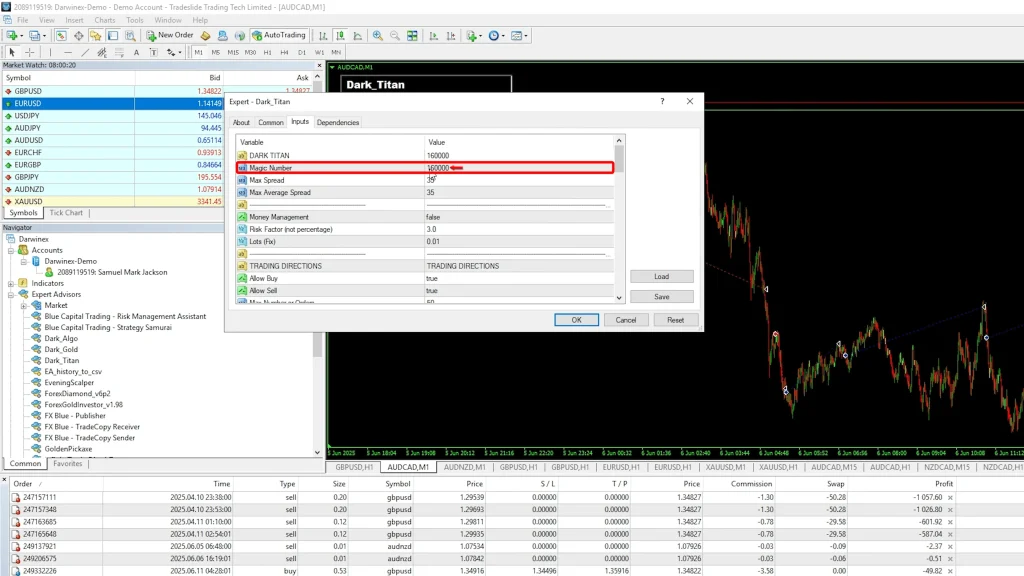
- Magic numbers: 160000 (AUD/CAD), 170000 (AUD/NZD)
I’m using magic numbers to track each pair separately in my FX Blue stats, which makes performance analysis much cleaner. If you’re running multiple EAs or testing different pairs, this organizational step saves headaches later.
Seven Years of Backtesting: What the Data Shows
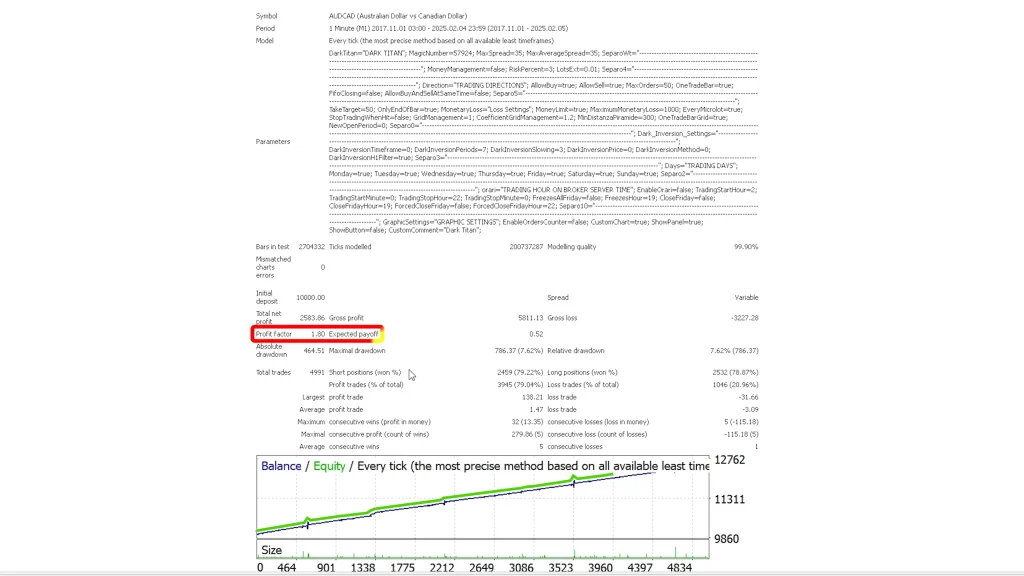
I ran complete backtests covering seven years of historical data for both pairs. The results align closely with what the developer shows on their website, which is always a good sign. When vendor backtests match independent testing, it suggests the settings aren’t cherry-picked for a specific time period.
The equity curves showed steady growth with manageable drawdowns. Nothing alarming jumped out. Both pairs demonstrated consistent profitability across different market conditions, including periods of market trend and high volatility.
What stood out was the win rate. Dark Titan consistently hit around 80% winning trades in backtests. That’s unusually high, and it immediately raised a question: would live trading maintain that percentage, or would slippage and real-world execution erode it?
Live Results: 183 and 150 Trades Respectively
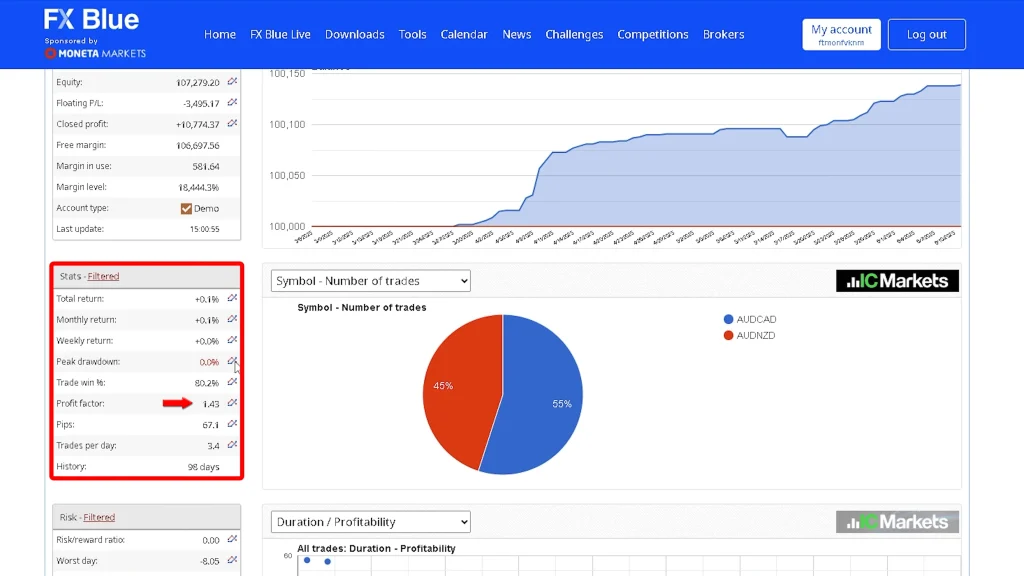
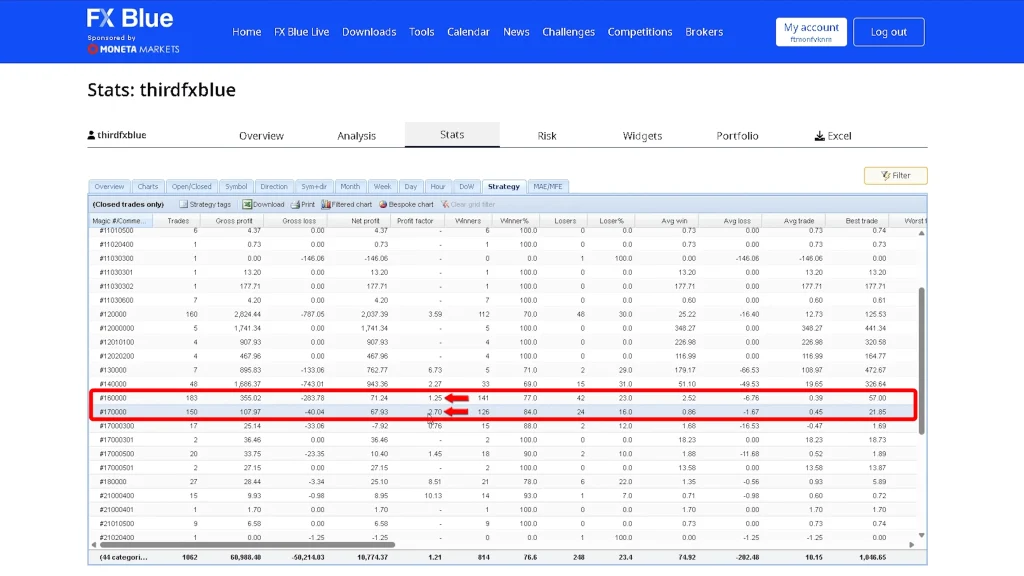
I’ve been tracking Dark Titan through FX Blue on a third-party EA demo account. The AUD/CAD pair has executed 183 trades so far. The AUD/NZD has completed 150 trades. Combined, that’s 333 trades, enough to start drawing conclusions.
First, let’s talk win rate. Both pairs are hovering right around 80%, matching the backtests almost exactly. The AUD/CAD is showing roughly 80%, and the AUD/NZD is similar. That consistency between historical testing and live execution is rare and encouraging.
Profit factor tells another part of the story. The combined profit factor sits at 1.43, with individual pairs showing 2.7 and 1.25, respectively. Those are solid numbers. A profit factor above 1.5 is generally considered good; above 2.0 is excellent. The variation between pairs is normal; different currency relationships behave differently.
Performance Metrics Comparison
| Metric | AUD/CAD | AUD/NZD | Combined |
| Total Trades | 183 | 150 | 333 |
| Win Rate | ~80% | ~80% | ~80% |
| Profit Factor | 2.7 | 1.25 | 1.43 |
| Equity Curve | Linear growth | Linear growth | Stable upward |
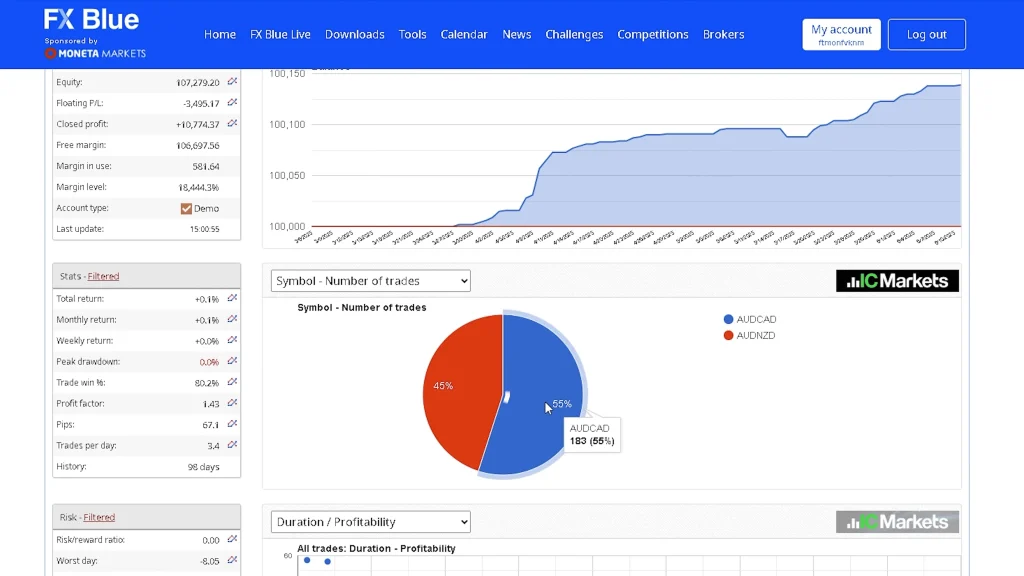
The equity curves on both pairs show relatively linear growth. The AUD/CAD had a stagnant period mid-way through testing, then resumed its upward trajectory. The AUD/NZD performed even better, almost a straight line upward with minimal flat periods.
Watching Dark Titan Trade in Real Time
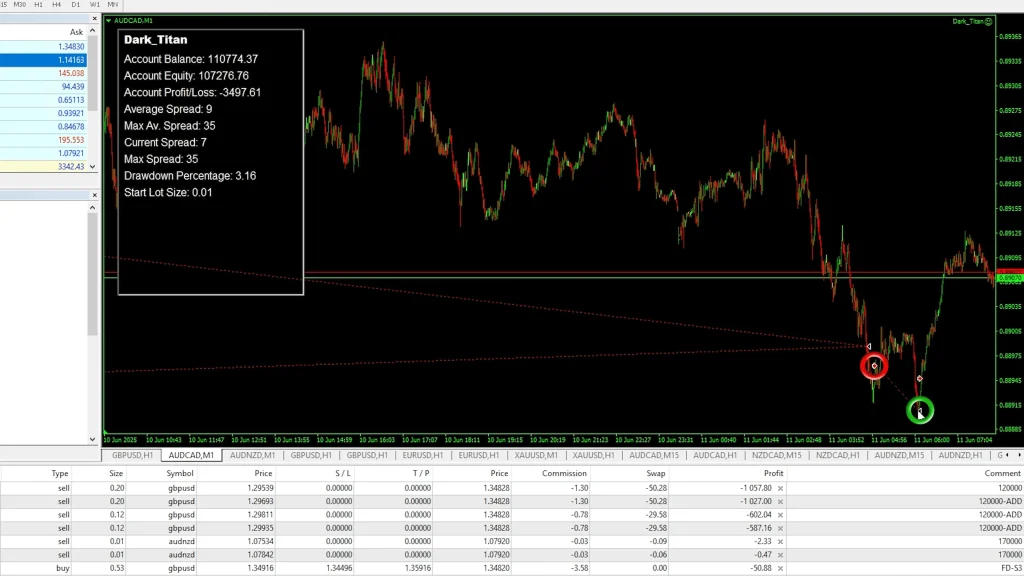
Observing the EA on the M1 charts gives you a sense of how it operates. I’ve seen it take short positions that close for profit within hours. Then it might flip to a long position and do the same thing. The speed of execution is impressive.
Not every trade wins, obviously. I’ve watched it take losses, but they’re typically smaller than the wins. That’s how you maintain an 80% win rate: cut losses quickly when the setup doesn’t play out, let winners run just enough to secure profit.
One sequence I noticed: five consecutive profitable trades in a single day. Long, profit. Long, profit. Short, profit. Long, profit. Short, profit. Then a losing trade, but the loss was contained. This pattern repeats frequently, strings of wins punctuated by occasional small losses.
The trade frequency is higher than many EAs I’ve tested. You’re not waiting days between positions. Dark Titan stays active, constantly scanning for setups on that M1 timeframe.
Price Point Analysis: Is $99 Worth It?
At $99 for a lifetime license, Dark Titan sits at the budget end of the EA market. Compare that to systems charging $300-$500 or more, and it’s clearly positioned for accessibility.
You also get a trading indicator included, though I haven’t used it extensively. The main value is the EA itself.
The developer offers set files, and here’s something important: I’m using the vendor’s default settings. No optimization, no tweaking, just the configurations provided with purchase. This reduces the risk of over-optimization, where settings work perfectly on historical data but fail in live markets.
When an EA performs well on default settings, it’s a stronger indicator of genuine edge versus curve-fitting.
The Third Pair Question: Why I Skipped NZD/CAD
The developer recommends trading all three pairs, but I made a judgment call to exclude NZD/CAD from my live testing. The backtest was profitable, sure, but not as compelling as the other two pairs.
My thinking: why dilute results with a marginal performer when I’ve got two strong pairs already? If the AUD/CAD and AUD/NZD continue producing consistent profits, I might revisit NZD/CAD later. For now, I’m comfortable focusing on what shows the strongest historical and live performance.
This kind of discretionary decision-making is part of EA trading. Just because the developer includes a pair doesn’t mean you’re obligated to trade it. Your capital, your rules.
Moving From Demo to Live: Next Steps
The demo results have convinced me that Dark Titan deserves live capital. The next phase is transitioning to a real money account, and I’ve chosen Eightcap as the broker for this test.
Why Eightcap? They’re well-regulated with solid trading conditions, competitive spreads, reliable execution, and good customer support. For minor pairs like AUD/NZD, broker selection matters more than with major pairs. You need tight spreads and fast execution to avoid eating into the EA’s edge.
I’m planning a $1,000 live account as part of ongoing EA testing. That’s real money, not demo funds. The pressure changes when it’s your own capital on the line, and I want to see if Dark Titan handles that transition smoothly.
Some EAs crumble when you move from demo to live, slippage hits harder, spreads widen at inconvenient times, and psychological pressure affects decision-making (even with automated systems, you still have to resist the urge to intervene). Dark Titan’s performance will either hold up or it won’t.
How This Fits Into Broader EA Testing
I’m running Dark Titan alongside several other expert advisors as part of a larger testing project. The goal is to identify which systems genuinely work and which ones only look good in backtests.
FX Blue verification provides transparency. Anyone can check my results; there’s no hiding losses or cherry-picking winning periods. Every trade, every drawdown, every profit is visible.
The magic number system lets me isolate Dark Titan’s performance from other EAs running on the same account. When you’re testing multiple systems simultaneously, this organizational clarity is essential. Otherwise, you can’t tell which EA is responsible for which results.
Over time, patterns emerge. Some EAs thrive in trending markets but struggle in ranges. Others are the opposite. Dark Titan seems relatively market-neutral so far; it’s performed consistently regardless of whether the pairs are trending or consolidating.
What the Statistics Actually Mean
An 80% win rate sounds great, but context matters. If your average loss is twice your average win, an 80% win rate still produces net losses. That’s why profit factor is equally important; it tells you whether wins are big enough to compensate for losses.
Dark Titan’s profit factors of 2.7 and 1.25 on individual pairs indicate that, yes, the wins are outweighing the losses sufficiently. The combined 1.43 profit factor across both pairs confirms this system is net profitable after accounting for spread, slippage, and all real-world trading costs.
Trade volume matters too. With 333 combined trades, we’re past the point where a few lucky wins can skew the statistics. This is a statistically meaningful sample. If Dark Titan had only executed 20 trades, I’d be far more cautious about drawing conclusions.
Linear equity growth is what you want to see. Erratic, jagged equity curves suggest the EA is taking big risks or getting lucky intermittently. Smooth, steady growth indicates a system with a consistent edge that’s being exploited repeatedly.
Settings and Configuration Approach
I mentioned using default vendor settings, and that’s worth expanding on. Many traders immediately start tweaking parameters, trying to squeeze extra performance. Sometimes that works. Often it leads to over-optimization.
The default settings have been tested by the developer across multiple market conditions. They’re designed to work broadly, not just on one specific historical period. When I backtest with those settings and then run them live, I’m testing the system as intended.
If performance degrades significantly from backtest to live with default settings, that’s a red flag about the EA itself, not about my configuration choices. Conversely, if it performs well, I know the system has a genuine edge that doesn’t depend on parameter tweaking.
Later, if I identify specific improvements through careful testing, I might adjust settings. But starting with defaults establishes a baseline.
Broker Selection for Minor Pairs
Trading AUD/CAD and AUD/NZD requires broker capabilities that go beyond the basics. These aren’t EUR/USD or GBP/USD; they’re minor pairs with wider spreads and sometimes lower liquidity.
Eightcap offers the execution quality needed for this type of trading. Their spreads on minor pairs are competitive, and their servers handle high-frequency EA trading without constant requotes or rejections.
I’ve tested other brokers where minor pair spreads made profitable EA trading nearly impossible. The theoretical edge gets consumed by trading costs. That’s why broker research matters before deploying capital.
Where to Access Dark Titan and Additional Resources
Dark Titan is available through the developer’s website and also through Algo Trading Space. The Algo Trading Space platform provides access to various EAs along with testing resources and trading insights. Full disclosure: we may earn a small commission if you purchase through our links, though this doesn’t affect the price you pay or the honest assessment in this review.
For traders serious about EA testing and live results, the Algo Trading Space VIP club offers exclusive access to verified trading results, early insights on new systems, and priority support. It’s worth exploring if you’re building a portfolio of automated strategies and want ongoing performance data beyond individual reviews.
I’ll continue tracking Dark Titan’s performance as it transitions to live trading. The FX Blue account remains public, so you can follow along with real results rather than relying solely on my analysis.
Frequently Asked Questions
What makes Dark Titan different from other high-frequency EAs that trade on M1 timeframes?
Dark Titan distinguishes itself through its unusually high win rate of around 80% while maintaining solid profit factors above 1.4. Many M1 EAs sacrifice win rate for larger occasional wins, or they maintain high win rates with poor risk-reward ratios.
Dark Titan manages to balance both frequent wins that are individually large enough to overcome the smaller losses. The seven-year backtest stability also suggests the strategy isn’t optimized for one specific market condition but adapts across various environments.
Can I trade Dark Titan on all three pairs simultaneously, or should I start with just one or two?
You can run all three pairs if your backtesting confirms solid performance across AUD/CAD, AUD/NZD, and NZD/CAD. However, based on my testing, I recommend starting with the two strongest performers in your own backtests rather than automatically trading all three.
Not every pair will perform equally well with every broker’s spreads and execution. Test each independently, compare results, then decide which combinations make sense for your account size and risk tolerance.
How much capital do I need to run Dark Titan safely without risking margin calls?
The minimum depends on your risk settings and lot sizes, but I’d suggest starting with at least $1,000 per pair if you’re trading conservatively. If running both AUD/CAD and AUD/NZD together, a $2,000 account gives you comfortable breathing room.
The M1 timeframe means frequent trading, so you want sufficient margin to handle multiple simultaneous positions without stress. Smaller accounts around $500 might work with very low lot sizes, but they leave little room for drawdown periods.
Does Dark Titan require constant monitoring, or can it run completely hands-off on a VPS?
Dark Titan operates autonomously once configured on a VPS with a stable internet connection. The M1 timeframe means it’s constantly scanning for setups, but it doesn’t need manual intervention. I check my FX Blue stats weekly to monitor overall performance trends, but daily monitoring isn’t necessary.
The EA handles entries, exits, and trade management automatically. That said, any EA benefits from periodic oversight to ensure it’s functioning correctly and performing within expected parameters.
What’s the typical drawdown range I should expect with Dark Titan based on your testing?
My testing showed relatively modest drawdowns compared to many high-frequency systems. The equity curves demonstrate occasional flat periods rather than deep dips, suggesting drawdowns typically stay in the 10-15% range during normal market conditions.
However, unexpected volatility events or news releases on AUD or NZD currencies could temporarily push drawdowns higher. The 80% win rate helps the EA recover quickly from drawdown periods, usually within days rather than weeks.


Comments
No comments yet. Be the first to comment!
Leave a Comment
Your email address will not be published. Required fields are marked with *