

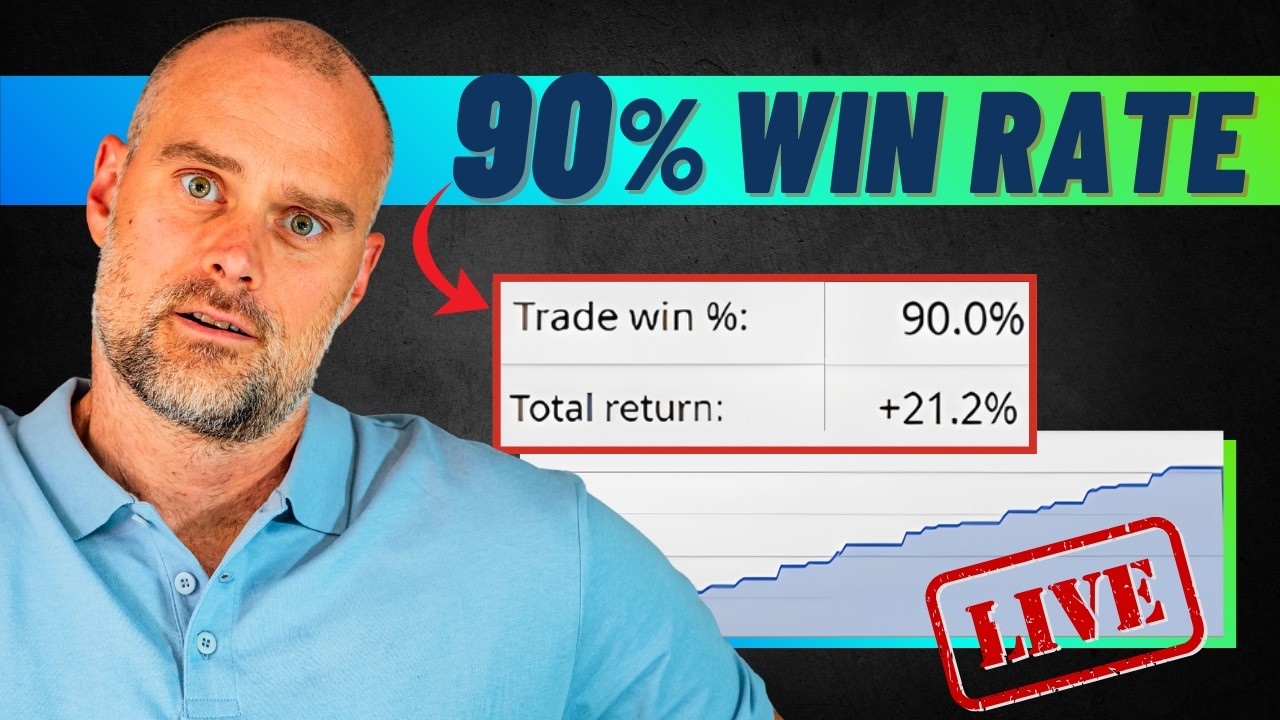
There’s something satisfying about being able to withdraw profits from a trading robot after six months of testing. Not hypothetical gains, not backtest results, but actual money transferred from your broker account to your wallet.
That’s exactly what happened with FX Proctor EA. After running this automated trading system on a $1,000 live account with BlackBull Markets for approximately six months, I just processed a $200 withdrawal, a clean 20% return on the initial capital.
Now, 20% over six months might not sound earth-shattering compared to the wild claims you see marketed by some forex robots. But here’s what makes it valuable: the equity curve has been remarkably smooth, the maximum drawdown stayed minimal, and the system achieved a 90% win rate while trading about every other day. That’s the kind of boring consistency that actually compounds into serious money over time.
FX Proctor EA specializes in AUD/USD (the Australian dollar), though upgraded versions exist for multiple currency pairs. The strategy uses a broad timeframe filter to identify market context and trend direction, then executes orders on the H1 timeframe. It’s essentially a plug-and-play system, with minimal settings to configure, straightforward to deploy, and so far at least, reliably profitable.
This review will show you the actual live trading results, walk through the backtest performance, explain the two “path” options the system offers, discuss the different pricing tiers for multi-pair versions, and help you assess whether this trading robot fits your automated trading strategy.
Let me show you what six months of real money testing revealed.
FX Proctor EA Performance Summary
| Metric | Live Account (6 Months) | Backtest (2 Years) |
| Starting Capital | $1,000 | $1,000 |
| Total Return | 20% | $897 profit |
| Monthly Average | ~4% | N/A |
| Win Rate | 90% | Not specified |
| Maximum Drawdown | Minimal (not breached) | $155 (15.5%) |
| Trade Frequency | Every other day (~15/month) | Similar pattern |
| Withdrawal Executed | $200 (20% of capital) | N/A |
| Currency Pair | AUD/USD only | AUD/USD only |
| Path Configuration | Path 1 | Path 1 |
| Lot Size | 0.1 | 0.1 |
Live Account Performance: The Numbers That Matter
Before we get into strategy details or theoretical discussions, let’s examine the actual performance on my live account. This is real money, real trades, real broker, not a demo simulation or cherry-picked backtest.
Six-Month Results Summary
Here’s what the $1,000 live account with BlackBull Markets generated:
- Total return: 20%
- Monthly return: Nearly 4% average
- Win rate: 90%
- Trade frequency: Approximately one trade every other day
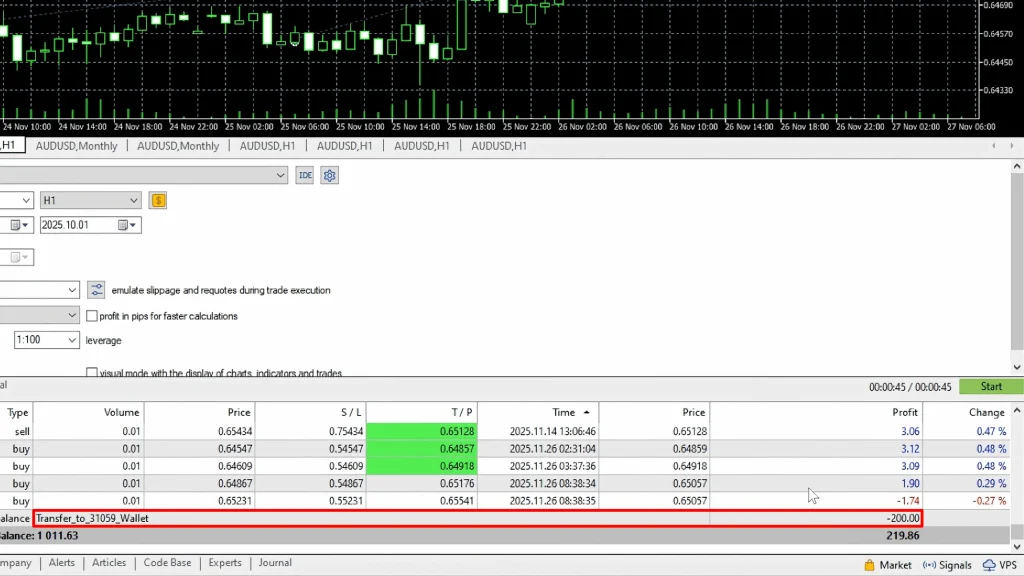
- Withdrawal executed: $200 transferred to wallet
- Currency pair: AUD/USD exclusively
That 4% monthly average is exactly the sweet spot I look for in automated systems. It’s high enough to generate meaningful returns through compounding, but not so aggressive that it requires excessive risk or unsustainable strategies.
FX Blue Track Record Analysis
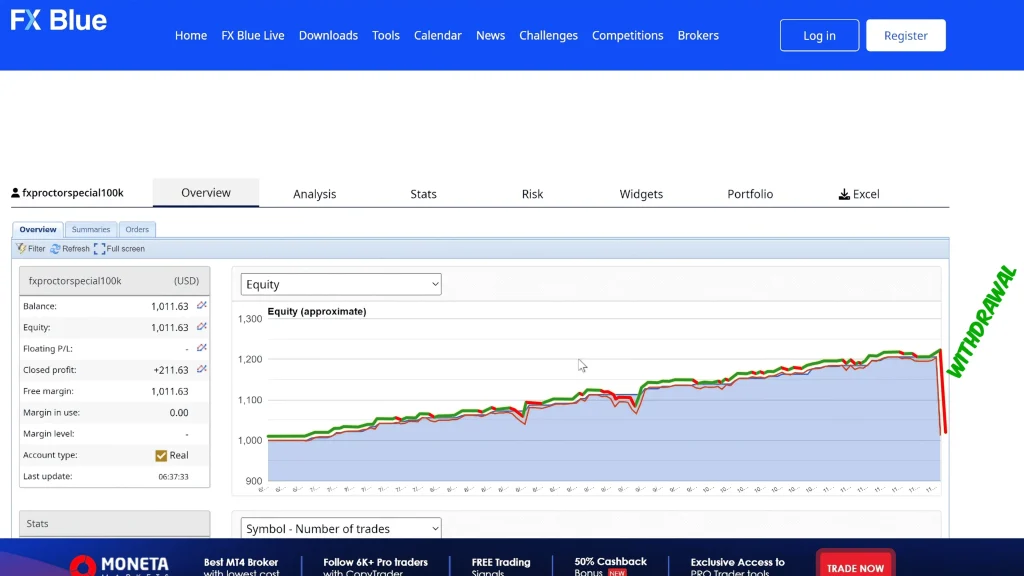
Looking at the FX Blue tracking data, several patterns stand out immediately. The balance line shows very steady growth, not the wild swings up and down you see with aggressive martingale systems or grid robots that eventually blow up. Just consistent, gradual appreciation over time.
The equity curve (which includes floating profit/loss from open positions) follows the balance remarkably closely. This tells you the EA isn’t holding massive open positions with large floating losses, hoping for reversals. When I examine the chart, I don’t see huge equity spikes or drops that would indicate the system is taking on hidden risk.
The Withdrawal Milestone
That $200 withdrawal is visible on the FX Blue chart as a noticeable drop in the balance line, but it’s not a loss; it’s profit extraction. After six months of watching this EA trade, generating consistent returns, and maintaining controlled risk, I felt confident enough to pull out 20% of the account.
This is an important psychological milestone for any trading system. It’s one thing to see paper profits accumulating. It’s another thing entirely to actually withdraw money and prove those profits are real and accessible.
Trade Distribution and Frequency
FX Proctor EA places roughly one trade every other day on average. This isn’t a high-frequency scalping system that executes dozens of trades daily, nor is it a long-term position trading approach that might hold trades for weeks.
The frequency feels just about right, active enough to capitalize on regular market opportunities, but not so frequent that trading costs eat into profitability or that you’re constantly exposed to market risk.
The 90% Win Rate
A 90% win rate over six months of live trading is genuinely impressive. Most profitable trading systems operate in the 55-70% win rate range, accepting that some losses are inevitable in exchange for capturing larger wins.
FX Proctor EA appears to achieve its high win rate through selective trade entry, waiting for high-probability setups rather than forcing trades. The “Path 1” configuration I’m using (more on that later) is specifically designed for less frequent but more accurate trade execution.
Does a 90% win rate guarantee future success? Of course not. Markets change, and what worked for six months might not work forever. But it’s certainly encouraging evidence that the entry logic is sound.
Version Comparison Table
| Feature | Basic (AUD/USD) | Special (2 Pairs) | Max (4 Pairs) |
| Currency Pairs | 1 (AUD/USD only) | 2 pairs | 4 pairs |
| Path Options | Path 1 only | Path 1 & 2 | Path 1 & 2 |
| Price Tier | Lowest | Medium | Highest |
| Minimum Capital | $500-$1,000 | $1,500-$2,000 | $3,000-$4,000 |
| Diversification | Single pair | Moderate | High |
| Management Complexity | Simple | Moderate | More complex |
| My Testing | 6 months live | Not tested | Not tested |
| Recommended For | Beginners, smaller accounts | Intermediate traders | Experienced, larger capital |
Settings and Configuration: Plug-and-Play Simplicity
One of FX Proctor EA’s strengths is how straightforward the configuration process is. Unlike some expert advisors with dozens of complex parameters requiring optimization, this system keeps things simple.
Core Settings Overview
When you load FX Proctor EA on your VPS and check the settings, here’s what you’re working with:
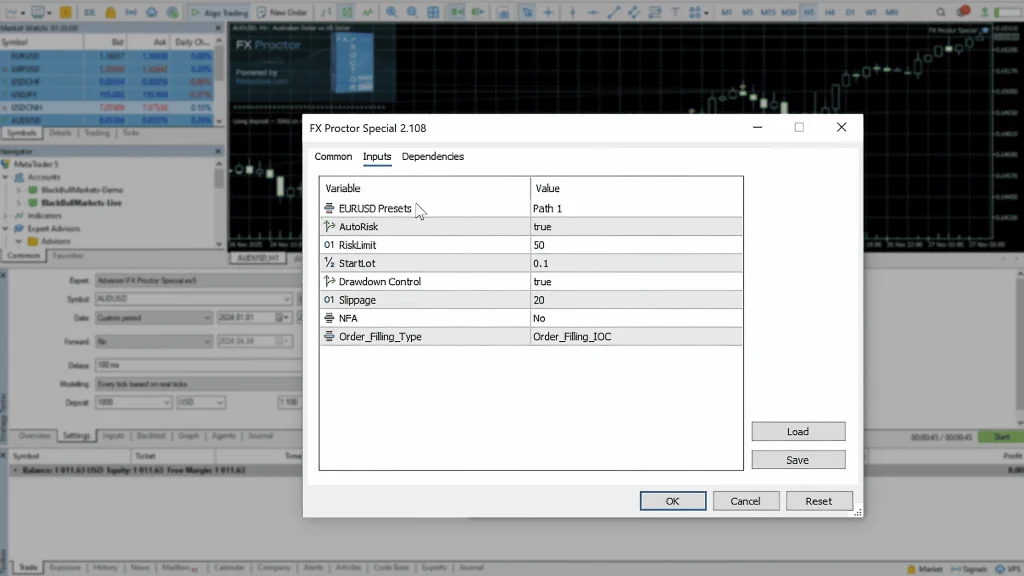
- Risk Protection: Set the equity percentage at which the EA closes all trades to protect capital. I configured mine at 50%, meaning if the account equity drops to half the starting balance, all positions close automatically.
- Start Lot Size: Configure the initial position size. I’m using 0.1 lots on the $1,000 account, which provides reasonable profit potential while keeping risk controlled.
- Path Selection: Choose between Path 1 (less frequent, higher accuracy) or Path 2 (higher frequency, more trades). I’m running Path 1 based on my preference for quality over quantity.
That’s essentially it. No complex indicator parameters, no optimization requirements, no endless tweaking needed. Load it, set your risk level and lot size, select your path, and let it run.
Path 1 vs. Path 2: Understanding the Difference
The vendor offers two distinct operational modes, and understanding the trade-off is important:
Path 1 Characteristics:
- Trades less frequently
- Higher win rate (more selective entries)
- Focuses on high-probability setups
- Better for traders prioritizing consistency
Path 2 Characteristics:
- Higher trade frequency
- More market exposure
- Potentially more profit opportunities
- Better for traders comfortable with more active trading
I chose Path 1 for my live account because I prefer fewer, higher-quality trades over constant market exposure. The 90% win rate I’m seeing suggests this approach is working well, at least in current market conditions.
Risk Management Configuration
The 50% equity protection setting acts as a circuit breaker. If something catastrophic happens, a flash crash, unexpected news event, or prolonged adverse trend, the EA will close all positions before the account is completely destroyed.
Is 50% a large drawdown to tolerate? Yes, absolutely. But looking at the backtest data (which I’ll detail shortly), the actual maximum drawdown was only $155 on similar account sizes. Setting protection at 50% provides a substantial buffer beyond what the system has historically needed.
You could certainly set this more conservatively, maybe 30% or 40%, if you have a lower risk tolerance. The trade-off is potentially missing recovery opportunities if the EA needs more room to manage temporary drawdowns.
Backtest Validation: Two Years of Historical Data
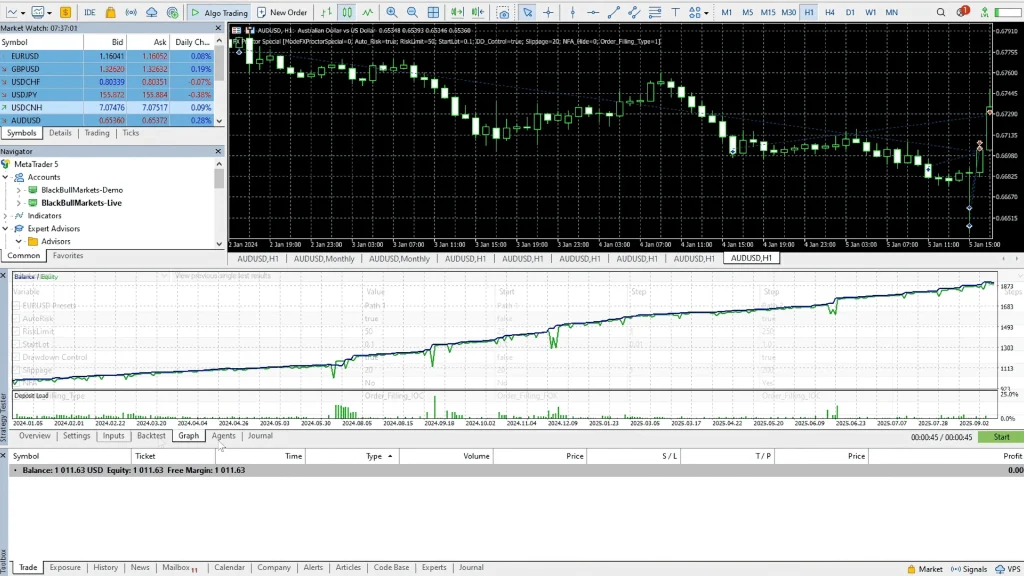
Live results over six months provide meaningful evidence, but backtesting extends the validation across different market conditions and time periods. I ran FX Proctor EA through comprehensive backtests to see how it would have performed historically.
Backtest Configuration
I tested the system using:
- Currency pair: AUD/USD
- Timeframe: H1 (1-hour chart)
- Account size: $1,000 (matching live account)
- Lot size: 0.1 (matching live settings)
- Path: Path 1
- Data period: 2 years of historical data
First, I ran the test using the “Open, High, Low, Close” model, which is faster but less precise. Then I validated with the “Full Tick” model, which captures trading costs more accurately.
Open High Low Close Results
The OHLC backtest generated impressive results:
- Total profit: $9,511.95
- Equity curve: Very smooth with no large spikes
- Balance growth: Steady upward progression
These numbers are obviously much better than the live results (20% in six months vs. massive gains in backtest), but that’s normal. Backtests never account for all real-world variables, slippage, connection issues, execution delays, spread variations during news events, etc.
What matters more than the absolute profit number is the shape of the equity curve. No massive drawdowns, no catastrophic losses, just consistent growth.
Full Tick Model Validation
The full tick backtest provides more realistic results because it captures trading costs more accurately:
- Total profit: $897
- Maximum drawdown: $155
- Equity curve: Very similar to the OHLC model
- Balance line: Smooth with controlled drawdowns
The fact that both backtesting models produced similar equity curve shapes is actually more important than the profit differences. It suggests the strategy isn’t overly sensitive to exact entry prices or spread variations; it’s robust enough to work across different execution conditions.
Drawdown Analysis
The $155 maximum drawdown in backtesting is remarkably small. On a $1,000 account, that represents only about 15.5% equity reduction at the worst point, and it recovered from there.
Compare this to grid martingale systems that can see 30%, 40%, even 50% drawdowns before recovering (if they recover at all). FX Proctor EA’s controlled drawdown profile makes it suitable for traders with lower risk tolerance and potentially even for funded account programs with strict drawdown limits.
Spread Sensitivity Testing
The vendor claims FX Proctor EA is “not dependent on narrow spreads” and works with almost any broker. The close alignment between OHLC and full tick backtest results supports this claim; if the system were highly spread-sensitive, you’d see major performance degradation in the full tick model.
This is actually a significant advantage. Many scalping EAs that work beautifully on backtests with perfect 1-pip spreads fall apart in live trading when real broker spreads are 2-3 pips or wider during certain hours.
Strategy Breakdown: How It Actually Trades
While the vendor doesn’t reveal every detail of the proprietary algorithm, enough information is available to understand the general strategic approach.
Multi-Timeframe Analysis
FX Proctor EA uses a two-layer timeframe approach:
- High Timeframe Filter: The system first analyzes the broader market context and long-term trend direction. This prevents counter-trend trading during strong directional moves and helps identify high-probability market conditions.
- H1 Execution Timeframe: Once the high timeframe filter confirms favorable conditions, the EA places orders on the 1-hour chart. This timeframe provides enough price action detail for precise entries without the noise and false signals common on lower timeframes like M5 or M15.
This multi-timeframe approach is actually quite sophisticated. Many struggling traders make the mistake of trading on a single timeframe without considering the broader market context. By requiring alignment between long-term conditions and shorter-term setups, the EA improves trade quality.
The AUD/USD Specialization
FX Proctor EA was specifically designed and optimized for AUD/USD. The Australian dollar has distinct characteristics:
- Strong correlation with commodity prices (especially metals)
- Influenced by Chinese economic data (major trading partner)
- Responds to risk sentiment (risk-on vs. risk-off environments)
- Liquid major pair with decent volatility
By specializing in a single pair rather than trying to be a jack-of-all-trades across dozens of currencies, the vendor could optimize the entry logic, filters, and parameters specifically for AUD/USD’s personality.
Does this mean the EA can’t work on other pairs? Not necessarily, the vendor offers multi-pair versions. But the core system was built around Aussie dollar characteristics.
Trade Selection and Entry Logic
Based on the 90% win rate and the every-other-day trade frequency, FX Proctor EA is clearly very selective about entries. It’s not taking every possible setup; it’s waiting for conditions to align perfectly before executing.
This patience is actually one of the system’s strengths. Overtrading is one of the fastest ways to destroy a trading account, whether automated or manual. By being selective, the EA avoids low-quality trades that might win sometimes but reduce overall profitability.
Exit Management
The EA uses take-profit targets rather than trailing stops or manual exits. Once a trade reaches its profit target, it closes automatically. This removes emotion and second-guessing from the exit process; if the target is hit, the profit is banked.
The system also appears to have stop loss protection, though exact parameters aren’t disclosed. The small maximum drawdown suggests stops are reasonable and not set so wide that a single losing trade could devastate the account.
Pricing Tiers and Multi-Pair Options
FX Proctor EA comes in different versions depending on how many currency pairs you want to trade simultaneously.
Version Comparison
Basic Version (AUD/USD Only – Path 1)
- Single currency pair: AUD/USD
- Path 1 option only
- Lowest price point
- This is the version I’m testing
Special Version (2 Pairs)
- Two currency pairs
- Both Path options are available
- Medium price tier
Max Version (4 Pairs)
- Four currency pairs
- Both Path options are available
- Highest price tier
The pricing increases with each tier as you add more pairs. The vendor’s website shows the exact costs, which I won’t specify here since they may change or have promotional discounts.
Which Version Should You Choose?
For most traders starting out, I’d recommend the basic AUD/USD version for several reasons:
- Lower initial investment: Test the system’s core strategy on one pair before committing to multi-pair versions.
- Simpler management: Monitoring one pair is easier than tracking four simultaneously.
- Proven performance: My six-month live results are specifically on the basic version, so you know this configuration works.
- Capital efficiency: You can run one pair effectively on a smaller account ($500-$1,000) rather than needing larger capital to properly allocate across multiple pairs.
Once you’ve proven the basic version on your own account and feel confident in the approach, you could consider upgrading to multi-pair versions for diversification.
Example Portfolio Integration
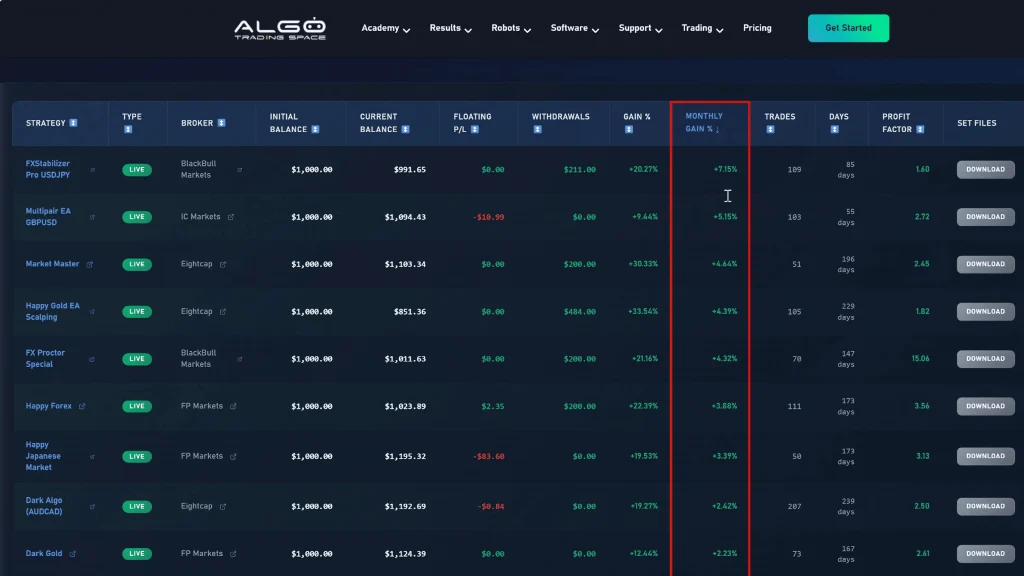
FX Proctor EA has earned a spot in my example portfolio, a collection of my best-performing automated systems trading on live accounts with full transparency.
The Portfolio Concept
The example portfolio consists of:
- $10,000 total capital across multiple accounts
- Diversified across different currency pairs
- Multiple strategies (not just one EA)
- All positions are tracked transparently
- Monthly gains ranging from 1.5% to 7% per strategy
FX Proctor EA is one of the top performers in this portfolio, contributing its steady 4% monthly returns alongside other systems with different risk-reward profiles.
How Traders Can Use This
If you have $10,000 to allocate toward automated trading, you could essentially replicate this entire portfolio:
- Open accounts matching the example
- Load the same EAs with identical settings
- Use the same risk parameters
- Get similar diversification
If you have less capital, say $2,000 or $3,000, you can select the 2-3 best-performing systems from the portfolio and run just those, scaling position sizes to match your available capital.
VIP club members get access to the exact set files I’m using, making replication straightforward rather than requiring extensive testing and optimization.
Portfolio Diversification Benefits
Running FX Proctor EA as part of a broader portfolio rather than as your only trading system provides several advantages:
- Reduced correlation: Different EAs trading different pairs with different strategies means less correlated risk.
- Smoother equity curves: When one system has a temporary drawdown, others might be profitable, smoothing overall account performance.
- Risk distribution: No single system failure destroys your entire capital.
- Performance comparison: See which strategies work best in current conditions and adjust allocations accordingly.
Broker Selection: Why BlackBull Markets
I tested FX Proctor EA specifically with BlackBull Markets, and there are solid reasons for that choice beyond just personal preference.
Execution Speed Matters
For any automated trading system, execution speed is critical. Delays between when the EA sends an order and when it actually executes can mean the difference between profit and loss, especially on shorter timeframe strategies.
BlackBull Markets provides lightning-fast execution speeds. Orders fill quickly with minimal slippage, which preserves the edge the EA is trying to capture.
Trading Cost Considerations
Every trade incurs costs through spreads and commissions. Over hundreds of trades, these costs compound significantly. Brokers with wide spreads or high commissions can turn a profitable EA into a break-even or losing one.
BlackBull Markets offers competitive trading costs, particularly with their institutional accounts.
The Institutional Account Advantage
Normally, institutional accounts (which provide tighter spreads and 50% commission reductions) require $20,000 deposits. That’s out of reach for many retail traders starting with $1,000-$5,000.
BlackBull Markets offers a promotional deal, 90% off institutional account requirements. Instead of needing $20,000, you can access institutional pricing with just a $2,000 deposit.
For automated trading where you’re executing regularly, those reduced costs add up quickly. If you’re serious about running FX Proctor EA or any other automated system long-term, the institutional account upgrade is worth considering.
Platform Compatibility
FX Proctor EA works on both MT4 and MT5. BlackBull Markets supports both platforms fully, so you have flexibility in which you prefer to use.
I’m currently running it on MT4, but knowing I could switch to MT5 if needed provides options for the future.
Refund Policy and Purchase Considerations
Before purchasing any EA, always check the refund policy. It tells you a lot about the vendor’s confidence in their product.
FX Proctor EA’s Refund Terms
The vendor offers a money-back guarantee, but, and this is important, it’s not a “no questions asked” policy. According to their terms, they’ll refund you if you’re not getting good results, but it’s conditional.
I prefer seeing straightforward 30-day or 60-day money-back guarantees regardless of performance. Those policies demonstrate vendor confidence and remove purchase risk for the buyer. With FX Proctor EA’s conditional refund, you’ll likely need to demonstrate the EA isn’t working as described to qualify.
Is this a dealbreaker? Not necessarily, especially given that my positive six-month results provide independent verification. But it’s worth knowing upfront so you’re not surprised if you request a refund and face conditions.
License Terms
Your purchase includes:
- License for one live trading account
- Works on both MT4 and MT5
- User manual (though it’s largely plug-and-play)
- Ability to change accounts unlimited times
That last point is valuable; if you switch brokers or want to move the EA between accounts for testing purposes, you can do so without buying additional licenses.
Minimum Account Requirements
The vendor recommends a minimum $500 account size. Based on my backtesting and live experience, I’d actually agree with that assessment. You could potentially run it on less, but you’d need to reduce lot sizes proportionally, which means very small absolute profits even when the percentage returns are good.
For comfortable operation with standard settings, I’d recommend $1,000 as a practical minimum. This gives you room for temporary drawdowns while maintaining reasonable position sizing.
Risk Assessment and Long-Term Viability
Let’s examine the risk factors honestly and assess whether FX Proctor EA represents sustainable long-term value or just short-term profitability that might fade.
The Drawdown Cushion
Looking at the backtest’s $155 maximum drawdown on a $1,000 account, there’s a substantial safety margin before hitting the 50% protection level I configured. In fact, you could probably trade at 2x the lot size I’m using and still remain reasonably safe from catastrophic losses.
However, I’m not inclined to push the risk higher. The system is already generating 4% monthly at current settings, which compounds to roughly 48% annually if performance continues. Why chase higher returns when you’ve already got excellent risk-adjusted performance?
Perhaps I’m being overly conservative, but I’d rather have a comfortable cushion and consistent, stress-free profits than squeeze every possible basis point while increasing the chance of significant drawdowns.
Long-Term Sustainability Questions
Six months of live results and two years of backtest data provide meaningful validation, but they don’t guarantee the strategy will work forever. Markets evolve, correlations change, and what works today might not work in 2027 or 2028.
FX Proctor EA’s selective entry approach (trading every other day rather than constantly) suggests it’s not over-optimized to specific conditions. The high win rate indicates it’s capturing genuine market inefficiencies rather than forcing trades.
Still, I’ll continue monitoring performance monthly. If the win rate drops significantly or drawdowns increase beyond historical norms, that’s a signal that market conditions may have shifted in ways that reduce the EA’s effectiveness.
Diversification Remains Critical
Even with FX Proctor EA’s strong performance, I wouldn’t recommend putting 100% of your trading capital into this single system. Diversification across multiple strategies reduces the impact if any one system stops working.
That’s why the example portfolio approach makes sense, FX Proctor EA as one component alongside other uncorrelated strategies provides more robust overall performance than any single system alone.
Key Advantages vs. Concerns
| Advantages | Concerns |
| ✓ 90% win rate over 6 months | ✗ Conditional refund policy (not no-questions-asked) |
| ✓ 4% monthly average return | ✗ Single pair only (basic version) |
| ✓ Minimal drawdown (15.5% max in backtest) | ✗ Limited long-term data (6 months live) |
| ✓ Successful $200 withdrawal executed | ✗ Requires $500-$1,000 minimum capital |
| ✓ Plug-and-play simplicity | ✗ Path 1 trades less frequently |
| ✓ Works on both MT4 and MT5 | ✗ Performance not guaranteed to continue |
| ✓ Not spread-dependent | ✗ Higher-tier versions cost more |
| ✓ Multi-timeframe analysis approach | ✗ Specialization limits flexibility |
Frequently Asked Questions
What’s the difference between Path 1 and Path 2 in FX Proctor EA?
Path 1 is designed for less frequent but more accurate trading, focusing on high-probability setups with better win rates. It trades more selectively, waiting for optimal conditions before executing. Path 2 offers higher trade frequency with more market exposure, taking more trades overall but potentially with slightly lower win rates.
My live account uses Path 1 and has achieved a 90% win rate over six months by being selective about entries. For traders prioritizing consistency and quality over quantity, Path 1 is typically the better choice. Path 2 suits those comfortable with more active trading and willing to accept more frequent small losses in exchange for greater total trade volume.
Can FX Proctor EA work on currency pairs besides AUD/USD?
Yes, the vendor offers upgraded versions that trade multiple currency pairs. The “Special” version covers two pairs, while the “Max” version trades four pairs simultaneously. However, the basic version I’ve tested specializes exclusively in AUD/USD, which the EA was specifically designed and optimized for based on the Australian dollar’s particular market characteristics.
My six-month live results and backtesting are all on AUD/USD only. If you want multi-pair diversification, you’ll need to purchase one of the higher-tier versions. For beginners, I’d recommend starting with the single-pair AUD/USD version to prove the strategy works before investing in multi-pair upgrades.
What’s the minimum account size needed to run FX Proctor EA safely?
The vendor recommends $500 as the minimum account size, and my backtesting confirms this is technically viable. However, I’d recommend $1,000 as a more practical minimum for comfortable operation. With smaller accounts, you’ll need to reduce lot sizes proportionally, which means very small absolute profits even when percentage returns are good.
My live testing uses a $1,000 account with 0.1 lot sizing, providing reasonable profit potential while maintaining risk control. The backtest showed a maximum drawdown of only $155, so a $1,000 account provides an adequate buffer. If you have $2,000+, you could run the institutional account with BlackBull Markets for better trading costs, improving overall profitability.
How does FX Proctor EA compare to grid or martingale trading systems?
FX Proctor EA is fundamentally different from grid martingale systems. It doesn’t average down with increasing position sizes when trades move against you; each trade uses fixed lot sizing based on your configured parameters. This eliminates the catastrophic blowup risk common with martingale systems that double positions during losing streaks.
The maximum drawdown in my backtesting was only $155 (15.5%), compared to 30-50% typical in grid systems. The EA trades selectively (every other day) rather than constantly adding positions, achieving a 90% win rate through quality entries rather than recovery through position sizing. This makes it substantially safer for capital preservation while still generating solid 4% monthly returns.
Does FX Proctor EA work on both MT4 and MT5 platforms?
Yes, FX Proctor EA is compatible with both MetaTrader 4 and MT5 platforms, giving you flexibility in platform choice. The license you purchase works on either platform without requiring separate purchases. I’m currently running my live account on MT4, but the vendor confirms full MT5 compatibility.
Your license covers one trading account but allows unlimited account changes, so you can switch between MT4 and MT5 or between different brokers as needed. This flexibility is valuable if you want to test different broker conditions or if your preferred broker eventually phases out MT4 in favor of MT5 as the industry gradually transitions toward the newer platform.
What makes the 90% win rate sustainable, and will it continue?
The 90% win rate over six months appears sustainable because it’s achieved through selective trade entry rather than artificial recovery mechanisms. FX Proctor EA uses Path 1 configuration, which trades less frequently but waits for high-probability setups where market context aligns across multiple timeframes.
This patience avoids low-quality trades that reduce overall performance. However, no win rate is guaranteed to continue forever; markets evolve, conditions change, and historical performance never guarantees future results.
I monitor monthly statistics to identify any degradation. If the win rate drops significantly or drawdowns increase beyond backtest norms, that signals potential strategy drift requiring either adjustment or discontinuation. For now, the selective approach and multi-timeframe analysis suggest robustness rather than curve-fitting.
Where to Learn More
If you’re interested in exploring FX Proctor EA further or want access to current pricing and vendor information, I’ve put together a comprehensive resource page on Algo Trading Space.
You can find everything here: algotradingspace.com/robots/forex/fx-proctor-ea
The page includes links to the vendor’s website, any available promotional codes, and ongoing access to my transparent FX Blue tracking so you can monitor continued performance as testing extends beyond the six-month mark.
Full transparency: purchases through that page provide a commission that supports ongoing independent testing and honest reporting across multiple forex robots. But whether you purchase through our link or directly, the most important thing is that you conduct your own testing, preferably on a demo first, before committing significant capital.
I’ll continue running FX Proctor EA on my live account, updating results publicly so you can see exactly how it performs over the next six months, year, and beyond. If performance degrades, you’ll see it. If it continues delivering 4% monthly, that will be visible too.
For traders interested in deeper insights, Algo Trading Space offers a VIP Club that provides exclusive access to our complete trading results dashboard, priority support, and early intelligence on high-performing EAs before they become public knowledge. Members also get downloadable set files, access to our private Discord community, and our full course library.
Testing Transparency Statement: This review reflects approximately six months of live account testing with $1,000 starting capital on BlackBull Markets, along with two years of historical backtesting. All performance metrics are tracked transparently through FX Blue with public access. A $200 withdrawal (20% of capital) has been successfully processed, confirming profits are real and accessible.
However, past performance never guarantees future results, and all forex trading involves substantial risk of loss. The vendor’s refund policy is conditional rather than no-questions-asked. Always conduct your own testing, preferably on demo accounts first, before committing significant capital to any automated trading system.


Comments
No comments yet. Be the first to comment!
Leave a Comment
Your email address will not be published. Required fields are marked with *