

What if I told you there’s an expert advisor where one of its currency pair configurations hasn’t had a losing basket of trades since 2015? That’s nearly a decade of consistent profitability on a single asset. Ranger EA, part of the Powerhouse Bundle from Responsible Forex Trading, might be one of the most reliable systems you’ve ever heard about.
I’ve been testing Ranger on both live and demo accounts for over four months now, and the results align with that bold claim. This isn’t about massive monthly returns or aggressive trading; it’s about steady, sustainable growth with remarkably low drawdown.
Let me show you real money results from my BlackBull Markets account, explain the strategy mechanics, and walk through why this conservative approach might actually be its greatest strength.
Live Account Performance: Four Months of Real Trading
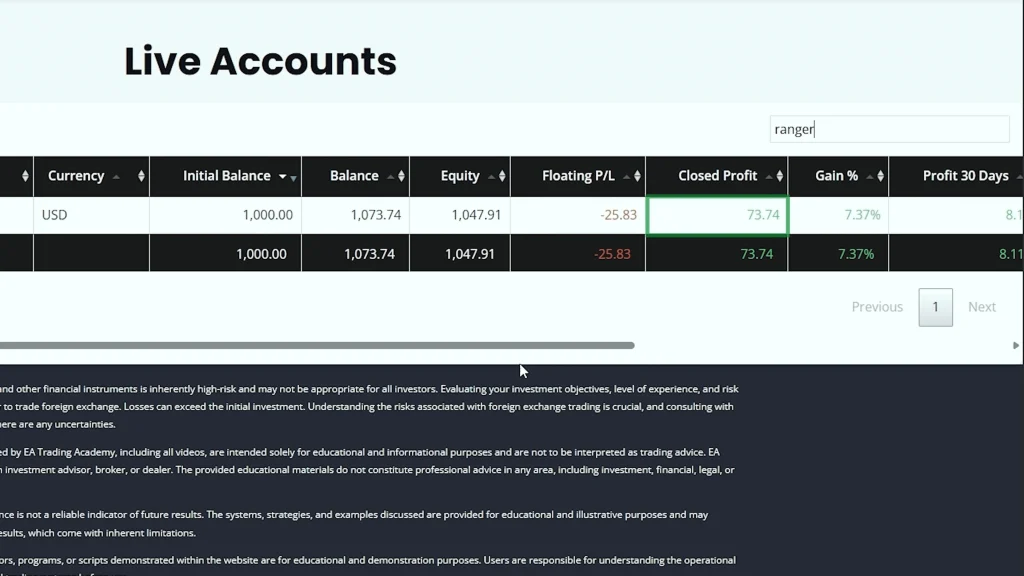
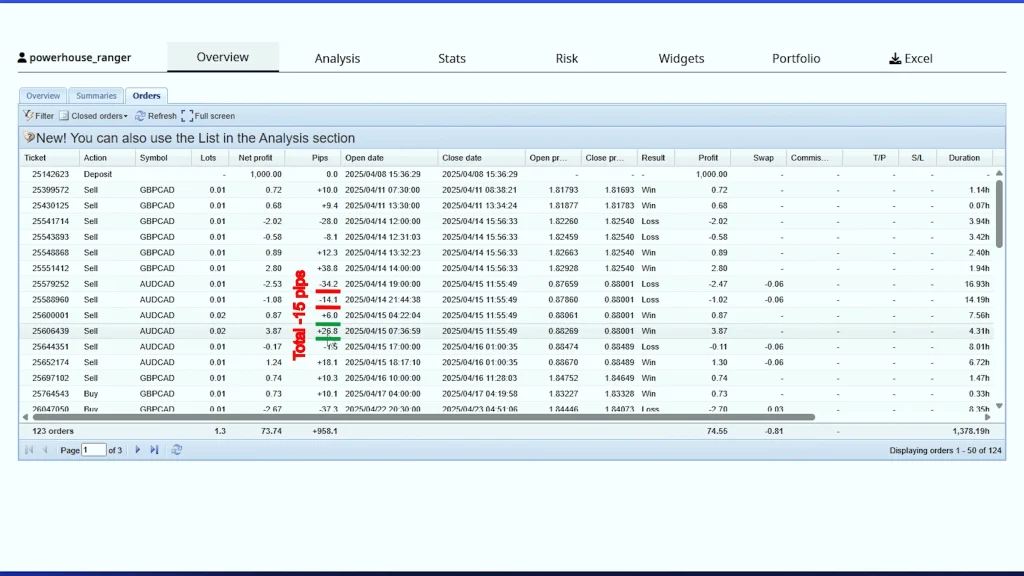
My BlackBull Markets live account started on April 9th with $1,000. After four months and approximately 120 trades, the account sits at 7% gain with a gross profit of $73.74.
That’s an average monthly return of 1.7%. Not explosive. Not flashy. But here’s what matters more: the maximum drawdown over those four months has never reached minus 1%. Even now, with open trades in small floating loss, the peak drawdown remains under 1%.
Think about that for a moment. Four months of live trading with less than 1% peak drawdown. I’ve tested dozens of expert advisors, and that level of stability is exceptional.
Performance Breakdown by Month
| Month | Return | Notes |
| April (partial) | ~1% | Account started mid-month |
| May | 3% | Strong performance |
| June | 0.5% | Slower period |
| July | 0.5% | Consistent with June |
| August (partial) | 0.5% | On pace for full month |
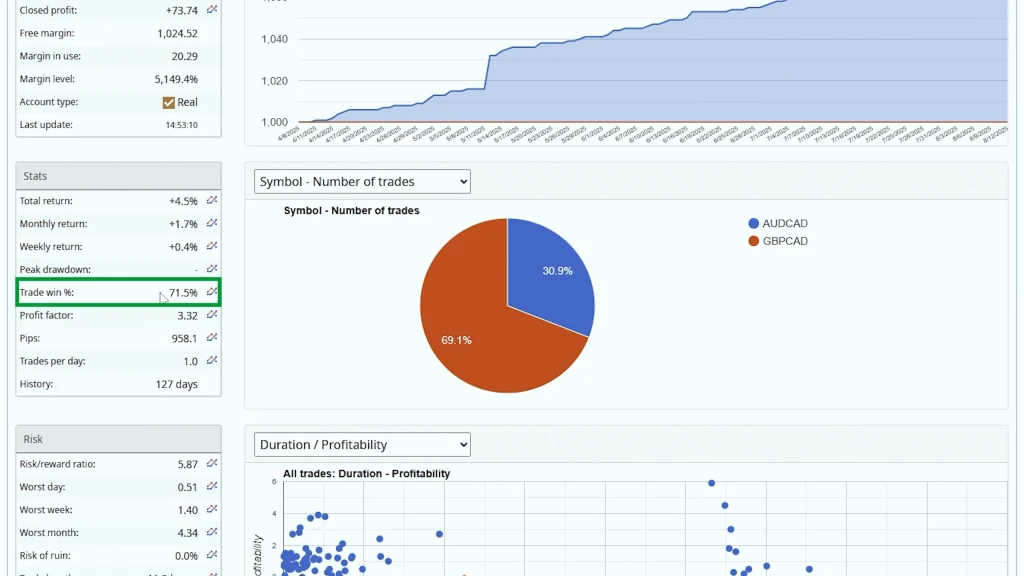
The trade win rate sits above 70%, which contributes to the smooth equity curve. Looking at the floating profit and loss chart, you’ll see remarkable stability, no dramatic spikes or crashes, just steady progression.
How Ranger Actually Trades
Ranger operates on two currency pairs: AUD/CAD and GBP/CAD. The majority of trades come from GBP/CAD, which makes sense once you understand the strategy differences between the two pairs.
The system uses only two indicators:
- Average True Range (ATR): Measures market volatility to adapt position sizing and grid spacing.
- Relative Momentum Index (RMI): Identifies momentum shifts and potential reversal points.
This simplicity is intentional. Complex multi-indicator systems often break when market conditions change. Ranger’s minimalist approach has remained unchanged since its creation in 2015, nearly a decade without strategy modifications. That longevity suggests robust logic rather than curve-fitted optimization.
The 20-Pip Flex Grid System
Ranger targets 10-15 pips profit per trade sequence, but here’s where it gets interesting: the grid system isn’t fixed. It adapts grid spacing based on ATR readings, which means position intervals expand or contract depending on current volatility.
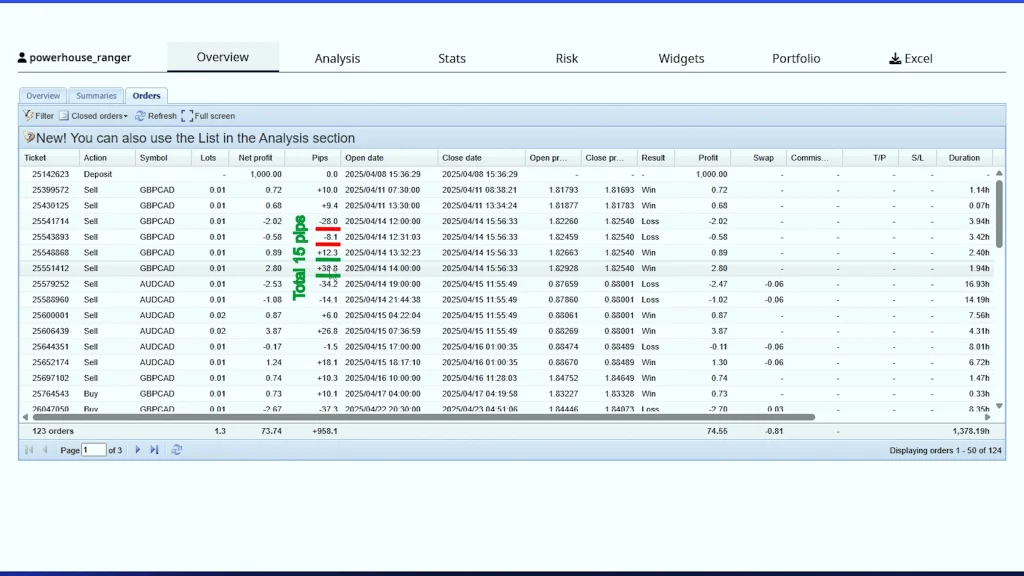
Looking through my closed trades, you’ll see:
- Single trades closing for 10 pips profit
- Trade sequences closing for 15 pips combined
- Occasional sequences hitting 20-25 pips when the flex grid activates
That flexibility helps the system handle both calm and volatile market conditions without requiring constant manual adjustment.
Counter-Trend Approach: Finding Reversals
Unlike trend-following systems that jump on momentum, Ranger specifically looks for reversals at market tops and bottoms. This counter-trend methodology sounds risky on the surface, but the track record demonstrates it works when executed properly.
The system doesn’t use trend filters. Instead, it relies on RMI readings to identify when momentum is exhausting and reversal probability increases. Combined with ATR-based grid spacing, this creates a system that enters against short-term moves while protecting itself through adaptive position management.
I can see this playing out in my trade history. Sequences often show multiple entries as price initially moves against the position, then all close profitably when the anticipated reversal occurs. The key is having sufficient margin to handle those intermediate drawdowns, which brings us to an important distinction between the two pairs.
GBP/CAD vs AUD/CAD: Critical Differences
After testing both pairs and discussing specifics with Ryan, the developer, I learned something crucial: GBP/CAD and AUD/CAD don’t use identical logic.
- GBP/CAD: Pure grid strategy with consistent lot sizing across all positions in a sequence.
- AUD/CAD: Grid strategy with martingale elements, meaning lot sizes can increase with additional positions.
Looking at my trade history confirms this. GBP/CAD sequences always show the same lot size across multiple entries. AUD/CAD sequences sometimes show position scaling.
This distinction matters for risk management. The martingale component in AUD/CAD means slightly higher drawdown potential during extended adverse moves, though the ATR-based flex grid helps mitigate this risk.
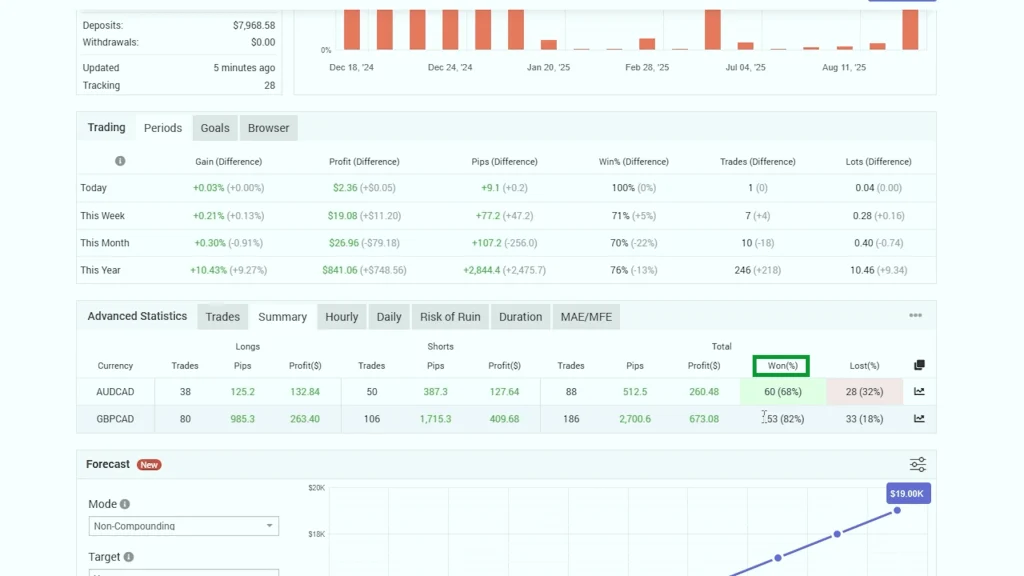
Interestingly, GBP/CAD produces the majority of my trades and maintains an above 80% win rate. Perhaps that’s why the developer claims this specific pair configuration hasn’t had a losing basket since 2015; the pure grid approach without martingale scaling appears more stable.
Vendor Track Record: Limited But Compelling
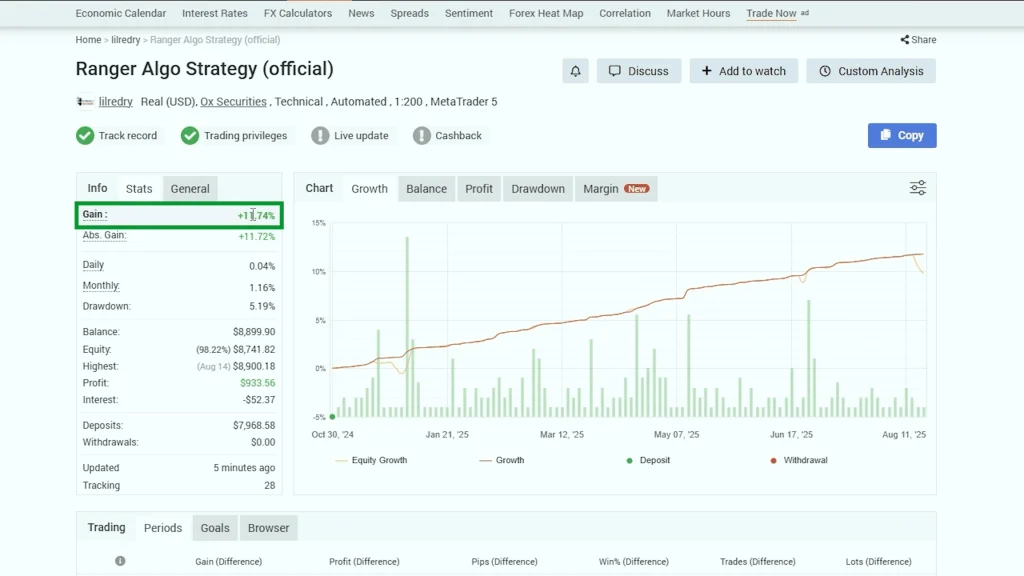
Responsible Forex Trading maintains a verified track record for Ranger, though it only dates back to October 30th of last year, less than one year of public data.
Here’s the frustrating part: Ryan confirmed they’ve never run Ranger on its own dedicated tracking account throughout its 10-year existence. We know GBP/CAD hasn’t had a losing basket since 2015 based on the developer’s internal records, but there’s no publicly verified decade-long track record to examine.
That’s genuinely disappointing. Having verifiable 10-year performance data would be incredible social proof for the strategy’s effectiveness.
What we do have shows consistent results:
- Starting date: October 30th, 2024
- Total return: ~12% in under one year
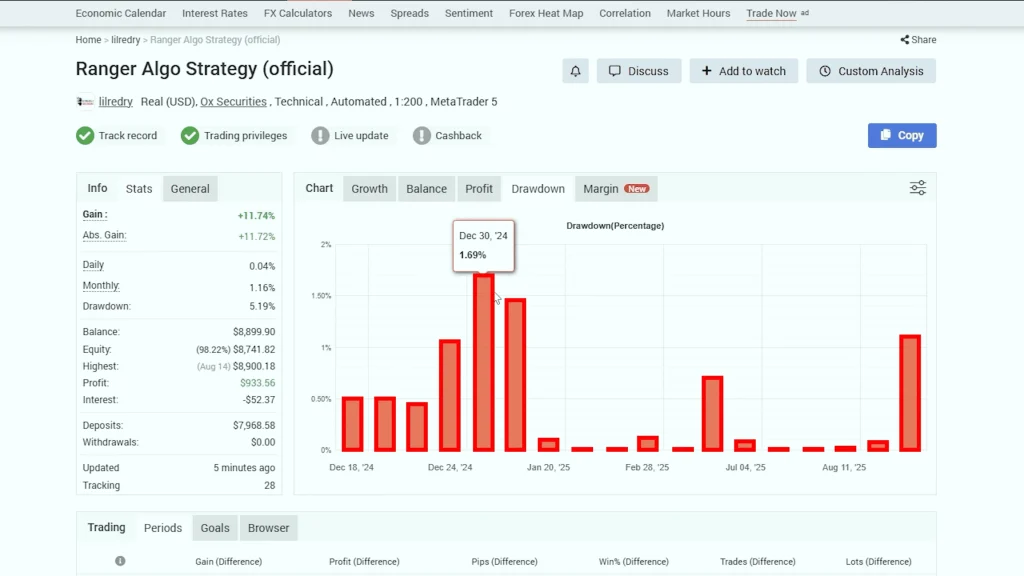
- Peak drawdown: Less than 2% (occurred December 30th)
- Current drawdown: ~1%
- Pairs traded: AUD/CAD and GBP/CAD
The vendor’s stats show GBP/CAD maintaining over 80% profitable trades, which aligns with what I’m seeing in my own live account. The developer’s equity curve mirrors mine, steady growth with minimal volatility.
Demo Account Experiments: Testing Beyond Defaults
Beyond the live account, I’m running Ranger on a demo account where I’ve been experimenting with non-standard configurations. This account started with $1,000 (technically $100,000 with $99,000 withdrawn to simulate a smaller capital) and currently shows 6.29% profit after 70 days and nearly 100 trades.
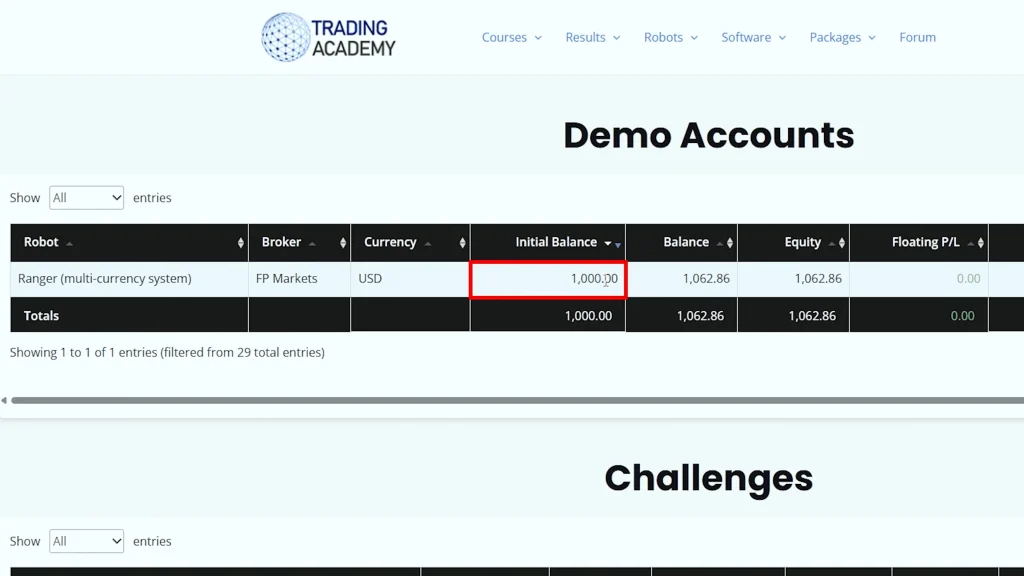
Here’s where things get interesting, and a bit messy. I’ve been testing Ranger on EUR/AUD, which isn’t a default pair for this system. I’ve also experimented with running the GBP/CAD M30 configuration on AUD/CAD M30 instead of the standard H1 timeframe.
The results? Mixed. The EUR/AUD experiment produced an 8% floating drawdown at one point. When I filter to show only the standard pairs (GBP/CAD and AUD/CAD), drawdown drops to 3-4%, and even that’s inflated because I’m testing AUD/CAD on M30 instead of H1.
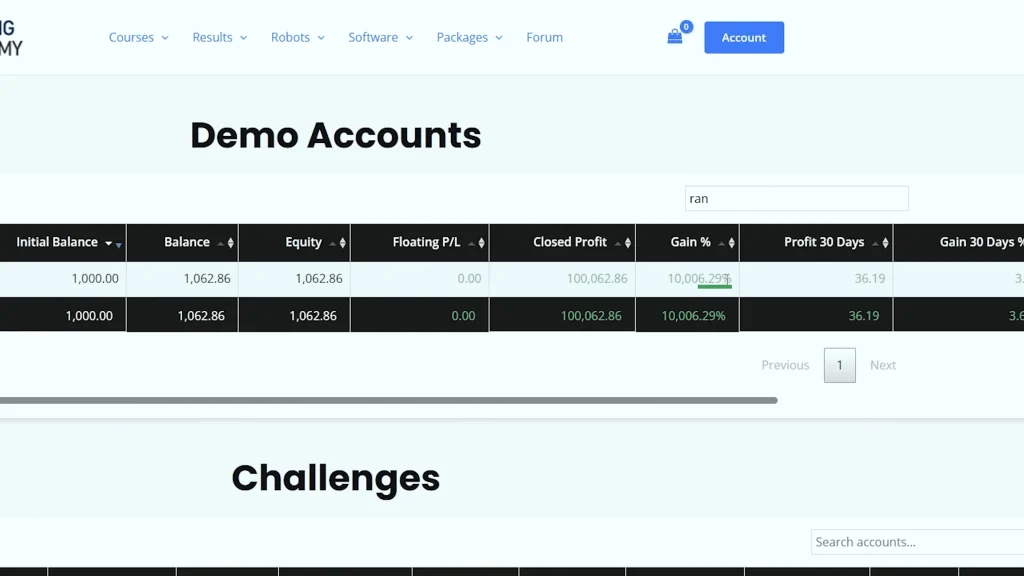
Important note: Don’t take any of these experiments as recommendations. I’m deliberately testing unusual configurations to see what breaks and what works. The default setup, GBP/CAD on M30 and AUD/CAD on H1, represents the developer’s tested and verified approach.
The backtests for Ranger show positive results on various currency pairs and timeframes, but there are subtle strategy differences between pairs that affect performance. Sticking with the developer’s recommended configurations makes sense unless you have substantial testing time to validate alternatives.
Why BlackBull Markets for This EA
I’m running Ranger on BlackBull Markets for specific reasons related to how grid strategies function. Full disclosure: this is a sponsored partnership, but I only work with brokers I actually use for my own trading.
BlackBull offered our community institutional-grade accounts for $2,000 instead of the typical $20,000 minimum. That’s significant because institutional accounts provide:
- Tighter spreads on minor pairs like GBP/CAD and AUD/CAD
- Lower commissions that directly impact profitability
- Professional execution quality
- No restrictions on automated trading or grid strategies
For grid-based systems like Ranger, trading costs accumulate quickly. Those 10-15 pip profit targets get eaten away if spreads are too wide or commissions are too high. BlackBull’s institutional pricing helps preserve those gains.
The broker is fully regulated and supports both MetaTrader 4 and MetaTrader 5 with no algorithmic trading restrictions. Their platform handles grid position management smoothly without requotes or rejection issues I’ve experienced with some other brokers.
When you’re running strategies that place multiple related positions, stable execution matters more than marketing promises. BlackBull delivers that reliability.
The Powerhouse Bundle Context
Ranger is one of six strategies included in the Powerhouse EA Bundle from Responsible Forex Trading. The other strategies include:
- Sharpshooter (which I’ve reviewed separately)
- Vigorous EA
- Three additional systems
You can purchase Ranger individually or get the entire Powerhouse package, which combines all six strategies in one expert advisor. I’m running the individual versions to track each system’s performance separately, but the bundled approach makes sense for traders wanting simplicity.
The developer’s website shows track records for each Powerhouse strategy. Sharpshooter recently experienced a drawdown that I documented in another video. Vigorous has its own performance characteristics. Each system operates differently, which creates portfolio diversification when running multiple strategies simultaneously.
Ranger’s role in that portfolio is clear; it’s the ultra-stable, low-drawdown component that provides consistent baseline returns while other strategies might experience higher volatility.
Realistic Expectations: Marathon, Not a Sprint
Let me be direct about what Ranger isn’t. This isn’t a get-rich-quick system. You’re not going to double your account in a month. The 1.7% average monthly return translates to roughly 20% annually if sustained, solid performance, but not spectacular.
What you get instead is remarkable consistency. Less than 1% peak drawdown over four months. Win rates above 70%. Equity curves that look like gentle slopes rather than jagged mountains.
For traders managing funded accounts with strict drawdown limits, that profile is actually more valuable than higher returns with proportionally higher volatility. A prop firm account with 5% maximum drawdown can run Ranger comfortably. An aggressive EA promising 10% monthly but risking 15% drawdown would get that same account terminated quickly.
Ranger is ideal for:
- Live trading accounts without daily drawdown restrictions, where grid strategies have room to work
- Long-term growth portfolios prioritizing capital preservation
- Traders willing to accept modest returns in exchange for exceptional stability
- Accounts that needa reliable baseline performance to balance more aggressive systems
It’s not ideal for traders chasing maximum returns regardless of risk or those needing quick account growth.
What Works and What Doesn’t
After months of testing, here’s my honest assessment of Ranger’s strengths and limitations:
What I Appreciate
- Simplicity breeds reliability: Only two indicators mean fewer components that can break when market conditions shift.
- Realistic profit targets: Taking 15 pips per sequence is sustainable long-term, unlike systems promising unrealistic returns.
- Developer discipline: Reducing profit targets over time to protect strategy longevity shows they prioritize sustainability over marketing hype.
- Perfect for live accounts: Grid strategies need margin breathing room, and standard broker accounts provide that without the daily restrictions prop firms impose.
The Limitations
- Still a grid system: Despite the flex grid adaptation, extended trending markets can create drawdowns. No grid system is completely immune to strong directional moves.
- Modest returns: If you need aggressive growth, this isn’t your solution. Ranger trades patience for consistency.
- Limited currency pair selection: Only two pairs by default (though you can experiment with others if you’re willing to test thoroughly).
- Missing long-term verification: The lack of a public 10-year track record is genuinely frustrating given the developer’s internal data claims.
The biggest disappointment remains that long-term track record gap. Knowing GBP/CAD hasn’t had a losing basket since 2015, but not being able to verify it publicly feels like a missed opportunity for demonstrating the strategy’s robustness.
Where to Access Ranger and Additional Resources
Ranger EA is available through Algo Trading Space, which provides access to the system along with additional automated trading resources. Full disclosure: we may earn a small commission if you purchase through our links, though this doesn’t affect the price you pay or the honest assessment in this review.
For traders building portfolios across multiple expert advisors, the Algo Trading Space VIP club offers exclusive access to verified trading results from various systems, early insights into new EAs, and priority support. If you want ongoing performance data and community access beyond individual reviews, it’s worth exploring.
I’ll continue running Ranger on both live and demo accounts with public tracking, so you can follow results as they develop beyond this initial review period.
Frequently Asked Questions
How does Ranger EA perform during strong trending markets, given its counter-trend approach?
Ranger’s counter-trend methodology does face challenges during extended directional moves, but the flex grid system helps mitigate this risk by adapting position spacing based on ATR volatility readings.
In my four months of live testing, even when positions moved against the initial entry, the grid recovery mechanism and reversal identification worked as designed. The key is having sufficient margin; grid strategies need breathing room.
Peak drawdown staying under 1% suggests the ATR-based adaptation is effective, though no grid system is completely immune to sustained trends.
What’s the difference between running GBP/CAD versus AUD/CAD configurations?
GBP/CAD uses a pure grid approach with consistent lot sizing across all positions in a sequence, while AUD/CAD incorporates martingale elements where lot sizes can increase with additional grid levels.
This makes GBP/CAD more stable with lower drawdown potential; it maintains above 80% win rate in my testing and reportedly hasn’t had a losing basket since 2015. AUD/CAD still performs well but carries a slightly higher risk due to position scaling. Most of my live trades come from GBP/CAD, which aligns with the developer’s recommendations.
Can I run Ranger on currency pairs other than the default GBP/CAD and AUD/CAD?
You can experiment with other pairs, but proceed cautiously. My demo account testing EUR/AUD produced 8% floating drawdown compared to 3-4% on standard pairs. Backtests show positive results on various currencies, but the strategy has subtle optimization differences between pairs.
The developer spent years refining GBP/CAD and AUD/CAD configurations; deviating from those defaults requires thorough independent testing. If you experiment with alternative pairs, start with small position sizes and expect different performance characteristics than the verified track records.
What account size do I need to run Ranger EA safely?
I’m running Ranger on a $1,000 live account successfully, but $2,000-$3,000 provides a more comfortable margin for the grid system to operate without stress. The critical factor is ensuring sufficient margin to handle multiple grid positions simultaneously, especially on AUD/CAD, which uses martingale scaling.
Smaller accounts around $500 might work with very conservative lot sizing, but grid strategies need room to breathe. If you’re using institutional accounts with lower spreads (like BlackBull’s $2,000 minimum), that’s ideal for preserving the 10-15 pip profit targets.
How does Ranger compare to other strategies in the Powerhouse Bundle, like Sharpshooter and Vigorous?
Ranger fills the ultra-stable, low-drawdown role in the Powerhouse portfolio. Where Sharpshooter might generate higher monthly returns with proportionally higher volatility, and Vigorous offers its own risk-reward profile, Ranger provides baseline consistency with less than 1% peak drawdown.
Running multiple Powerhouse strategies together creates diversification, and different systems perform better in different market conditions. My live account data shows each EA contributing at different times, with Ranger’s role being reliable, steady growth rather than occasional large gains.


Comments
No comments yet. Be the first to comment!
Leave a Comment
Your email address will not be published. Required fields are marked with *