 Petko Aleksandrov
Artificial Intelligence (AI) is transforming the trading industry, offering new possibilities for automation and strategy development. With machine learning models advancing rapidly, traders are increasingly looking at AI-generated trading bots to execute trades and optimize market opportunities. Among these emerging technologies is DeepSeek AI, a relatively new AI model gaining attention for its ability to generate DeepSeek Trading Bot (Expert Advisor/EA) for MetaTrader.
DeepSeek AI is designed to code in multiple programming languages, including MQL4 and MQL5. Latter are used to develop automated trading systems for MetaTrader platforms. The AI can generate trading strategies based on user-defined prompts, potentially eliminating the need for manual coding. However, a crucial question remains: Can a free AI tool like DeepSeek create a profitable trading strategy?
This article examines DeepSeek’s ability to generate a functional EA, evaluates its performance through backtesting, and explores whether it can find profitable free trading bots online. Through step-by-step testing, we uncover the strengths and limitations of AI-driven trading automation.
Table of Contents:
| Test Category | Result | Details |
| Simple Strategy Coding | ❌ Failed | Moving Average EA wouldn’t compile |
| Detailed Strategy Coding | ❌ Failed | CCI + MA strategy wouldn’t compile |
| Reference Strategy Coding | ✅ Partial Success | Compiled after many iterations using existing EA as reference |
| Backtest Profitability | ❌ Failed | Complete loss despite successful compilation |
| Risk Management | ❌ Critical Failure | Attempted 30.95 lots instead of 1% risk |
| Finding Profitable Free EAs | ❌ Failed | 0 out of 5 recommendations were viable |
| Time Investment | ⚠️ High | 4+ hours of prompting, debugging, testing |
| Overall Verdict | ❌ Not Recommended | Cannot create profitable strategies or find reliable EAs |
Is DeepSeek capable of coding an EA: Setting Up the Experiment and Initial Failure
We were also thrilled to find out: Is DeepSeek capable of coding an EA? So we decided to test it ourselves. Many traders remain skeptical about AI’s ability to generate functional trading bots. But to be fair, DeepSeek did manage to code an EA that compiled successfully in MetaTrader. Something which by the way was unsuccessful in the past using other AI models like ChatGPT. But how excatly the DeepSeek Trading Bot was created ? Well, let’s find out.
To evaluate DeepSeek AI’s capability in coding a trading robot, we conducted an experiment. We requested it to generate an Expert Advisor (EA) using a simple moving average strategy. We just wanted to see if it will be capable of doing it so the first prompt given to DeepSeek was straightforward:
“Code for me an EA for MetaTrader 5 that uses a simple Moving Average. It should be trading EURUSD on the M5 time frame. If the price crosses the 21-day moving average upwards, it should buy. And it should sell if the price crosses the Moving Average downwards. Also add SL and TP in an appropriate range of 50-100 pips.”
The expectation was that we will receive a DeepSeek Trading Bot code which we would then go on and compile in MetaTrader. Or in other words, DeepSeek would return a clean and error-free MQL5 script that could be executed without major modifications. And it actually started coding. But, the result was far from encouraging. This thing simply didn’t work. Upon receiving the AI-generated code, it was copied directly into MetaTrader’s MetaEditor for compilation. However, it didn’t compile on MetaTrader.
Not fan of time consuming experiments ? There is easier and faster way of crafting an automated trading strategy.
How DeepSeek Compares to ChatGPT for EA Coding
Previously, I attempted generating MetaTrader EAs using ChatGPT with similarly disappointing results. Neither AI successfully compiled working code on first attempts.
However, DeepSeek showed ONE advantage: with sufficiently detailed prompts referencing existing strategies, it eventually generated compilable MQL5 code. ChatGPT struggled even with detailed specifications.
Key Comparison
| Aspect | ChatGPT (Previous Test) | DeepSeek (Current Test) |
| Simple strategy compilation | ❌ Failed | ❌ Failed |
| Detailed strategy compilation | ❌ Failed | ✅ Succeeded (after many iterations) |
| Risk management accuracy | ❌ Not tested | ❌ Failed (30.95 lots instead of 1%) |
| Strategy profitability | N/A | ❌ Complete loss |
| Finding profitable EAs online | ❌ Not tested | ❌ Failed (misleading results) |
| Server reliability | ✅ Consistent access | ❌ Frequent “try again later” errors |
| Code quality | Poor (syntax errors) | Better (compiled successfully) |
| Financial logic | ❌ Lacking | ❌ Equally lacking |
Verdict: DeepSeek can compile code better than ChatGPT when given detailed specifications, but neither AI understands trading strategy profitability or proper risk management. Both fail the fundamental test: creating strategies that actually make money.
What This Comparison Reveals
The marginal improvement DeepSeek demonstrates over ChatGPT highlights a crucial limitation of current AI models: they excel at syntax but fail at semantics in financial contexts.
Both AIs can generate syntactically correct MQL5 code, DeepSeek does this more reliably than ChatGPT. However, neither possesses genuine understanding of:
- Market dynamics and price behavior
- Risk-adjusted returns and position sizing
- Strategy robustness across different market conditions
- The difference between curve-fitted backtests and genuine edge
Think of it this way: asking AI to create a profitable trading strategy is like asking a spelling checker to write a bestselling novel. The spelling checker ensures every word is spelled correctly, but it has no concept of plot, character development, or narrative arc. Similarly, DeepSeek ensures your code compiles, but it has no concept of what actually makes money in markets.
When Each AI Might Be Useful
Despite their limitations, both tools have narrow applications:
ChatGPT Better For:
- Explaining trading concepts in plain language
- Brainstorming strategy ideas (not implementing them)
- Answering theoretical questions about indicators
- Educational content about trading basics
DeepSeek Better For:
- Converting detailed strategy specifications into compilable code
- Debugging syntax errors in existing MQL5 scripts
- Explaining MQL5 function parameters and usage
- Translating algorithms from pseudocode to MQL5
Neither Should Be Used For:
- Creating original profitable strategies from scratch
- Risk management implementation without human verification
- Finding reliable trading robots online
- Making actual trading decisions
Refining the Strategy and Testing DeepSeek’s Limits
The next logical step in the quest for DeepSeek Trading Bot was to refine the prompt.
Testing a More Detailed Strategy
We decided to take more structured approach with strategy that has been used in the past. This time we crafted a new, detailed prompt:
“Code for me an EA for MetaTrader 5 that uses: 1st entry condition – Fast MA crosses Slow MA upward (find the best inputs) 2nd entry condition – CCI is higher than the level line. When the two entry conditions confirm each other, we should have a long trade. 3rd indicator – Exit condition, CCI crosses the level line downward; when this happens, we should exit the trade. Also, add SL and TP in an appropriate range of 10,000-100,000 points. The EA should be trading ETHUSD on M15.”
Despite providing clear instructions, DeepSeek still failed to generate a working EA. And this happened quite many times. Another thing which is worth mentioning is that throughout the process, DeepSeek’s server was constandly busy. Frequently “Please try again later” messages were displayed which was causing delays.
Final Attempt with a Reference EA
At that moment somewhere, we realized that an abstract request alone was insufficient to gauge DeepSeek’s full capabilities. So we decided to make one final attempt, however, using a new approach. We picked a ready-to-use expert advisor from the Prop Firm Robots app, that is designed especially for prop firm challenges. Then we uploaded it in EA Studio. This way we were able to determine the exact parameters of the strategy including its entry indicators, exit rules, stop-loss, and take-profit levels. And then we wrote a new, highly detailed prompt. At that point, we really wanted to know if DeepSeek is capable of coding this expert advisor.
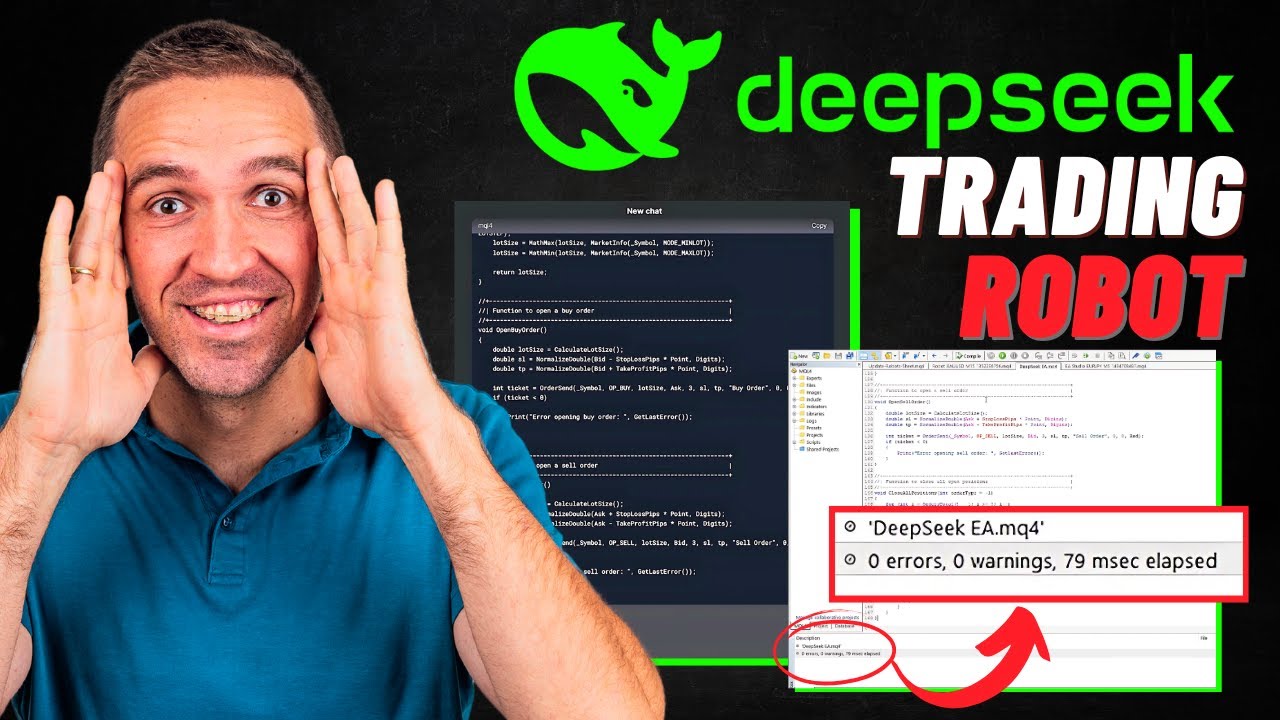
This time, DeepSeek provided a code with all required elements which upon pasting into MetaEditor, was compiled successfully with no errors or warnings.
So after several refinements, DeepSeek generated a more sophisticated EA that was successfully compiled in MetaTrader—a significant improvement over previous attempts. The process, however, was far from straightforward. It required extensive interactions, multiple prompt adjustments, and ongoing refinements to produce a working script. This highlights both the potential and the limitations of AI-driven coding—while DeepSeek can assist in automation, the success of its output still heavily depends on human oversight and iterative debugging.
However, an even bigger challenge awaited—would this refined strategy be profitable?
Backtesting Results – Does DeepSeek Trading Bot Work?
From excitement to Disappointment
With a functional EA finally compiled, it was time to determine whether it could generate profits in real trading conditions. This was done through backtesting in MetaTrader 4, using historical market data.
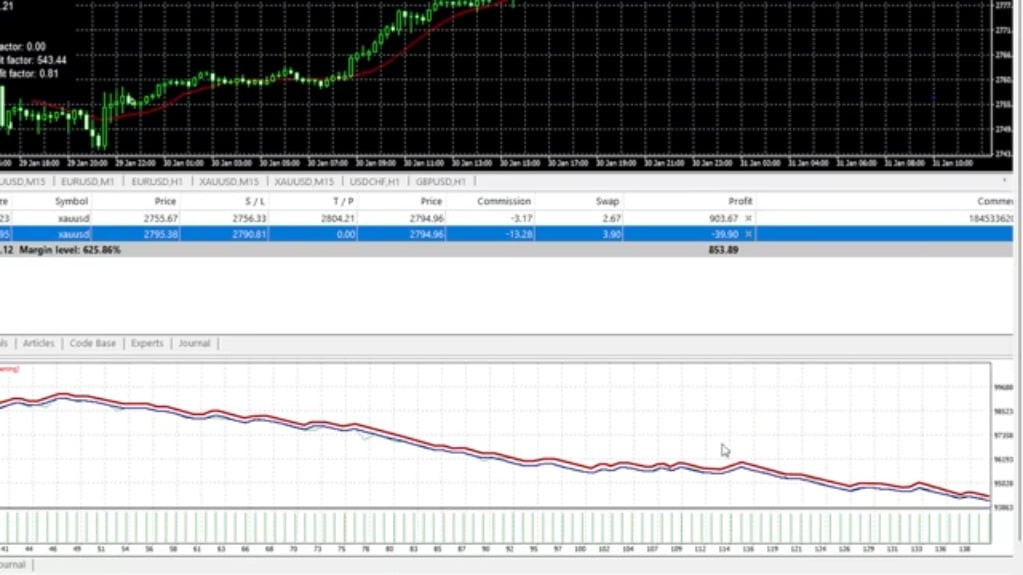
The excitement of reaching this stage quickly faded once the MetaTrader backtest results were revealed. The EA, despite being based on a strategy that had previously shown promising backtests in EA Studio, failed miserably. The backtesting graph was a complete downward trend, showing that DeepSeek’s EA was fundamentally flawed and incapable of generating sustainable profits.
Initially, there was optimism about adding custom indicators and introducing randomization options to optimize the strategy further. However, this quickly turned to disappointment as soon as the backtest was launched. The performance was an absolute loss, proving that just because an EA compiles successfully does not mean it will be profitable.
Risk Management Concerns
Additionally, a major issue with risk management emerged. The first version of the EA that successfully compiled contained a critical lot size miscalculation. Instead of following the instruction to risk 1% per trade on a 100K account, DeepSeek generated an EA that attempted to place a 30.95-lot trade on EUR/JPY. This error was a major red flag—had this EA been placed in live trading, it could have resulted in extreme volatility, leading to either an enormous gain or, more likely, a devastating loss. The only way to correct this issue was to manually lower the risk settings from the expert properties and enforce the 1% risk rule. Once corrected, the EA was backtested again, but the results remained unchanged—another losing backtest.
This stage of the experiment reinforced an essential lesson: AI-generated trading strategies cannot be trusted blindly. While DeepSeek was capable of coding an EA, it failed to apply proper risk management and could not generate a profitable trading system. The backtesting results confirmed that the AI struggled to understand financial strategies beyond basic coding principles. Without human oversight and optimization, an AI-generated EA cannot be expected to perform reliably in live market conditions.
Searching for Pre-Made EAs – Can AI Find a Profitable One
After failing to create a profitable EA from scratch, the next logical step was to see if DeepSeek AI could at least help locate profitable free trading robots available online. The idea was simple: if AI struggled with coding a winning strategy, perhaps it could find one that already exists and has been tested by other traders.
To put DeepSeek to the test, we crafted a specific prompt:
“Find the best five free expert advisors or trading robots over the internet that I can use to trade on MetaTrader. As a result, I want to see EAs that I can download for free and test them. Make sure these have track records from FX Blue or MyFXBook websites. Also, the EAs need to have a proven track record on MyFXBook and reviews on Trustpilot for the website or the brand.”
The AI took 31 seconds to process this request and provided the following five recommendations:
a default MetaTrader EA
The first result was MACD Sample EA from MetaTrader – a default MetaTrader EA preinstalled in the platform, which DeepSeek identified as a promising free expert advisor. We found it in the built-in MetaTrader 4 expert advisor folder, meaning it was neither unique nor a specialized strategy. The backtest results on EUR/USD (H1 timeframe) initially showed neutral to slightly negative performance, fluctuating without strong trends. When tested over five years, the EA demonstrated periods of minor profitability, but ultimately, the equity curve declined, making it unsuitable for real trading. Additional tests on AUD/CAD showed slightly better results, but not enough consistency to be considered a viable long-term solution. Despite DeepSeek’s suggestion, this EA was more of an example file rather than a profitable automated trading solution.
a misleading suggestion
The second suggested expert advisor was called Scalping Dream EA. This EA was suggested as a free download from community forums, and DeepSeek claimed it had a track record, strategy details, and pros and cons. However, we did further research and did not find any verifiable download link or reputable source. We also tried searching Google for this expert advisor, and came accross Scalper Dream, which turned out to be a paid EA, unrelated to any free, verifiable expert advisor. Additionally, another product called Dream Scalper Indicator appeared, but it was an indicator, not an EA. Ultimately, no actual free expert advisor under this title could be found, making this a misleading suggestion from DeepSeek. The lack of concrete evidence or MyFXBook verification further confirmed that this was not a viable recommendation.
Another built-in MetaTrader EA
Moving Average EA – Another built-in MetaTrader EA was the third suggestion. Like the MACD Sample EA, it is included by default with MetaTrader installations. DeepSeek’s recommendation suggested it as a viable free trading bot, but backtesting revealed it performed poorly on GBP/USD (M15 timeframe) with negative returns. This confirmed that the AI was simply listing preinstalled examples rather than unique profitable strategies.
Ambigous Suggestions with Lack of Track Record
The fourth suggestion was RSI EA, which we found on MQL5. However, it lacked a track record on MyFXBook or FX Blue, making it difficult to verify its profitability. Upon further investigation, it became evident that DeepSeek did not specify which RSI EA it was recommending. Searching through the platform revealed multiple versions, including a paid version called RSI Trustful Trading and an Updated RSI EA. However, without a direct link, it was impossible to confirm which EA was intended. This lack of clarity significantly reduced the usefulness of the recommendation. Additionally, none of the identified RSI EAs had MyFXBook verification or independent reviews, making them difficult to assess in terms of real-world trading performance. This further reinforced the limitations of DeepSeek AI in effectively filtering profitable EAs.
Collection of Outdated EAs
One of the more interesting suggestions by DeepSeek AI was the fifth one – a GitHub repository containing numerous free EAs, specifically the F4 and F5 EA, which is a customizable risk management EA. Unlike the previous recommendations, this time DeepSeek actually provided a direct link. Upon visiting the repository, it was evident that it contained a large number of expert advisors, but with little to no supporting documentation or track records. Most of these EAs were uploaded over three years ago, making their viability questionable in today’s market conditions.
To test DeepSeek’s recommendation, we selected randomly one EA from the collection, called Equilibrium EA, for backtesting. After downloading and adding it to MetaTrader’s Expert Advisor directory, we tested it on EUR/USD (H1 timeframe). The initial backtest showed a drop in balance, followed by a temporary recovery of around $800 in profit, before the performance flattened out and continued sideways. When tested on M5, the results varied slightly, but there was no clear sign of sustained profitability.
A major drawback of the repository was that there was no filtering mechanism to identify which EAs might be worth testing, forcing traders to manually sort and backtest each one. While some EAs showed potential in certain conditions, there was no verified performance data from platforms like MyFXBook or FX Blue, making this collection an unreliable source for serious trading applications.
Later, we tested DeepSeek capabilities one more time. We won’t be going into details here about this, but if you are interested, please follow the link – Can DeepSeek find Profitable Paid EAs.
Conclusion – Is DeepSeek Worth Using for Trading
After extensive testing, the answer to the main question is clear: No, DeepSeek AI alone is not enough to build a profitable trading strategy. While it is capable of generating functional code for trading robots, it lacks the financial reasoning necessary to create a strategy that consistently performs well. Furthermore, its ability to find profitable free EAs online is severely limited, often leading to misleading or outdated recommendations.
That said, AI tools like DeepSeek can still be useful as coding assistants rather than standalone solutions. Traders can leverage AI to generate basic scripts, but these must be rigorously tested, optimized, and manually adjusted to be viable for real trading. Blind trust in AI-generated strategies is a recipe for failure.
For those serious about automated trading, paid EAs with verified track records on MyFXBook or FX Blue are a more reliable option. Additionally, traders should invest time in manual backtesting and strategy development to ensure their bots perform under real market conditions.
If you’re interested in exploring better alternatives, consider trying EA Studio, which offers a 15-day free trial. It provides tools for building, testing, and optimizing expert advisors, ensuring you don’t rely solely on AI-generated solutions. Experiment wisely, but always backtest before trading live!
Frequently Asked Questions
Can DeepSeek AI replace EA Studio or other automated strategy builders for creating profitable trading systems?
Absolutely not. While DeepSeek generates compilable MQL5 code, it lacks an understanding of what constitutes a genuine market edge. EA Studio systematically tests thousands of strategy combinations against historical data, applying statistical validation to identify robust patterns.
DeepSeek merely translates your written instructions into code without evaluating whether those instructions represent profitable logic. Think of EA Studio as a professional chef creating recipes through experimentation and testing, while DeepSeek is a translator converting your recipe instructions into another language without tasting the result.
Is DeepSeek better than paying a freelance MQL programmer to code my trading strategy?
For simple syntax translation, DeepSeek offers faster initial drafts than waiting for freelancer responses. However, experienced MQL programmers provide crucial value DeepSeek cannot: they question illogical strategy elements, suggest improvements based on trading experience, implement proper error handling, and optimize code performance.
A skilled programmer might say “Your stop loss placement will trigger constantly in normal volatility”, feedback that prevents costly mistakes. DeepSeek blindly codes whatever you request, even if guaranteed to fail. For serious trading systems requiring money, human expertise remains irreplaceable.
Why did DeepSeek generate a 30.95 lot size when instructed to risk only 1% per trade?
This catastrophic error reveals DeepSeek’s fundamental lack of financial reasoning. Proper position sizing requires understanding account balance, currency pair pip values, leverage, and risk percentage, concepts requiring financial mathematics, not just code syntax.
DeepSeek likely misinterpreted the “1% risk” instruction or failed to implement the calculation formula correctly. This dangerous failure demonstrates why AI-generated trading code requires meticulous human verification before live deployment. A single overlooked error like this could instantly destroy an entire trading account through massive overleveraged positions.
Could DeepSeek improve with better prompts, or is the limitation fundamental to current AI capabilities?
Better prompts help marginally, my final successful compilation used extremely detailed specifications extracted from a proven EA. However, improvements hit a ceiling: AI models lack lived market experience and cannot distinguish genuinely robust strategies from cleverly curve-fitted backtests.
They cannot intuitively grasp why certain strategy elements work during specific market regimes but fail in others. This represents a fundamental limitation of current AI technology. Until AI models train directly on decades of actual trading outcomes (not just code examples), they’ll remain sophisticated translation tools rather than strategy creators.
Should beginners use DeepSeek to learn MQL5 coding and trading strategy development?
Beginners risk learning incorrect practices from AI-generated code that compiles but violates trading best practices. DeepSeek might generate working code with poor error handling, inefficient loops, or dangerous assumptions about market conditions. Learning from such examples ingrains bad habits.
Instead, beginners should study official MQL5 documentation, analyze professionally coded EAs, and follow structured courses teaching proper development practices. DeepSeek can supplement learning by explaining specific functions or converting pseudocode examples, but should never serve as the primary educational resource for trading strategy development.