

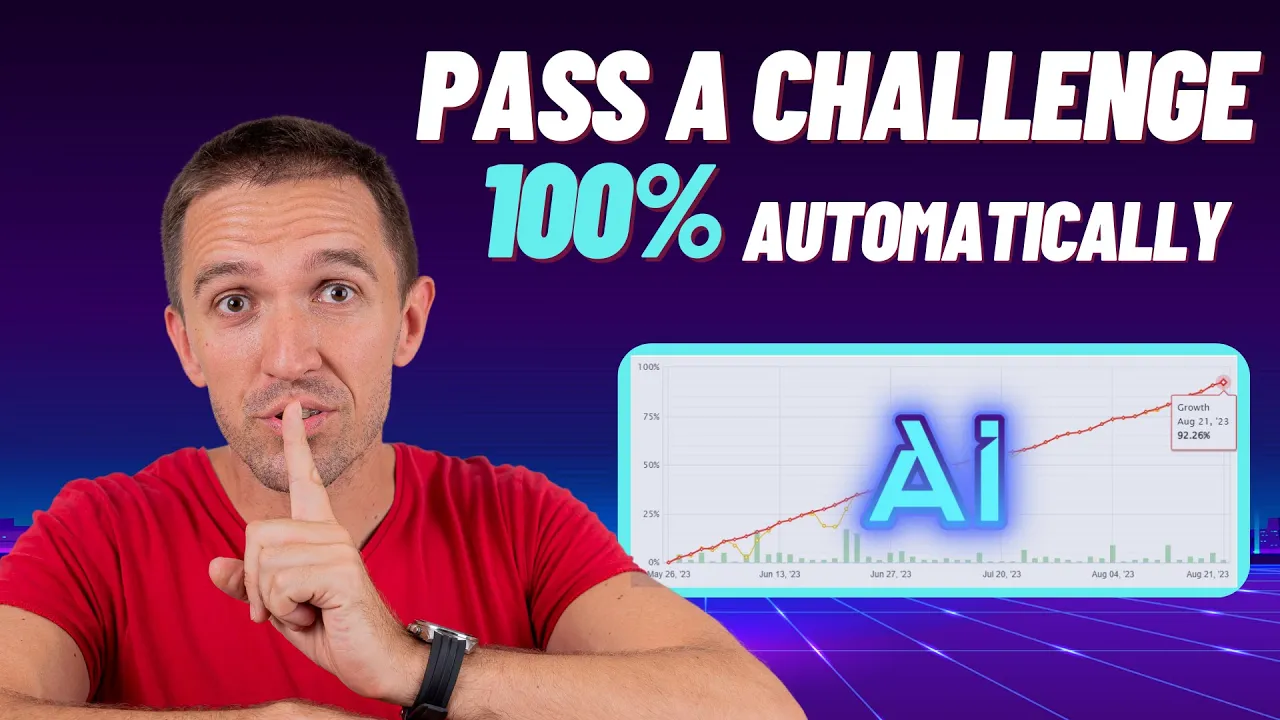
To pass a prop firm challenge, you need to hit a profit target (typically 8-10%) without exceeding a daily loss limit or maximum drawdown, while trading for a minimum number of days. Prop firms are not looking for the biggest winner in the room. They are looking for the most disciplined one. Publicly shared pass-rate figures from prop firms and trading communities often suggest that only a small minority of traders pass evaluations, though exact rates vary by firm, account size, rule set, and market conditions.
If that sounds discouraging, it should not be. Most failures come from traders who attempt the challenge without understanding the rules, without a tested strategy, and without a plan for handling pressure. This guide covers each of those gaps, step by step: what the challenge actually tests, how to structure your risk, what role Expert Advisors can play, and where most traders go wrong. Whether you trade manually or use automation, the core principles are the same.
How to Pass a Prop Firm Challenge: 8-Step Checklist
| Step | Action |
| 1 | Read every rule before buying the challenge |
| 2 | Choose a firm that fits your trading style and instruments |
| 3 | Use a strategy with historical drawdown well below the firm’s limit |
| 4 | Risk only 0.5-1% per trade |
| 5 | Set a personal daily stop before the firm’s daily loss limit |
| 6 | Trade only tested setups that match your backtested criteria |
| 7 | Reduce position size after drawdown or when approaching the profit target |
| 8 | Review trades daily and never change strategy mid-challenge |
What a Prop Firm Challenge Actually Tests
A lot of traders approach prop firm challenges with one question: “How do I hit the profit target?” That is the wrong starting point.
The real question prop firms are answering is: “Can this trader manage capital responsibly under pressure?” The profit target matters, but it is secondary to the risk rules. Firms want to fund traders who can protect the account first and grow it second. Think of it from the firm’s perspective: they are about to hand over real capital. They need confidence that the person holding it will not blow through it in a single bad session.
A typical evaluation tests a trader on:
- Ability to reach a profit target (usually 8-10%) within a set or unlimited timeframe
- Staying below the daily loss limit (commonly 3-5% of the account balance)
- Staying below the maximum overall drawdown (commonly 5-10%)
- Trading for a minimum number of days (often 5-10)
- Following any additional trading rules the firm has set
The firms that survive and pay out consistently tend to be strict about these boundaries. Breaking even one rule, even by a fraction, usually results in immediate disqualification. No appeals, no partial credit.
Key Rules, Terms, and Challenge Parameters
Before placing your first trade, understand the rules of the specific firm you have chosen. Every firm is different. Some allow holding over weekends; some do not. Some ban trading during major news events; others have no restriction. Some calculate the daily loss limit based on the starting balance of the day; others calculate it from the highest balance reached during the day, which is more punishing if you are up early and then give it back.
Here is a quick reference for common challenge parameters, based on rules published by firms such as FTMO, FundedNext, The5ers, and Topstep:
| Parameter | Typical Range | What to Watch For |
| Profit target, Phase 1 | 8-10% | Achievable with patience; rushing causes blow-ups |
| Profit target, Phase 2 | 4-5% | Lower bar, but same drawdown limits still apply |
| Daily loss limit | 3-5% | Resets daily; one bad session can end the challenge |
| Maximum drawdown | 5-10% | Cumulative; your buffer shrinks as losses add up |
| Minimum trading days | 5-10 days | Cannot pass in one lucky trade |
| Time limit | 30-90 days or unlimited | Unlimited is usually better for conservative traders |
| Profit split (once funded) | 70-90% | Varies by firm and account tier |
Understand the terms thoroughly. Do not assume that what applies at one prop firm carries over to another. The trading rules can differ in small ways that have large consequences.
Key Prop Firm Challenge Terms
| Term | Meaning |
| Prop firm challenge | An evaluation traders must pass to qualify for a funded account |
| Funded account | An account where the trader uses the firm’s capital and shares profits |
| Profit target | The percentage gain required to pass a challenge phase |
| Daily loss limit | The maximum loss allowed in one trading day |
| Maximum drawdown | The largest total account decline allowed during the challenge |
| Trailing drawdown | A drawdown limit that moves upward as the account reaches new highs |
| Static drawdown | A drawdown limit that stays fixed relative to the starting balance |
| Minimum trading days | The minimum number of active trading days required |
| Expert Advisor (EA) | An automated trading robot used on MetaTrader |
| Profit split | The percentage of profits paid to the trader after becoming funded |
Risk Management: The Skill That Separates Pass From Fail
If this article had a single takeaway, this would be it. Risk management is not one piece of the puzzle; it is the frame that holds every other piece together.
Most traders fail prop firm challenges not because they cannot find winning trades. They fail because one or two oversized losses destroy the account before the winners have a chance to accumulate.
For most prop challenges, 0.5-1% risk per trade is the practical range. At 0.5%, a trader can survive around 10 consecutive losses before reaching a 5% drawdown. At 2%, the account can fail after only three losing trades. The lower-risk approach may take longer, but it gives the strategy enough room to survive normal losing streaks.
The math makes this clear:
| Risk Per Trade | Consecutive Losses to Hit 5% Drawdown | Consecutive Losses to Hit 10% Drawdown |
| 0.5% | 10 trades | 20 trades |
| 1% | 5 trades | 10 trades |
| 2% | 2.5 trades | 5 trades |
| 3% | ~1.7 trades | ~3.3 trades |
A practical framework for challenge risk management:
- Risk 0.5-1% of the account per trade. No exceptions.
- Set a daily stop: if you lose 1.5-2% in a single session, close the platform and walk away.
- Trade only setups that match your backtested criteria. No improvising.
- Reduce position size if you are ahead and approaching the profit target; protect what you have earned.
Daily Loss Limit vs. Maximum Drawdown
These are two separate rules, and confusing them is one of the most common reasons for disqualification.
The daily loss limit (typically 3-5%) is the maximum you can lose in a single day. It resets each day, usually at a fixed time. Some firms, like FTMO, calculate this from the day’s starting equity. Others calculate it from the day’s peak equity, which is stricter because it includes unrealized gains you later gave back.
The maximum drawdown (typically 5-10%) is the total cumulative loss allowed across the entire challenge. Once equity drops below this threshold relative to the starting balance (or, in firms using trailing drawdown, relative to your highest balance), the account is closed.
Both limits must be respected at all times. You can survive ten days of small gains and still fail on day eleven if a single bad session breaches the daily cap. Understanding lot size and position sizing is essential for staying within these boundaries.
Build a Strategy That Fits the Challenge Framework
Here is something that perhaps does not get said enough: not every profitable strategy is suited for a prop firm challenge. A strategy that makes 40% a year with a 25% drawdown might work well on a personal account, but it will fail most evaluations because the drawdown exceeds what the firm allows.
You need a proven trading edge that also fits within the firm’s risk limits. That means:
- The strategy’s historical maximum drawdown should be well below the challenge’s maximum drawdown cap.
- The strategy should be capable of reaching the profit target within a reasonable timeframe at reduced risk levels.
- The strategy should be backtested across at least 6-12 months of data, and ideally longer.
You can test strategies using tools like EA Studio or Forex Strategy Builder Professional, both of which let you define entry and exit rules and run them against historical data. If the numbers do not hold up in testing, they will not hold up under live evaluation conditions.
Manual vs. automated approaches
Manual traders build their strategy around discretionary entries and exits: reading price action, watching indicators, placing orders by hand. This works if you have the discipline to follow your plan without deviation. Many successful funded traders use this approach.
Automated traders use Expert Advisors to execute trades based on predefined rules. The advantage is that EAs remove hesitation, emotional bias, and inconsistency from the process. You set the parameters, deploy the robot on a VPS, and the system runs continuously.
Both methods can pass prop challenges. The question is which one fits your personality and skill set. If you tend to deviate from your plan under stress, automation might be the better fit.
Develop a Trading Plan Before the Clock Starts
A trading plan is not optional. It is the document you follow when things go wrong, when a trade moves against you, when you are tempted to double down, or when you are ahead and thinking about taking a bigger position than your rules allow.
Your plan should include:
- Which instruments you will trade (stick to what you know)
- The timeframe or timeframes you will monitor
- The entry criteria and exit criteria for each setup
- The position size per trade, calculated against the challenge account balance
- The maximum number of trades per day
- When you will stop trading for the session (after X losses, or after X% gain)
Write this down before you buy the challenge. Not in your head. On paper or on screen. The plan should be specific enough that another trader could follow it and produce roughly similar results.
Emotional Control and the Psychology of Challenge Trading
Even traders who understand the rules and have a working strategy can fail when emotions take over. The evaluation environment creates a specific kind of pressure: you paid for the challenge, you have a deadline (real or self-imposed), and every trade feels like it carries more weight than it would on a personal account.
Emotional discipline is harder to develop than technical skill, and it matters just as much. A few patterns to watch for:
- Revenge trading: You take a loss and immediately re-enter with a larger position to “make it back.” This is the single fastest way to breach the daily loss limit.
- Profit protection anxiety: You are ahead and start tightening stops too aggressively, getting stopped out of good trades prematurely.
- Overtrading near the profit target: You are at 7% and need 8%, so you increase lot sizes or take marginal setups. The gap usually widens instead.
- End-of-deadline panic: If the challenge has a time limit, the final days often produce the worst decisions.
Emotional control does not mean you stop feeling fear or frustration. It means you act according to the plan regardless.
Using Expert Advisors to Pass Prop Firm Challenges Safely
Automated systems can be a strong fit for prop evaluations, and not just because they trade without emotion. They also solve the consistency problem. An EA runs the same strategy the same way every single session; it does not get tired, distracted, or overconfident.
Here is how the process typically works:
- Choose or build an EA designed for low-drawdown performance. If you do not code, tools like EA Studio can generate EAs based on backtested parameters.
- Backtest the EA against historical data to confirm it can reach the profit target within the challenge’s drawdown limits. Use the Historical Data App for clean tick data.
- Forward-test the EA on a demo account to confirm that live performance matches the backtest.
- Deploy the EA on the challenge account, hosted on a forex VPS for uninterrupted uptime.
- Monitor weekly. Automation does not mean abandonment.
Critical settings for challenge-specific EA deployment:
- Use conservative lot sizing (e.g., 0.01 per $25,000 or a dynamic lot mode with low deposit load).
- Set maximum daily drawdown protection inside the EA if the software supports it.
- Enable spread protection to prevent opening trades during abnormally wide spreads.
Before deploying any EA, check whether the firm bans high-frequency trading, latency arbitrage, grid or martingale systems, copy trading, tick scalping, reverse arbitrage, or third-party account management. Passing a challenge with a prohibited method can still lead to account termination or payout denial, even after you reach the profit target. Firms like FTMO, FundedNext, and The5ers publish their EA policies on their rules pages; read them carefully.
The Prop Firm Robots App from Algo Trading Space was designed specifically for this workflow, and the team publishes live challenge results from real evaluations so you can see how different EAs perform under challenge conditions.
Common Mistakes That Get Traders Disqualified
Even with a solid plan, there are traps that catch traders during evaluations. Here are the ones that appear most often.
- Ignoring the daily loss limit. The overall drawdown gets all the attention, but the daily cap is what kills most challenges. One bad session is all it takes.
- Not reading the fine print. Some firms ban weekend holding. Some ban news trading. Some require positions to be closed by a specific server time. Violating any of these results in instant failure, even if your trades were profitable.
- Changing the strategy mid-challenge. You hit a losing streak and switch from swing trading to scalping. Now you are trading an untested method under pressure. It rarely ends well.
- Over-leveraging to recover losses. After a drawdown, the instinct is to increase the lot size to claw back faster. Larger positions after losses only magnify the next loss.
- Treating the challenge fee like a lottery ticket. Some traders buy a challenge with no tested strategy and no plan, hoping for a good week. That is not a method. That is a gamble.
Fastest Ways to Fail a Prop Firm Challenge:
- Risking 2-3% per trade
- Ignoring the daily loss limit
- Trading during banned news windows
- Holding positions over the weekend when the firm prohibits it
- Switching strategies after a losing streak
- Using a martingale or grid EA without checking the rules
- Increasing lot size to recover losses
- Not reading the challenge terms before the first trade
The traders who pass prop firm challenges consistently tend to be boring. They risk small amounts, follow the same plan every day, and do not try to be heroes.
Choosing the Right Prop Firm for Your Style
Not every prop firm suits every trader. Before you spend money on a challenge, compare a few firms on the factors that actually affect your chances:
| Factor | What to Compare |
| Drawdown type | Trailing vs. static; end-of-day vs. real-time calculation |
| Profit targets | Phase 1 and Phase 2 percentages |
| Time limits | Unlimited is usually better for conservative strategies |
| Allowed instruments | Does the firm offer the pairs or assets you trade? |
| EA policy | Some firms restrict or ban automated trading entirely |
| Payout terms | Profit split percentage, payout frequency, minimum payout |
| Challenge cost | Cheaper is not always better if the rules are stricter |
| Reputation | Check reviews, payout proofs, and how long the firm has operated |
If you trade with Expert Advisors, prioritize firms that explicitly support algorithmic execution and ideally offer an algo-specific evaluation track. Firms like FTMO and FundedNext have published their EA policies, making it easier to verify what is allowed before you buy.
Algo Trading Space maintains a prop firm comparison page and publishes live challenge results from real evaluations, so you can review performance data before committing your own money.
Frequently Asked Questions
How long does it take to pass a prop firm challenge?
It depends on the firm’s rules and your risk per trade. With a 1% risk approach targeting an 8-10% profit target, most backtested strategies need roughly four to eight weeks under normal market conditions. Some firms impose a 30-day or 90-day time limit, while others, including FundedNext and several newer firms, allow unlimited time. Conservative traders who risk 0.5% per trade may need two to three months. The key principle: staying within drawdown limits matters more than passing quickly.
Can I use an Expert Advisor to pass a prop firm challenge?
Yes, many prop firms explicitly allow automated trading, and some offer dedicated algo evaluation tracks with adjusted rules. Confirm the firm’s policy before deploying, because a few firms restrict high-frequency trading or specific EA types such as martingale and grid systems. When using an EA, test it thoroughly on historical and demo data first, deploy it on a VPS for continuous uptime, and set conservative lot sizes with built-in drawdown protection. The Prop Firm Robots App was built for this workflow.
Are martingale EAs allowed in prop firm challenges?
Most major prop firms either ban or heavily restrict martingale and grid systems. The reason is straightforward: these methods increase position size after losses, which can breach the daily loss limit or maximum drawdown in a single volatile session. FTMO, FundedNext, and several other established firms list martingale as a prohibited strategy in their terms. If you are unsure, contact the firm’s support team directly before deploying. Using a banned method can lead to account termination even after reaching the profit target.
What happens after I pass a prop firm challenge?
Once you pass all phases of the evaluation, the prop firm provides a funded account loaded with their capital. You trade with the firm’s money and receive a percentage of the profits, typically 70-90%. Some firms require a two-phase challenge before granting funding; others use a single-phase model. The challenge fee you paid upfront is often refunded with your first profit split. After becoming funded, you still need to follow the firm’s ongoing risk rules to keep the account active.
Is a one-step or two-step prop firm challenge better?
Neither is universally better; it depends on your trading style. One-step challenges usually have a higher profit target (often 10%) but let you pass faster with fewer rules. Two-step challenges split the target across two phases (e.g., 8% then 5%), which can feel more manageable per phase but takes longer overall. Two-step evaluations tend to have slightly more flexible drawdown rules. If your strategy produces steady, moderate gains, a two-step model often fits better. Aggressive traders may prefer the speed of a single-step format.
Can I trade news during a prop firm challenge?
It varies by firm. Some prop firms, such as FTMO, restrict trading within a specific window around major economic releases. Others have no news restriction at all. Breaking a news-trading ban, even accidentally, typically results in immediate disqualification regardless of the trade’s outcome. Before your evaluation starts, check the firm’s restricted-events calendar and set alerts or filters in your trading platform to avoid placing orders during banned windows. If you use an EA, configure a news filter or avoid running it during high-impact data releases.
The most reliable way to prepare for a prop firm challenge is to test your strategy under realistic conditions before the clock starts. Algo Trading Space offers a free beginner course that covers strategy building, risk management, and EA deployment from the ground up. If you want ready-to-run robots designed for challenge conditions, the free EA library is a practical starting point. And for monthly updated strategies, live challenge results, and direct support, the VIP Club is where serious traders go next. Reach out to the team whenever you need a second opinion on a strategy or a firm; that is exactly what they are there for.
How to Pass Prop Firm Challenges In 2026: Fresh Insights
This update draws on new first-hand material — watch the full breakdown here:
How to Use the Track Record Program to Offset Costs
The Track Record Program is a way to recover your initial investment by sharing your success. Once you have passed a challenge and are trading a funded account, you can choose to share your results and the system you used publicly. This transparency is encouraged, as it provides valuable feedback for the community and helps others understand different trading approaches.
If you choose to participate, you can request a reward based on the cost of your challenge. For example, if you passed a challenge that cost $500, you can request a product from Algo Trading Space worth that same amount. This program is designed to turn your successful evaluation into a tangible benefit, effectively offsetting the costs of your journey.
Sharing your journey can also lead to deeper engagement. Traders who share their results and systems may be invited to participate in a podcast to discuss their strategies. This creates a win-win scenario where you gain recognition and tools, while the community gains insight into successful, disciplined trading methods.
How to select the best strategy using Out-of-Sample data
Testing with out-of-sample data ensures your strategy is robust and not just over-optimized to historical patterns. While in-sample data is used to generate the strategy, the out-of-sample period simulates live trading to verify if the edge actually exists in unseen market conditions. This step is critical to ensure that the results you see in a backtest will translate to a real evaluation.
To select the best strategy, you should arrange your results by specific criteria such as profit or profit factor. A reliable method is to prioritize the “oldest audit” strategies, which means selecting the ones that have been trading the longest within the out-of-sample period. For example, if a strategy was added 60 days ago and has remained profitable throughout that entire out-of-sample duration, it demonstrates a more consistent edge. You can use the best forex EA to automate this process, allowing you to combine different symbols and parameters to find the most stable performers for your specific challenge.
How to Pass Prop Firm Challenges In 2026: Frequently Asked Questions
Can I use one robot for multiple prop firm accounts?
Yes, you can use the same Expert Advisor across multiple prop firm accounts. The Prop Firm Robots App allows you to export as many expert advisors as you wish for one year, enabling you to trade them on whatever account you decide.
This flexibility allows you to scale your results by running different strategies or the same system across various platforms. For example, a trader might use the top three strategies for the pound to manage several different challenges simultaneously. Since the app generates new strategies continuously, you can select and combine them in many different ways to fit your specific trading needs.
Further Reading
- What Is Prop Firm Trading
- What Is the Consistency Rule in Prop Firms
- How To Pass Prop Firm Challenges
- Darwinex Zero vs Prop Firms
- Prop Firm vs Live Accounts
- Prop Firm vs Personal Capital
- Best EA For Prop Firm Challenges
- Prop Firm Robots App Complete Guide
- Best Prop Firms
- How The Top 10 Robots App Works
- How To Manage Multiple Prop Firm Accounts


Comments
No comments yet. Be the first to comment!
Leave a Comment
Your email address will not be published. Required fields are marked with *