 Petko Aleksandrov
Welcome back to my blog, where we explore the world of trading technology. Today, I will be reviewing one of the top Expert Advisors available on the MQL5 Marketplace—the Bonnitta EA MT5. Many of you have requested my thoughts on this Expert Advisor, and I’m here to provide an honest assessment. Join me as we delve into the details of this highly-priced EA and uncover its value.
Examining the Bonnitta EA
The Bonnitta EA has gained significant attention on the MQL5 Marketplace, with its price recently jumped up from $5000 to $5750. Such price adjustments are often made when there is high demand or to create a sense of scarcity, urging potential buyers to make quick decisions. However, let’s assess if this Expert Advisor truly offers value beyond its price tag.
| Specification | Details |
| Platform | MetaTrader 5 (MT5 version reviewed; MT4 also available) |
| Strategy Type | Pending Position Strategy (PPS) + Secret Algorithm |
| Indicators | Custom proprietary indicators, Trendlines, Support/Resistance, Price Action |
| Recommended Pairs | EURUSD, GBPUSD (H1 timeframe) |
| Multicurrency Support | Yes (up to 3 pairs on one chart) |
| Stop Loss | None (relies on position averaging and recovery) |
| Take Profit | Percentage-based (adjustable) |
| Max Positions | 99 buy, 99 sell (extremely high risk) |
| Positions Per Day | 20 buy, 20 sell maximum |
| News Filter | Yes (configurable) |
| Minimum Deposit | $1,000 (developer recommendation) |
| Leverage Required | Not specified (higher is better) |
| Current Price | $5,750 |
| Previous Price | $5,000 (recently increased) |
| Developer Claim | “Limited buyers only” (artificial scarcity) |
| Real Account History | MQL5 signal from 2019, 873% growth, 35.6% max DD |
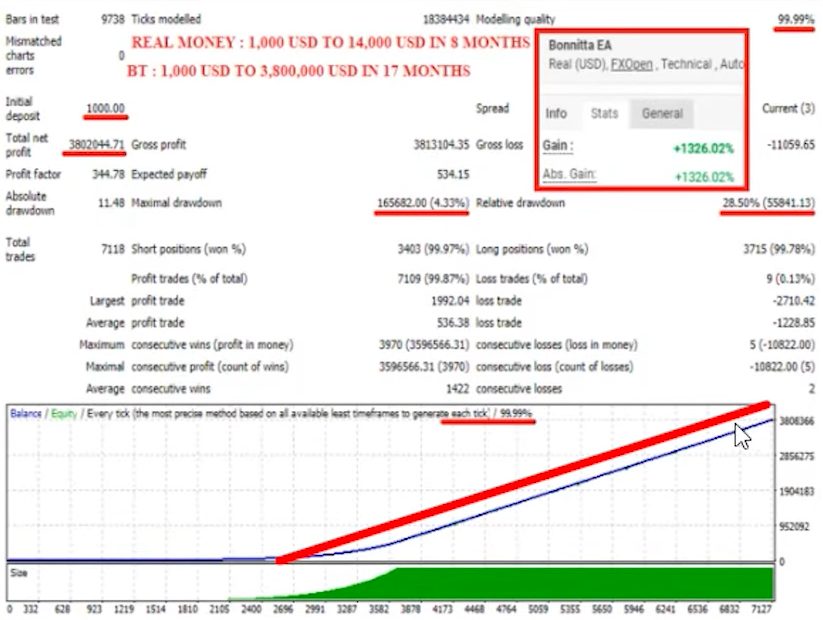
| Backtest Claims | $1,000 → $3.8M (Jan 2020 – May 2021) |
| Backtest Verification | Failed on recent data (2022-2023), failed on 1-month test |
| Code Access | No (proprietary closed-source) |
| Refund Policy | Not disclosed |
| Developer Support | Active on MQL5 marketplace (responds to comments) |
| Updates Frequency | Multiple versions released (v1.3, v1.36, v1.42+) |
| Win Rate (Claimed) | 79% (from MQL5 signal data) |
| Average Trade Duration | Not disclosed (appears to be hours to days based on charts) |
Strategy and Features
The Bonnitta EA is based on the Pending Position Strategy (PPS) and uses Custom Indicators, Trendline Support and Resistance Levels, and Price Action. It is worth noting that coding Price Action strategies is more challenging than integrating standard indicators into MetaTrader platforms. The developer claims to have conducted extensive testing, including stress tests with Slippage and Commission.
Backtest Results and Skepticism
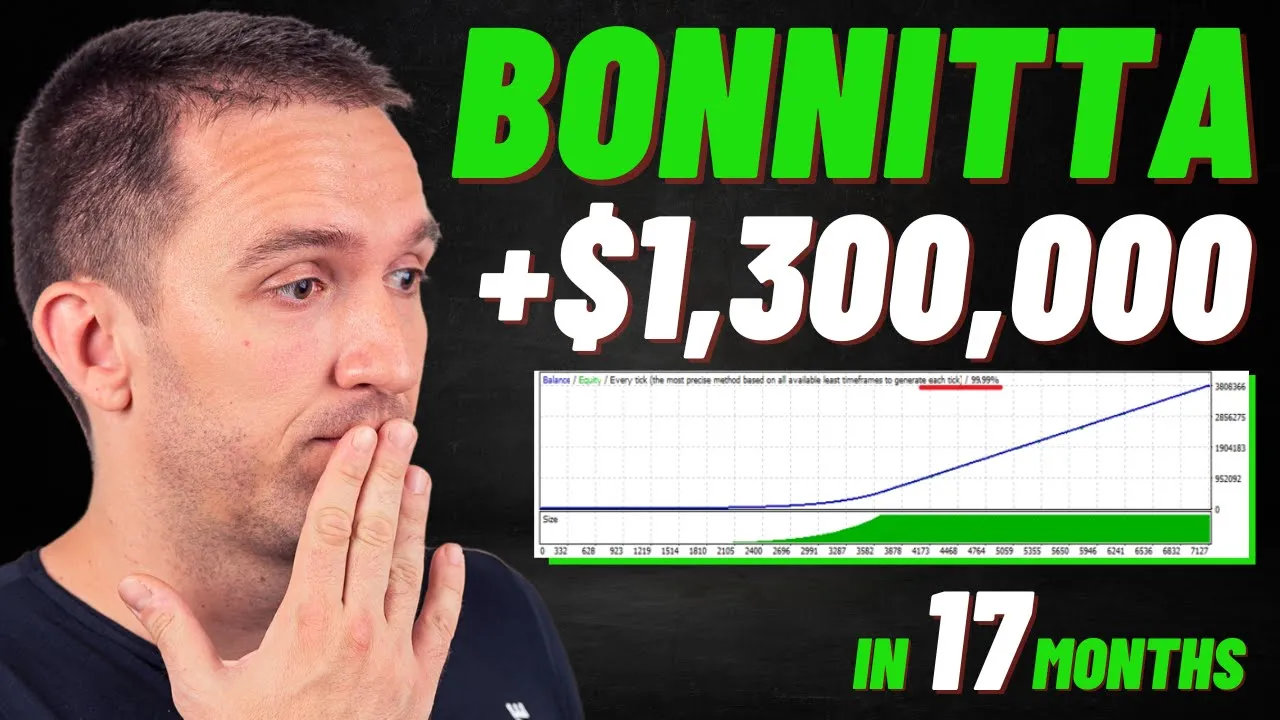
While the Bonnitta EA boasts impressive backtest results, it’s important to approach such claims with caution. Skilled developers can create EAs with outstanding backtests, but real-time trading results often differ. Let’s examine the provided images showing the exceptional equity line. However, relying solely on descriptions and images is not enough—we need to test it ourselves.
Personal Backtest and Findings
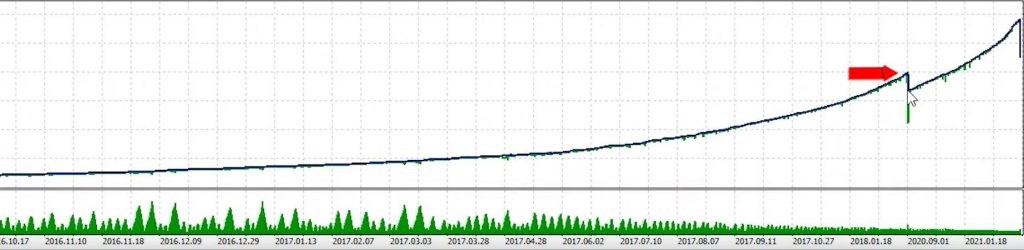
To gain personal experience, I downloaded the Bonnitta EA’s demo version and conducted a backtest. Testing it on the EURUSD pair with the H1 time frame, as suggested, I used the maximum available historical data from my MetaTrader terminal. Upon looking at the results, it became apparent that the backtest ended abruptly in 2021, raising questions about its completeness.
Inconsistencies and Further Evaluation
As I continued looking into the backtest, I encountered more inconsistencies. Attempting to test specific time frames, such as the last one year or one month, the backtest failed to provide reliable results. Such behavior is highly unusual, especially considering the price tag associated with this Expert Advisor.
Three Backtests, Three Different Outcomes
Test 1 – Maximum Available History (2016 forward): Result: Backtest completed but mysteriously stopped in 2021. The equity curve showed a dramatic drop near the end, then another huge drop before abruptly ending. Critically, the backtest refused to continue beyond 2021 despite 2022-2023 data being available.
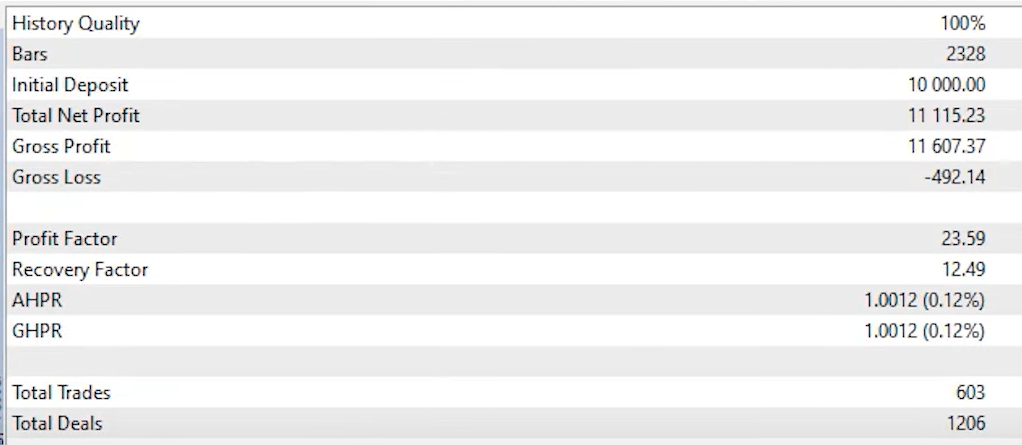
Test 2 – Last 1 Year: Result: Backtest completed successfully. Net profit: $11,000 (over 100% return). Steady equity curve with reasonable drawdowns. This is the “happy path” scenario the developer wants you to see.
Test 3 – Last 1 Month: Result: Complete failure. The backtest simply failed to run at all. No error message, no results—just failure.
What This Pattern Reveals
For a $5,750 Expert Advisor, backtest failures are unacceptable. But the PATTERN of failures is even more revealing:
- Works on historical data (2016-2020): Perfect results
- Stops at 2021: Avoids recent market conditions
- Fails on 1 month: Cannot handle current data
This suggests the EA is optimized (curve-fitted) to specific historical periods. When confronted with data outside its optimization range—particularly recent market conditions—it either fails or produces catastrophic results.
The selective success pattern points to intentional code limitations. Professional trading robots process all available historical information without discrimination. Bonnitta EA’s refusal to analyze post-2021 data indicates fundamental flaws the developer knows exist but chooses to conceal through strategic code restrictions.
The Developer’s Response to This Problem
Rather than fixing the underlying issues, the developer appears to have updated the robot’s code to ensure it continues producing “ideal” backtests on historical data while avoiding recent performance validation. The 1-star reviewer’s claim that “version 1.36 just made the cheat more evident” suddenly makes more sense in this context.
Version updates should improve functionality across all data periods. Instead, each Bonnitta EA version seems designed to maintain its historical backtest performance while systematically avoiding validation on contemporary market conditions. This approach prioritizes marketing over genuine improvements.
Why You Should Care
If an EA cannot backtest on recent data, it means one of two things:
- Technical incompetence: The code is so poorly written it breaks on modern data
- Intentional deception: The EA is designed to hide its poor recent performance
Either explanation disqualifies a $5,750 purchase. Professional EAs should backtest flawlessly across ALL available historical data, including the most recent month.
Consider the implications: you’re being asked to invest nearly $6,000 based on results from 2016-2020, with zero evidence the strategy works in 2022-2023. Market conditions change. Strategies that worked pre-2021 often fail in today’s environment. Without recent validation, you’re buying blind faith in outdated performance.
The one-month backtest failure is particularly damning. This isn’t asking for years of data—it’s requesting validation on the last 30 days. Any legitimate EA handles this trivially. Bonnitta EA’s complete failure at this basic task exposes how carefully the developer has constructed barriers preventing exposure of its contemporary inadequacy.
Analyzing the Backtest
To begin our evaluation, let’s revisit the previous backtest we conducted. As we delve into the results, we can draw some initial conclusions about this EA’s performance. The backtest reveals an impressive net profit of over $11,000, showcasing a remarkable return of more than 100% within a one-year period.
Visualizing the Backtest
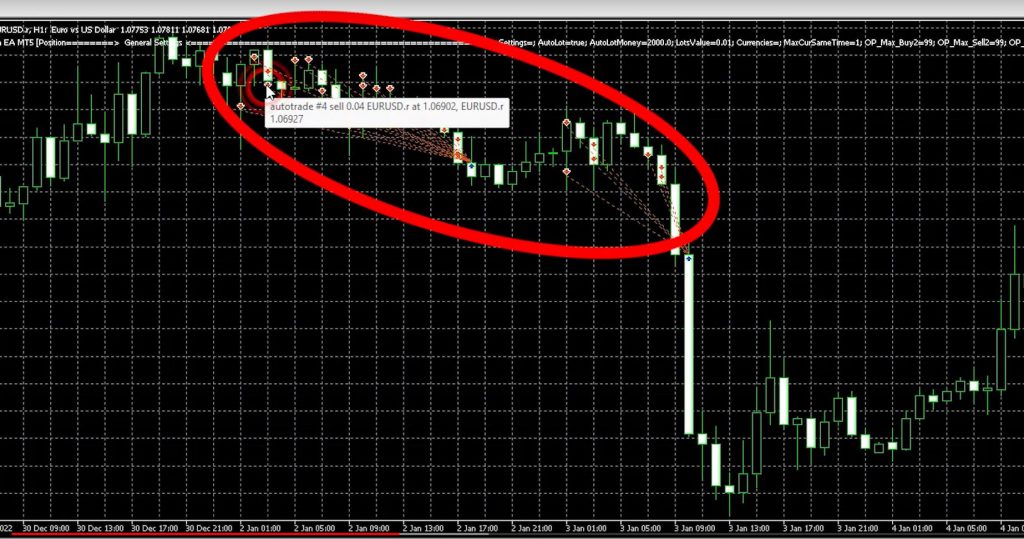
To gain a better understanding of the Bonnitta EA’s performance, let’s explore the visual representation of the backtest. Observing the chart, we can identify multiple trades being opened and closed, indicated by the appearance of candlesticks. Notably, there are instances where two trades are opened and subsequently closed within a short time frame.
Analyzing Trade Patterns
Upon closer examination, we notice that during upward market movements, the Bonnitta EA tends to open more long trades. Conversely, during downtrends, it favors short trades. This suggests that the EA could utilizes a trend-following indicator to guide its trading decisions. However, the limited information available on the chart hinders our ability to understand the strategy in greater detail.
The Trust Factor
As traders, we often find ourselves in a position of trust when evaluating Expert Advisors. The Bonnitta EA is no exception. With minimal insights gleaned from the chart and the description section provided, we are compelled to rely on the seller’s claims. This reliance on trust can sometimes be challenging, as it leaves us craving more transparency and a deeper understanding of the EA’s underlying mechanisms.
Real Account Track Record
To gain further confidence in the Bonnitta EA’s performance, let’s explore its real account track record. Examining the MQL5 Marketplace, we can assess the EA’s proven track record and verify its historical results. This information can provide additional assurance regarding the reliability of this trading tool.
Understanding the Inputs
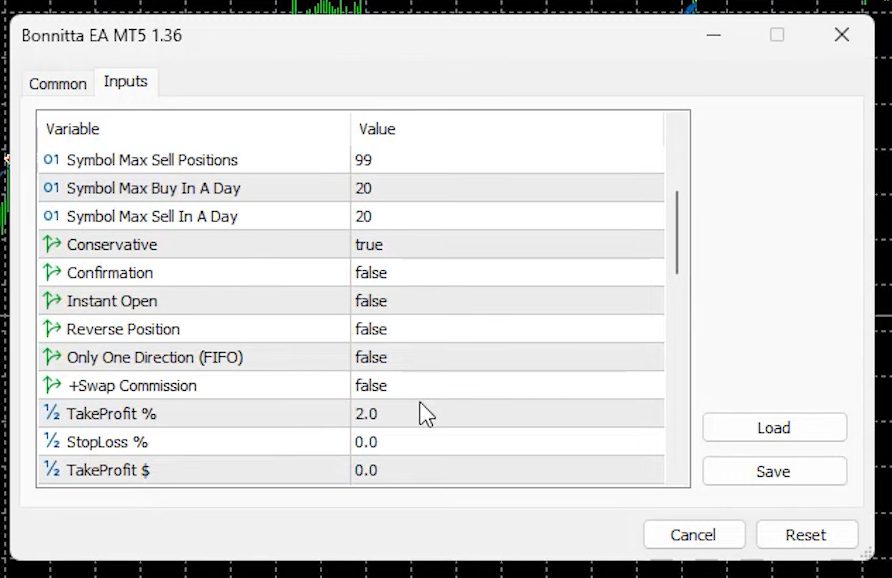
Let’s take a closer look at the inputs of the Bonnitta EA. By simply dragging the Expert Advisor onto the chart, we can access its settings. Notably, we find parameters such as Symbol Max for buy positions, which is set to 99, and Symbol Max for buy and sell positions in a day, set to 20. These values appear quite high, raising questions about their effectiveness.
The Account-Blowing Configuration
Two settings immediately concerned me:
- Symbol Max Buy Positions: 99
- Symbol Max Buy/Sell Per Day: 20
These numbers are staggeringly high. Combined with the absence of stop losses, this creates a catastrophic risk scenario.
Here’s the death spiral:
- EA opens long trade, market moves against it
- No stop loss triggers, position stays open
- EA opens another long trade (averaging down)
- Market continues lower, now 2 losing trades
- EA opens 3rd, 4th, 5th trades…
- With 20 trades per day permitted, the EA can open 20 losing positions before the day ends
- All 20 positions bleeding losses simultaneously
- No stop loss protection means no automatic exit
- Drawdown spirals until margin call
When I examined the backtested charts, I could visually confirm this behavior—clusters of 5-10 short trades all opened near the same price zone. The question became obvious: if the market had continued higher instead of eventually reversing, what would have happened?
Answer: Complete account destruction.
The EA relies on mean reversion—the assumption that price will eventually reverse and rescue losing positions. This works… until it doesn’t. During strong trending markets (like we saw in 2022-2023), this strategy fails spectacularly.
Visual Evidence from Chart Analysis
Scrolling through the backtest charts revealed repeated instances of position clustering. During one downtrend, I counted seven short positions opened within a 50-pip range. All seven remained open simultaneously, creating compounding exposure. The chart showed the blue balance line (closed trades) and green equity line (including open positions) dramatically diverging—sometimes by 30-40% of account balance.
This visual confirmation proves the EA’s systematic approach to position averaging. Each new position increases risk exponentially. With leverage amplifying exposure, seven simultaneous losing positions can easily consume 50-60% of account equity even before considering margin requirements.
Why Recent Market Conditions Expose This Flaw
This explains why:
- The EA refuses to backtest 2022-2023 data
- Recent 1-month backtest completely fails
- The 1-star reviewer claims it’s “too dangerous without stop loss”
With trending markets dominating recent years, the EA’s position-averaging-without-stops strategy has likely blown numerous accounts. The developer’s solution wasn’t to fix the strategy—it was to prevent the EA from backtesting periods where it would expose its failures.
2022 saw EUR/USD fall from 1.15 to 0.95—a 2,000-pip trend lasting months. 2023 brought USD/JPY rising from 128 to 152—another sustained directional move. These conditions devastate averaging strategies without stop losses. Each averaged position adds fuel to an account-destroying fire.
The developer knows this. Rather than implementing protective stops or reducing maximum positions, they’ve chosen code manipulation preventing validation on these catastrophic periods. The message is clear: “Don’t look at what happened recently; trust my selected historical results.”
The Margin Call Mathematics
Let’s calculate the actual risk. Assuming:
- $1,000 account (minimum recommended)
- 0.01 lot per trade (conservative sizing)
- 10 simultaneous losing positions
- 200-pip average loss per position
Total loss: 10 trades × $2 per pip × 200 pips = $4,000 loss on $1,000 account
This scenario isn’t theoretical—it’s exactly what clustered positions without stops create during trending markets. Even at micro-lot sizing, position multiplication without protective stops guarantees eventual catastrophic losses exceeding account balance.
Digging Deeper into Functionality
Upon examining the inputs, we realize that understanding how this Expert Advisor works and the indicators behind it becomes a challenging task. Despite the option to check news for various currencies, which is crucial in a high-priced EA like this, the lack of transparency regarding its functionality and code accessibility raises concerns. Trading Expert Advisors without code access can be highly risky, necessitating further investigation.
Evaluating Performance
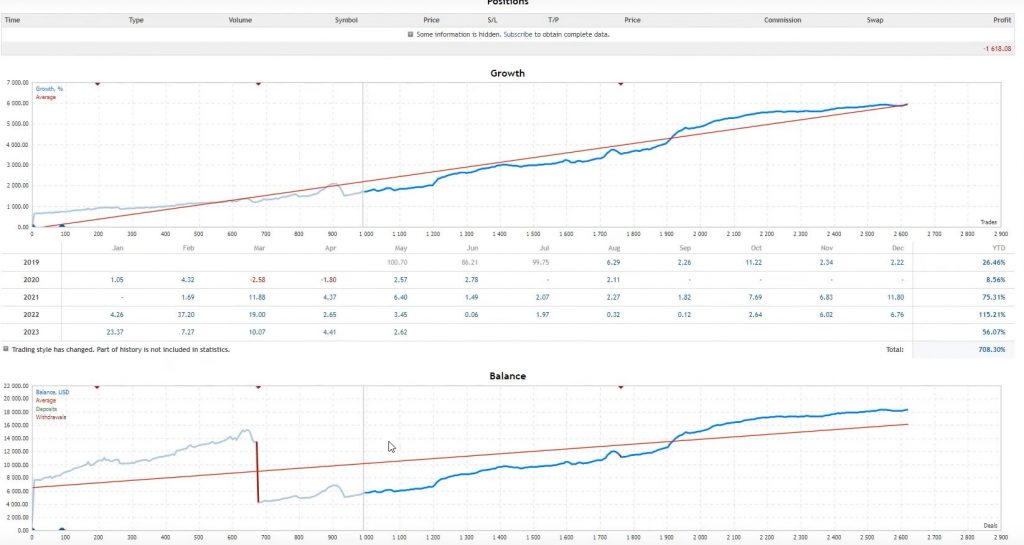
Next, let’s evaluate the performance of the Bonnitta EA. Starting from 2019, we can see some signals but a noticeable absence of reviews, which is a concerning aspect. However, an in-depth analysis reveals impressive yearly profits, especially in 2022, with returns exceeding 100%. These results are confirmed by conducting backtests on MetaTrader. Nonetheless, the absence of reviews raises suspicions and warrants a closer look at user experiences.
User Reviews – A Mixed Bag
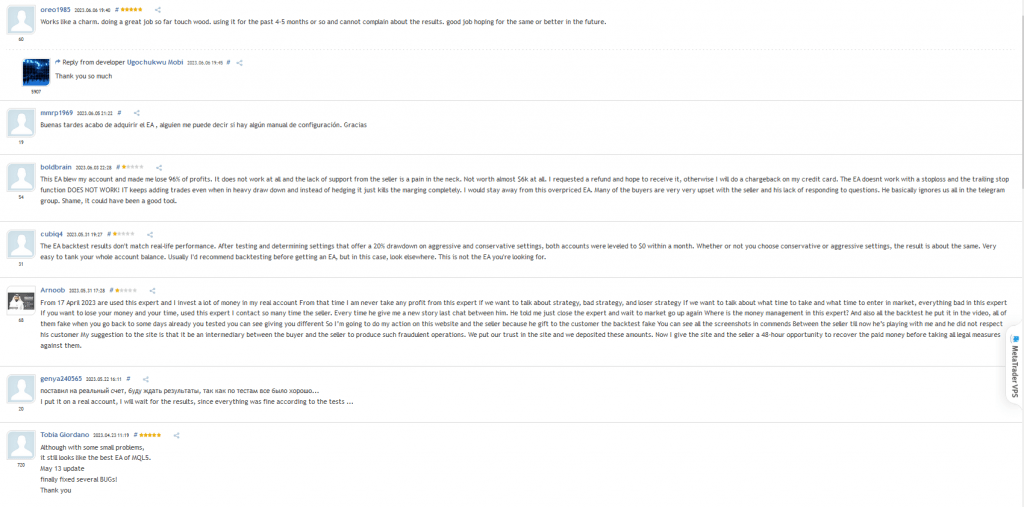
Turning our attention to user reviews, we find a majority of positive feedback, indicating satisfaction with the Bonnitta EA. However, one review stands out with a rating of 1 star. Delving into the details, the reviewer claims that the author released new versions, leading to a conclusion that it is a scam.
The reviewer mentions bugs in version 1.3 and their subsequent correction in version 1.36, which only magnified the deceit. Allegedly, the EA opens 15 times the number of real trades, allowing it to achieve impressive backtest results. This revelation, coupled with the absence of a Stop Loss, raises concerns about account safety.
The Developer’s Strategies and Backtest Dilemmas
Upon reconsidering the review, it is plausible to assume that the Bonnitta EA’s developer updates the robot with settings that ensure favorable backtest results. Such tactics make it difficult to replicate the same success in live trading. This raises doubts about the effectiveness of the Expert Advisor and the reliability of its backtest results. It is crucial to keep this in mind and approach the Bonnitta EA with skepticism.
Personal Perspective and Conclusion
As an experienced trader and reviewer, I remain skeptical of this high-priced EA available on the MQL5 Marketplace. Personally, I find the $5000 price tag exorbitant, especially considering the absence of comprehensive user reviews and the potential risks associated with limited code accessibility. I encourage you, the readers, to share your thoughts and experiences with the Bonnitta EA in the comments section. Your insights will undoubtedly be invaluable to others interested in exploring this Expert Advisor.
In the meantime, feel free to check out my review of other Expert Advisosr from the MQL5 Marketplace on my YouTube Channel and Blog Together, let’s navigate the complex world of trading software and make informed decisions to enhance our trading journey.
Frequently Asked Questions
Why does Bonnitta EA cost $5,750 when other successful EAs cost under $1,000?
The developer justifies this extreme pricing through “limited buyers only” marketing, claiming exclusivity increases value. However, legitimate successful EAs like Waka Waka ($999) and FXStabilizer ($447) prove profitability doesn’t require premium pricing. Bonnitta’s cost appears designed to exploit traders who equate high price with quality.
Combined with frequent price increases creating artificial urgency, this pricing strategy prioritizes revenue extraction over customer value. Consider whether backtesting failures and zero signal reviews justify spending 5-10× more than proven alternatives.
Can Bonnitta EA be profitable if I reduce the maximum positions from 99 to something safer like 5?
Reducing maximum positions would fundamentally change the EA’s core strategy, potentially breaking its operation entirely. The developer designed Bonnitta around position averaging and recovery, requiring multiple simultaneous trades to function as intended.
Limiting positions to 5 might prevent the averaging mechanism from executing properly, causing the EA to underperform or fail completely. More importantly, if limiting positions was viable, why wouldn’t the developer include safer default settings? The 99-position maximum suggests the strategy inherently requires dangerous exposure levels to achieve advertised returns.
Does the “secret algorithm” and proprietary indicator give Bonnitta EA an advantage over transparent strategies?
Transparency typically indicates confidence, while secrecy often conceals weaknesses. Professional EAs explain their core logic—trend-following, mean reversion, breakout trading—allowing users to understand risks and market conditions favoring the strategy. Bonnitta’s “secret algorithm” prevents this crucial understanding. You cannot evaluate whether the strategy suits current market conditions, adjust for changing environments, or troubleshoot problems when results disappoint.
Secret strategies also eliminate independent verification; you must trust the developer’s claims entirely. Proven EAs succeed through transparent excellence, not mysterious black boxes.
Is the 35.6% maximum drawdown on the MQL5 signal account acceptable for long-term trading?
Professional money managers consider 20% drawdown the upper limit for acceptable risk; 35.6% exceeds this threshold dangerously. Drawdowns above 30% create psychological stress causing most traders to abandon strategies prematurely, often at the worst possible moment.
Additionally, recovering from 35.6% drawdown requires 55% gains—nearly twice the loss percentage. Given Bonnitta EA operates without stop losses and permits 99 simultaneous positions, future drawdowns could easily exceed 50-60%, approaching complete account destruction. Conservative traders should avoid strategies regularly experiencing 30%+ drawdowns regardless of eventual recovery.
Why do some users leave 5-star reviews while others claim Bonnitta EA is a scam?
Review polarization typically indicates survivorship bias and timing-dependent outcomes. Users testing during favorable ranging market conditions (2019-2020) likely experienced the positive results shown in selective backtests, prompting 5-star reviews. Those testing during trending markets (2022-2023) probably encountered the failures causing 1-star “scam” allegations.
Averaging strategies without stops succeed brilliantly in ranging environments but catastrophically fail during trends. The developer controls which periods get validated through strategic backtest limitations. This explains why recent data fails testing—protecting the illusion works until real money encounters genuine trending conditions.