 Petko Aleksandrov
Note: MetaTrader interface steps below reflect a general workflow that has held steady across versions, but exact menu names and layout can vary by version, broker, and device. Confirm against your platform’s current documentation if something doesn’t match what you see.
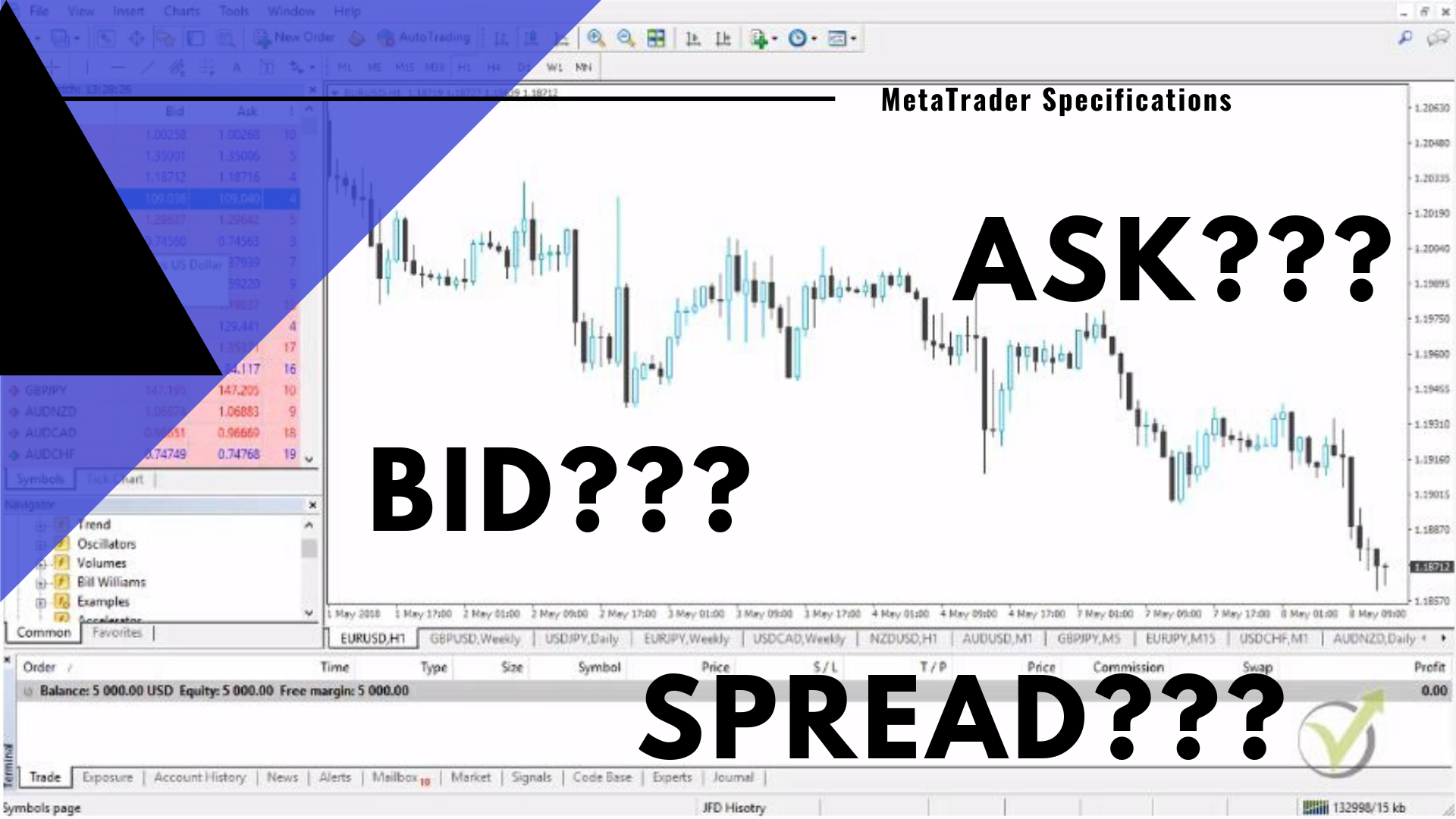
In forex, the bid is the price at which you can sell a currency pair, and the ask is the price at which you can buy it. The spread is the difference between the ask and bid prices. A long trade opens at the ask and closes at the bid; a short trade opens at the bid and closes at the ask. The spread is therefore an implicit trading cost.
For example, if EUR/USD is quoted at 1.10000 bid and 1.10012 ask, the spread is 0.00012, or 1.2 pips. That’s the whole concept in one sentence and one number. Everything below fills in the details, why that cost exists, how to calculate it precisely, why it changes, and what it actually means for the strategies and Expert Advisors most readers of this site are building.
Bid, Ask, and Spread: A Worked Example
Numbers make this concrete faster than definitions do, so let’s start there.
| Term | Meaning for the Trader | EUR/USD Example |
| Bid | Price at which the trader can sell | 1.10000 |
| Ask | Price at which the trader can buy | 1.10012 |
| Spread | Ask minus bid | 1.2 pips |
The math itself: 1.10012 minus 1.10000 equals 0.00012. Since one pip in EUR/USD equals 0.0001, that 0.00012 difference works out to 1.2 pips. A trader who buys at 1.10012 would need the bid price to rise above 1.10012 before the trade shows a profit, excluding commission and slippage. This is exactly why a freshly opened trade often starts life slightly underwater, a point worth its own section below.

The classic comparison still holds up well for beginners: this works much like a currency exchange bureau, which buys your currency at one rate and sells it back at a slightly better rate for them. The gap in a bureau is usually far wider than what you’ll see quoted between forex brokers, but the underlying logic, one price to sell, a different price to buy, is identical.
How Long and Short Trades Use Each Price
The mechanics are consistent regardless of direction, and it’s worth being precise about them since this trips up a lot of beginners.
A long position opens at the ask price and closes at the bid price. A short position opens at the bid price and closes at the ask price. That asymmetry is the entire source of the spread as a cost. The spread is normally an implicit transaction cost rather than a separately deducted fee. A long trade opens at the ask and is valued for closing at the bid, while a short trade opens at the bid and closes at the ask. You won’t see a line item labeled “spread charge” in your account history, but the cost is real, it’s simply built into the two different prices you transact at rather than billed separately.
Why Your Trade Shows a Loss the Moment It Opens
A newly opened forex trade often begins with a small unrealized loss because the trade opens at one side of the quote and would close at the other. A long position opens at the ask but is valued for closing at the bid. A short position opens at the bid but would close at the ask. The market must first move far enough to overcome the spread, plus any commission or slippage, before the position turns to an actual unrealized profit.
This isn’t a platform glitch or a broker error, however alarming it looks the first time a beginner notices it. It’s simply the spread showing up honestly the instant a position exists, rather than being hidden until you try to close it.
Pips vs Points
This distinction causes real confusion, and the terminology genuinely does shift depending on the pair and the quote format.
| Quote Format | Example | One Pip | One Point |
| Five-decimal non-JPY pair | EUR/USD 1.10012 | 0.0001 | 0.00001 |
| Three-decimal JPY pair | USD/JPY 149.123 | 0.01 | 0.001 |
For most non-JPY pairs, one pip is usually 0.0001, and on a five-decimal quote, the extra final digit is a point, or pipette, worth 0.00001, meaning ten points equal one pip. For JPY pairs, one pip is usually 0.01, and on a three-decimal quote, one point is 0.001, again with ten points making up one pip. Some trading platforms display spread in points rather than pips by default, which is worth checking, since a spread quoted as “12” could mean 12 points, or 1.2 pips, depending on how your specific platform labels it.
Calculating Spread Cost
Beyond just knowing the spread exists, it’s worth being able to put an actual number on what it costs a given trade.
Approximate spread cost = Spread in pips × Pip value × Position size
If the spread is 1.2 pips and the pip value is $10 for the selected position size, the approximate spread cost is $12. Pip value itself depends on the currency pair, your account currency, the position size, and the current exchange rate, so that $10 figure is illustrative rather than universal, it genuinely varies by trade. Most trading platforms display pip value directly, or calculate it automatically once you enter a position size, so you rarely need to work it out by hand, but knowing the formula helps you sanity-check what the platform is showing you.
Why Spreads Widen and Tighten
Spread behavior depends on both liquidity and volatility, not on volatility alone, and it’s worth separating the two.
Spreads may widen during major economic announcements, sudden market volatility, thin trading hours, daily rollover, holiday periods, weekend reopening, or general market stress. Spreads are often tighter when liquidity is deep, many participants are actively quoting, the pair is heavily traded, and market conditions are orderly. Spreads usually tighten when liquidity is deep and competition between quotes is strong. They often widen during volatile events or periods of low liquidity. This matters most for any strategy sensitive to entry price, since a spread that looks tight on a demo account during a quiet moment can widen meaningfully right when a strategy actually wants to trade, around news, for instance.
Fixed, Variable, and Raw Spreads
Not every broker or account type prices spread the same way, and these labels aren’t perfectly standardized across the industry.
| Spread Type | Meaning | Main Consideration |
| Variable spread | Changes with liquidity and volatility | Can widen sharply |
| Fixed spread | Usually quoted at a set level under specified conditions | May include higher markup or exceptions |
| Raw spread | Underlying spread with little or no markup | Usually paired with commission |
Avoid assuming these labels mean identically the same thing at every broker. A “fixed” spread account at one broker might genuinely hold steady under normal conditions but widen during extreme events despite the label, and a “raw” spread account typically pairs a very tight or near-zero spread with a separate per-lot commission, so the all-in cost needs both numbers added together, not just the headline spread figure.
Spread vs Commission: Who Actually Earns From It
The broker may earn revenue through a spread markup, commission, dealing activity, or a combination of these. The entire displayed spread should not automatically be treated as broker profit. Depending on the broker’s execution model, the displayed spread might include the underlying market or liquidity-provider spread passed through mostly as-is, a broker markup added on top, or a separate commission structure paired with a tighter raw spread. There isn’t one universal answer here, which is exactly why it’s worth checking a specific broker’s actual pricing structure rather than assuming.
It’s also worth separating two ideas that get conflated often: regulation and pricing. Regulation and trading costs are separate considerations. Compare the broker’s legal status, average spreads, commissions, execution policy, and slippage independently. A well-regulated broker isn’t automatically the one offering the tightest spread, and a broker with a very low advertised minimum spread isn’t automatically the best overall deal, since that headline figure often coexists with a higher commission, wider average spread outside the tightest moments, or restricted trading conditions elsewhere in the terms.
Total Trading Cost Goes Beyond Spread Alone
Spread is one piece of the cost picture, not the whole thing. Total trading cost may include spread, commission, slippage, swap or financing, conversion charges, and other account fees. A displayed zero spread does not necessarily mean the trade is free. Check commission, slippage, financing, and the average spread over the times you actually trade, since a broker advertising a headline zero spread on a major pair during peak liquidity may still charge a commission that adds up to a similar total cost as a broker with a modest all-in spread and no separate fee.
How Spread Affects Expert Advisors
Spread sensitivity matters more for automated, high-frequency strategies than for a trade targeting a large move, and this is genuinely one of the more common reasons a strategy that looked strong in testing disappoints once it’s live.
Automated strategies should be tested with realistic variable spreads, commissions, slippage, and execution assumptions. A fixed-spread backtest can materially overstate performance, since real spread widens exactly during the volatile moments a strategy is often trying to trade. Spread alone isn’t the only reason an EA’s live results can diverge from a backtest, either. Differences in spread, commission, slippage, data, broker time zone, and execution can cause an EA’s results to differ between accounts. A more complete list of what to check when live results disappoint includes commission, slippage, execution latency, rejected orders, variable spread behavior, the broker’s specific price feed, minimum stop distance requirements, swap charges, trading-session differences, missing or poor-quality historical data used in the original test, and position-sizing differences between the test and the live account.
Major Currency Pairs and Typical Spread Behavior
A commonly used list of major pairs includes EUR/USD, USD/JPY, GBP/USD, USD/CHF, USD/CAD, AUD/USD, and NZD/USD. Definitions vary slightly by source, so treat this as a common industry convention rather than a fixed regulatory classification. These pairs generally see the highest trading volume and the most competition among liquidity providers, which tends to keep their typical spreads tighter than less commonly traded, or exotic, pairs, though “tends to” is doing real work in that sentence, since actual spreads still depend on your specific broker and the exact moment you’re trading.
How to Display the Spread in MetaTrader
If the spread column isn’t visible in your Market Watch window by default, right-click within that panel and look for a spread option to enable it. Similarly, if you’re only seeing a limited list of tradeable assets after installing the platform, right-clicking and selecting an option to show all available symbols typically reveals the broker’s full offering, currencies, indices, stocks, commodities, and whatever else that specific broker provides.
How to Compare Broker Trading Costs
Rather than judging a broker on one advertised number, work through a fuller checklist.
| Item | What to Check |
| Average spread | Typical spread during your actual trading hours |
| Minimum spread | Whether the advertised rate is commonly available |
| Commission | Charge per lot or per side |
| Slippage | Difference between requested and filled price |
| Swap | Cost or credit for holding overnight |
| Rollover spread | Pricing around the broker’s daily reset |
| Execution policy | How orders are routed and filled |
| Account currency | Whether conversion fees apply |
| EA restrictions | Scalping, order frequency, or minimum-distance rules |
Compare average or typical spreads during your trading session rather than relying only on an advertised minimum spread, since the number on a marketing page is often the best-case figure rather than what you’ll actually see most of the time.
Frequently Asked Questions
Is a lower spread always better for a trader?
Not automatically. A very low headline spread can come paired with a higher commission, wider average spreads outside the tightest moments, poorer execution quality, or more slippage, any of which can offset the apparent savings. The more useful comparison looks at total trading cost across spread, commission, and slippage combined, evaluated during the sessions you actually trade in, rather than a single advertised minimum figure that may not reflect typical, real-world conditions.
Do all forex brokers show the same spread for the same currency pair?
No. Spread depends on the broker’s specific liquidity providers, execution model, and pricing structure, so two brokers can quote noticeably different spreads on the exact same pair at the exact same moment. Market makers, brokers who take the other side of client trades themselves, may price spread differently than brokers routing orders to external liquidity providers. This is exactly why comparing a specific broker’s actual typical spread matters more than assuming forex pricing is uniform across the industry.
Why does the spread on my broker’s demo account sometimes look different from the live account?
Demo accounts sometimes use a simplified or delayed pricing feed that doesn’t perfectly replicate live market conditions, including how spread actually widens during volatile or thin periods. A demo spread that looks consistently tight can create a misleading impression of a strategy’s real cost sensitivity. Testing spread-sensitive strategies, especially automated ones, on a live account at minimal size is usually the only reliable way to confirm how spread actually behaves under your specific broker’s real execution.
Does spread affect long-term position trades as much as short-term trades?
Not nearly as much, proportionally. A strategy targeting a 200-pip move absorbs a 1.2-pip spread far more easily than a scalping strategy targeting a 5-pip move, where that same spread represents a much larger share of the intended profit. This is a large part of why spread sensitivity gets discussed so often in the context of Expert Advisors and short-term automated systems specifically, rather than position trading, where spread is still a real cost but a proportionally smaller one.
Can spread alone explain why my Expert Advisor performs differently across two brokers?
It’s often a meaningful factor, but rarely the only one. Differences in commission structure, slippage, execution speed, the broker’s specific price feed, minimum stop distances, and swap charges can all contribute alongside spread. Before assuming spread is the sole cause of a performance gap between accounts, it’s worth checking each of these factors individually, since attributing every discrepancy to spread alone can mask other execution differences that matter just as much.
Final Summary
To sum up, bid and ask define the two prices you actually transact at, and the spread between them is a real, implicit trading cost even though it never appears as a separate line item. Calculate it precisely using the formula above, understand that it widens and tightens based on liquidity and volatility together, not volatility alone, and remember that the headline spread figure a broker advertises is rarely the complete picture of what a trade actually costs. For anyone running automated or short-term strategies specifically, testing with realistic, variable spread assumptions rather than a fixed, optimistic number is one of the more reliable ways to avoid an unpleasant surprise once a strategy goes live.