

 Petko Aleksandrov
The best USDJPY robots on our data come down to one robot, run two ways, and one robot to avoid. We tracked three USDJPY expert advisors on money we fund ourselves, and the gap between the top and bottom of this list is the widest of any roundup we have published. This page is for traders looking at automated systems on the dollar-yen pair who want real results rather than vendor claims.
The short answer: as of August 6, 2026, JapanStrike ranked first in both of its settings, while FXStabilizer PRO recorded the worst result in our entire dataset: a 93% drawdown and −89% on its tracked account.
All figures come from live accounts we own, drawn from a tracking set of 527 live and funded accounts and 122,837 closed trades. The three records run from 11 to 15 months.
Affiliate disclosure: some links here, including the “Try Now” buttons, earn us a commission if you buy, at no extra cost to you. Commissions never change the figures or the ranking, and we sell the robots on this page.
Key takeaways
- JapanStrike HighRisk ranked first: an 18% worst drawdown and a +75% return over 15 months.
- JapanStrike in its standard setting ranked second: a 21% drawdown, with every account positive at +1% to +46% over 11 months.
- The HighRisk setting drew down less than the standard one, which is the opposite of what its label suggests.
- FXStabilizer PRO ranked last with a 93% drawdown and a −89% return over 11 months, the worst figures we hold for any robot.
- Neither JapanStrike setting adds to losing trades; FXStabilizer PRO does.
How did we track and rank these USDJPY robots?
Every robot ran on capital we put up ourselves, never customer accounts, under identical rules. Think of it as independent monitoring rather than a vendor’s showcase.
- Worst drawdown is the largest fall in total account value from a high point to the following low, counting closed and open losses and ignoring deposits or withdrawals. A drop from $10,000 to $6,000 is a 40% drawdown.
- Worst open loss shows how far underwater the unclosed trades went at their deepest point, exposing robots that sit on losers while the balance looks calm.
We ranked by return against drawdown, then by record length and accounts in profit. This is live tracking rather than a controlled experiment, and grid and martingale accounts in our set skew young, so shorter records may not yet include a bad month.
What is a USDJPY expert advisor, and which types made the list?
An expert advisor is trading software that places trades on its own inside MetaTrader 4 or MetaTrader 5. MetaQuotes’ documentation describes how each running EA is tied to a chart on the MetaTrader platform and can open or close positions whenever automated trading is permitted. This primer on what an EA in forex is covers the setup side.
We sort every trading system into one of six types by what its trades show rather than its sales page; our guide to EA strategy types sets out all six. Two appear here.
Grids open equal-size positions as price moves and never scale up on losers: JapanStrike, in both its standard and HighRisk settings. Martingales add bigger trades when a position turns against them: FXStabilizer PRO. That single difference explains most of this ranking.
How do the best USDJPY robots compare side by side?
Here are all three on one screen, in ranked order. Figures are as of August 6, 2026.
How they trade
| Rank | Robot | Type | Market | Hold | Adds to losers |
| 1 | JapanStrike HighRisk | Grid | USDJPY | Intraday | No |
| 2 | JapanStrike | Grid | USDJPY | Intraday | No |
| 3 | FXStabilizer PRO | Martingale | Mostly USDJPY | Days to weeks | Yes |
Live results
| Rank | Robot | Tracked for | Win rate | Returns across accounts | Worst drawdown | Worst open loss |
| 1 | JapanStrike HighRisk | 15 months | 70% | +75% | 18% | 25% |
| 2 | JapanStrike | 11 months | 74% | +1% to +46% | 21% | 35% |
| 3 | FXStabilizer PRO | 11 months | 65% | −89% | 93% | 47% |
I did not expect the setting labeled “HighRisk” to record the smaller drawdown, the smaller open loss and the bigger return. Labels on robot settings are marketing until live data says otherwise.
Which USDJPY robots ranked highest, and why?
Each section below leads with how the robot trades, then what it did on our accounts.
1. JapanStrike HighRisk: best overall
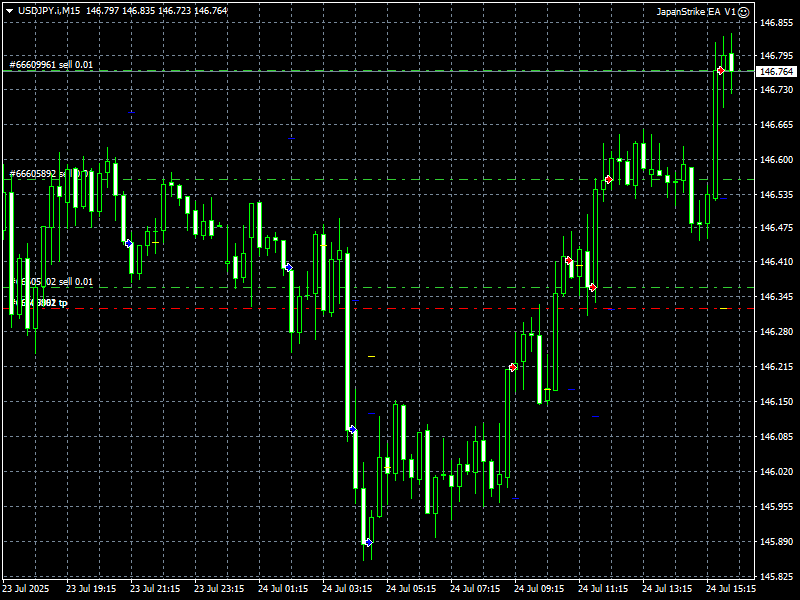
JapanStrike HighRisk is not a separate product but a risk setting of JapanStrike, a USDJPY grid. It adds same-size positions as the market swings, closes them within the day and never enlarges a losing trade.
Over 15 months, the longest record here, the HighRisk setting returned +75% as of August 6, 2026. Its worst drawdown was 18% and its worst open loss 25%, with a 70% win rate sitting beside that 18% figure. An open loss above the drawdown means it carried losing positions for a while before they recovered.
Loading trading accounts…
2. JapanStrike: best consistency across accounts
The standard version of JapanStrike uses the same grid logic on USDJPY, closing positions intraday without adding bigger trades.
Across 11 months, its accounts returned between +1% and +46% as of August 6, 2026, so every one finished in profit. The worst drawdown was 21% and the worst open loss 35%, beside a 74% win rate. It ranks second only because the HighRisk setting did better on every measure, over a longer record.
Loading trading accounts…
3. FXStabilizer PRO: the robot to avoid
FXStabilizer PRO is a martingale that trades mostly USDJPY, adding larger trades whenever a position goes against it and holding for days to weeks.
Over 11 months, its tracked account returned −89% as of August 6, 2026. The worst drawdown reached 93%, the deepest figure in our entire dataset, and the worst open loss 47%, while its 65% win rate sat beside that 93% drawdown. We sell this robot, and on this evidence I cannot recommend it to anyone.
Which USDJPY robots did we track but leave off the list?
Two more robots lead with USDJPY in our data but spread their trades across several pairs, so they belong in a multi-pair roundup rather than here. Wallstreet Recovery Pro, a martingale, recorded a 7% drawdown over 9 months with returns of +1% to +14%. Architect Algo, a grid, recorded 15% over 17 months, returning +8%.
Neither is a like-for-like substitute for a USDJPY-only robot. If you already run one, though, check its lead pair before adding JapanStrike, since both would lean on the same currency.
How do these USDJPY robots differ, criterion by criterion?
The ranking splits along mechanism first, then depth of risk and the settings a buyer chooses.
Mechanism
JapanStrike’s grid adds equal-size positions and never scales up. FXStabilizer PRO’s martingale enlarges positions on losers, the design behind rare but very large losses; our explainer on martingale EAs sets out why. On USDJPY, that difference separated a positive result from a near-total loss.
Risk shape
Across 67 martingale accounts in the broader dataset, the deepest drawdown ever recorded was 93%, and it belongs to FXStabilizer PRO. Its drawdown ran about twice its open loss, so the damage came mostly from baskets it closed at a loss rather than one position left open.
Both JapanStrike settings show the opposite shape: open losses above their drawdowns, meaning positions sat underwater for a while and then recovered. On a hypothetical $10,000 account, the standard setting’s worst open loss equals about $3,500, against $2,500 for HighRisk.
Market and session
JapanStrike trades USDJPY only; FXStabilizer PRO trades it for most of its activity. The pair is heavily traded during Tokyo hours, but our data does not break out sessions for these robots, so we cannot say whether any of them concentrates there. The tracker embeds are the place to check trade timing.
Trade frequency and holding time
Both JapanStrike settings close positions within the day, which keeps them out of the market overnight. FXStabilizer PRO holds for days to weeks, adding overnight and weekend exposure, and swap charges at most brokers, on top of its martingale sizing.
Suitability
- Prop firm challenge: JapanStrike HighRisk’s 18% drawdown is the closest fit, though its 25% open loss still needs checking against a firm’s loss rule; our beginner’s guide to prop firm challenges covers the limits.
- Small account: both grids hold several positions at once, so both need headroom; FXStabilizer PRO’s growing positions need far more.
- Long-term holding: the HighRisk setting’s 15 months is the longest record here, with +75% beside an 18% drawdown.
Which USDJPY robot should you choose?
On this pair, the choice is really about which JapanStrike setting suits you. Which describes you?
- Run JapanStrike on the HighRisk setting if you want the stronger recorded result: +75% over 15 months with an 18% drawdown.
- Run JapanStrike on the default configuration if consistency across accounts matters more: every account positive, +1% to +46% over 11 months, with a 21% drawdown.
- Avoid FXStabilizer PRO entirely on current data: −89% over 11 months with a 93% drawdown.
Whichever setting you pick, remember that our HighRisk figures come from a single return figure; the tracker shows how many accounts sit behind it. Our directory of tracked robots covers every USDJPY-led robot we follow.
What goes wrong when these robots hit a bad stretch?
FXStabilizer PRO shows the worst case in full. Over 11 months, its account fell 93% from its peak and ended down 89%, closing losing baskets again and again while adding bigger trades each time. Nine-tenths of the capital was gone before the record reached a year.
JapanStrike’s bad stretches were real but recoverable. The standard setting’s open trades went 35% underwater at their deepest, and every account still finished positive as of August 6, 2026. That is the grid pattern at its most forgiving: deep dips, followed by recovery, at least so far.
What an experienced trader would do before running any of these:
- Size the account against the worst open loss, not the average month.
- Pick one JapanStrike setting per account instead of stacking both on USDJPY.
- Never add fresh money to a martingale mid-drawdown in the hope of recovery.
- Host the terminal on a stable server so trades stay managed; this guide to choosing a forex VPS provider lists what to check.
How should you choose between the two JapanStrike settings?
The two settings split on evidence as much as on results. HighRisk recorded the stronger numbers over the longer record, but its +75% is a single figure, so you cannot see from this page how widely outcomes varied between accounts. The standard setting shows a full range, +1% to +46%, and every account in that range finished positive.
A sensible approach, if you are undecided, is to start with the setting whose worst open loss you could sit through without intervening. For HighRisk that was 25% of the account; for the standard version, 35%. Size the account for that figure, check the tracker for how many accounts back each setting, and only then decide whether the higher recorded return is worth trusting.
Verdict: what are the best USDJPY robots in 2026?
JapanStrike is the best USDJPY robot we track, and its HighRisk setting recorded the better result: +75% over 15 months with an 18% drawdown, against +1% to +46% and 21% for the standard setting, as of August 6, 2026.
FXStabilizer PRO finished lower than any other robot in our records. A 93% drawdown and −89% over 11 months is not a risk profile; it is an outcome.
I would treat the HighRisk label with caution until more accounts confirm it, but on the evidence we hold, JapanStrike is the only USDJPY robot on this list worth running.
FAQs
Why did JapanStrike’s HighRisk setting draw down less than the standard one?
JapanStrike’s HighRisk setting drew down less on our accounts, 18% against 21%, and our data cannot say exactly why. Settings change position sizing and entry rules, and results also depend on when each account started and which market conditions it met. The same pattern appears elsewhere: on another robot family we track, the “LowRisk” setting recorded a 38% drawdown against 18% for “MidRisk.” Treat any risk label as a claim to test, not a guarantee.
What happened to FXStabilizer PRO on your account?
FXStabilizer PRO lost 89% of its tracked account over 11 months to August 6, 2026, the worst result in our dataset. It is a martingale that adds bigger trades to losing positions, and its worst drawdown reached 93% against a 47% worst open loss. That gap shows it closed baskets at a loss repeatedly rather than holding a single position underwater. Its 65% win rate offered no protection; win rate says little about the size of the losses.
Is a vendor’s live signal the same as independent tracking?
A vendor’s live signal is not the same as independent tracking, because the vendor chooses which accounts to show and when to start them. The CFTC has warned that promoters of trading bots often advertise near-perfect win rates and huge returns. We publish results from our own money, including losing ones such as FXStabilizer PRO’s −89%. When reading reviews or signals, ask for the full range across accounts, not a single highlight.
How much leverage can EU retail traders use on USDJPY?
EU retail traders can open USDJPY positions at up to 30:1 leverage, the limit ESMA set for major currency pairs when it restricted CFDs in 2018. ESMA’s review also found that 74% to 89% of retail CFD accounts typically lost money. For robots that hold several positions, whether grid or martingale, each trade needs margin, and brokers must close positions once margin falls to 50% of the minimum required, often at the worst moment.
Can I run both JapanStrike settings at the same time?
Running both JapanStrike settings together is possible in MetaTrader, where each instance tags its orders with its own magic number, but it doubles exposure to one pair. Both settings trade USDJPY with the same grid logic, so a strong move would push both into open losses at once: 35% and 25% at their worst, measured separately. We have never tracked them together. If you want both, use separate accounts sized for each.
Are there USDJPY robots that trade one position at a time?
No USDJPY robot in our data trades one position at a time; every robot leading with the pair is a grid or a martingale. The single-trade robots we track trade other markets, and comparing them with JapanStrike would be a cross-market choice. Prop Firm Robots App, a multi-market trend-following robot, won 43% of trades beside a 17% worst drawdown and returned −8% to +26% over 10 months. It is a different strategy type, not a USDJPY substitute.
Related reading
- Why backtest results differ from live trading
- How to spot forex EA scams
- How to recover from a trading loss
- Forex algorithmic trading explained
Sources
- Algo Trading Space live account tracking, Trading Robot Content Brief, figures current as of August 6, 2026 (all robot performance figures).
- ESMA, “ESMA agrees to prohibit binary options and restrict CFDs to protect retail investors,” March 27, 2018: https://www.esma.europa.eu/press-news/esma-news/esma-agrees-prohibit-binary-options-and-restrict-cfds-protect-retail-investors
- CFTC, “Customer Advisory: AI Won’t Turn Trading Bots into Money Machines”: https://www.cftc.gov/LearnAndProtect/AdvisoriesAndArticles/AITradingBots.html
- MetaQuotes, MetaTrader 5 Help, “Expert Advisors and Custom Indicators”: https://www.metatrader5.com/en/terminal/help/algotrading/trade_robots_indicators
Risk and affiliate disclosure
Trading forex with expert advisors carries a real risk of losing some or all of your capital, as FXStabilizer PRO’s −89% on our account shows. The results above are historical figures from accounts we own and do not predict future performance.
Some links on this page are affiliate links. If you buy through them, Algo Trading Space may earn a commission at no extra cost to you; this never affects the data we publish or which robot we recommend.


