 Petko Aleksandrov
Important: Forex trading involves significant risk of loss. The majority of retail trader accounts lose money when trading forex with leverage. This guide is for educational purposes only and does not constitute financial advice. Never risk more than you can afford to lose.
Forex trading from home allows anyone with a computer, an internet connection, and a trading account to access the global foreign exchange market 24 hours a day, five days a week. In this guide, you will learn how to trade forex from home step-by-step, how to choose a reliable forex broker, how to use a trading platform, how to manage risk, and how to place your first trade safely as a beginner.
This guide is written by Petko Aleksandrov, founder of Algo Trading Space and EA Trading Academy, with over a decade of live trading experience across manual and algorithmic strategies, and over 100,000 students educated globally across 200 countries.
Quick Facts
| Feature | Details |
| Market Name | Foreign Exchange Market (Forex / FX) |
| Market Hours | 24 hours a day, 5 days a week |
| Most Traded Pair | EUR/USD |
| Other Major Pairs | GBP/USD, USD/JPY, USD/CHF, AUD/USD |
| Minimum Deposit | From $50 to $200 (varies by broker) |
| Best Platforms | MetaTrader 4, MetaTrader 5, cTrader, TradingView |
| Leverage Range | 1:30 (EU/UK regulated) to 1:500 (offshore regulated) |
| Skill Level | Beginner-friendly with proper education |
| Risk Level | High, due to leverage and market volatility |
What Is Forex Trading?
Forex trading involves buying and selling currencies in the foreign exchange market with the aim of profiting from changes in exchange rates. When you trade forex, you are simultaneously buying one currency and selling another. For example, if you buy EUR/USD, you are buying euros while selling US dollars, expecting the euro to strengthen against the dollar.
The foreign exchange market is the largest and most liquid financial market in the world, with daily trading volume exceeding $7 trillion. Unlike stock markets, the forex market has no central exchange. It operates through a global network of banks, financial institutions, brokers, and individual traders, accessible from home through an online brokerage account and a trading platform.
Forex trading involves exchanging one currency for another based on the current exchange rate, with the difference between your entry and exit price determining your profit or loss. Because forex is traded on margin, relatively small deposits can control much larger positions, which amplifies both potential gains and potential losses.
How Does the Foreign Exchange Market Work?
The foreign exchange market operates across four major trading sessions that follow the sun around the globe: Sydney, Tokyo, London, and New York. These sessions overlap at certain times, creating periods of higher liquidity and tighter spreads.
The London and New York session overlap, typically from 13:00 to 17:00 UTC, is widely considered the most active and liquid period of the trading day. Major currency pairs like EUR/USD and GBP/USD see the highest volume and the tightest spreads during this window, making it the most cost-effective time for home traders to be active.
Prices in the forex market move continuously in response to economic data releases, central bank decisions, geopolitical events, and overall market sentiment. As a home trader, you access this market through a regulated broker offering forex accounts, which connects your trading platform directly to the interbank pricing network.
Understanding Currency Pairs
Forex trading is always conducted in currency pairs, where the first currency is called the base currency and the second is the quote currency. The price shown for a currency pair tells you how much of the quote currency is needed to buy one unit of the base currency.
Major pairs involve the US dollar and one other major world currency. They are the most liquid and have the tightest spreads:
- EUR/USD (Euro vs US Dollar) — the most traded forex pair globally
- GBP/USD (British Pound vs US Dollar)
- USD/JPY (US Dollar vs Japanese Yen)
- USD/CHF (US Dollar vs Swiss Franc)
- AUD/USD (Australian Dollar vs US Dollar)
- USD/CAD (US Dollar vs Canadian Dollar)
Minor pairs (also called cross pairs) involve two major currencies but exclude the US dollar, such as EUR/GBP or EUR/JPY.
Exotic pairs combine a major currency with the currency of an emerging or smaller economy, such as USD/TRY or EUR/ZAR. These tend to have wider spreads and higher volatility.
For beginners trading forex from home, starting with EUR/USD is widely recommended due to its high liquidity, tight spreads, and the volume of educational material available for this specific pair.
How to Trade Forex From Home: Step-by-Step
Step 1: Educate Yourself First
Before opening a brokerage account or depositing any money, invest time in understanding how forex markets work, what moves currency prices, and how leverage and margin function. The majority of retail traders who lose money do so because they begin trading before they have the knowledge and discipline to manage risk effectively. Free educational resources, demo accounts, and structured courses all provide a solid foundation before any real capital is committed.
Step 2: Choose a Regulated Broker
Select a reliable forex broker regulated by a credible authority such as ASIC (Australia), FCA (UK), or CySEC (Cyprus). Regulation ensures your funds are held in segregated accounts, that the broker operates under strict financial reporting requirements, and that you have access to an independent dispute resolution process. Never deposit money with an unregulated broker.
Step 3: Open and Verify Your Account
Complete the broker’s online registration, provide identity verification documents (government-issued photo ID and proof of address), and complete the suitability questionnaire. Most brokers verify accounts within 24 hours.
Step 4: Start With a Demo Account
Before risking real money, open a demo account and practice trading under live market conditions with virtual funds. A demo account replicates real spreads, execution speeds, and price movements. Use it to learn the platform, test your strategies, and develop discipline. Only move to a live account when you are consistently profitable in demo conditions over a meaningful period.
Step 5: Fund Your Live Account
Once ready, deposit funds using your preferred method: credit card, bank transfer, or e-wallet. Start with the minimum deposit if available, and only risk capital you can afford to lose entirely. The forex market is high-risk, and no trading strategy is guaranteed to be profitable.
Step 6: Select Your Currency Pair
Open your trading platform and select a currency pair to trade. For beginners, EUR/USD is the recommended starting point due to its tight spreads and high liquidity. Search for it in the platform’s market watch or symbol list.
Step 7: Analyze the Chart
Before placing a trade, conduct basic analysis. Identify the current trend on the daily or 4-hour chart, look for key support and resistance levels, and check the economic calendar for any scheduled data releases that could affect the pair. On MetaTrader, TradingView, or cTrader, this analysis is done directly on the charting tools built into the platform.
Step 8: Place Your Trade
Decide whether to buy (go long, expecting the price to rise) or sell (go short, expecting the price to fall). Right-click on the chart in MetaTrader or use the new order button to open the order panel. Set your lot size based on your risk tolerance, and always set a stop-loss order to limit potential losses. Consider setting a take-profit level to automatically close the trade when your target is reached.
Step 9: Set Your Stop-Loss
A stop-loss is a pre-set price level at which your trade closes automatically if the market moves against you. Every trade should have a stop-loss. Setting it before the trade opens, not after, is a fundamental discipline that separates consistent traders from those who blow their accounts.
Step 10: Monitor and Review
Once your trade is active, monitor it without over-managing. Review your stop-loss and take-profit levels as the trade develops, and close positions when your criteria are met. After every closed trade, record the outcome in a trading journal and review what worked and what did not.
How to Choose a Forex Broker From Home
Choosing a reliable forex broker is one of the most important decisions a home trader makes. Here is what to evaluate:
- Regulation: Only use brokers regulated by recognized authorities. ASIC (Australia), FCA (UK), and CySEC (Cyprus) are Tier 1 and Tier 2 regulators that enforce fund segregation, transparency, and negative balance protection. Offshore entities regulated by the FSA (Seychelles) or IFSC (Belize) offer lighter protections.
- Spreads: The spread is the difference between the buy and sell prices of a currency pair. On EUR/USD, raw ECN spreads can be as low as 0.0 to 0.1 pips at competitive brokers, with a small per-lot commission. Standard accounts typically include wider spreads from 0.6 pips upwards with no commission. Lower spreads reduce your cost per trade, which matters significantly over time.
- Execution speed: Fast, reliable execution reduces slippage, particularly important during news events and for active trading strategies. Look for brokers with infrastructure hosted near major financial data centers.
- Deposit and withdrawal methods: A reliable forex broker should support multiple deposit methods, including bank transfer, credit and debit cards, and e-wallets such as Skrill, Neteller, or PayPal, with fast processing times and no broker-side withdrawal fees.
- Platform support: Confirm the broker supports your preferred platform. MT4 and MT5 are the most widely supported and suitable for both manual and automated trading. cTrader suits traders who want advanced order management. TradingView is popular among chart-focused traders.
- Swap fees: If you hold forex positions overnight, swap fees (also called rollover fees) are charged. Check the broker’s published swap rates before committing to strategies that involve holding positions for multiple days.
- Customer support: A quality broker provides 24/5 or 24/7 support via live chat, email, and phone. Test the support quality before depositing by asking a pre-sales question.
Forex Trading Platforms for Home Traders
MetaTrader 4 (MT4)
MT4 is the most widely used forex trading platform in the world. It is free to download through most regulated brokers, supports manual and automated trading via Expert Advisors, and includes a full suite of technical analysis tools, including 30 built-in indicators, multiple chart types, and nine timeframes. MT4 is the recommended starting platform for most beginner home traders and the industry standard for algorithmic forex trading.
MetaTrader 5 (MT5)
MT5 is the successor to MT4 with additional timeframes, more built-in indicators, a built-in economic calendar, depth of market data, and access to additional asset classes, including stock and futures CFDs. It supports more advanced backtesting and is better suited to traders who want multi-asset exposure beyond forex.
cTrader
cTrader is an advanced platform popular with professional and algorithmic traders. It offers Level II pricing, detachable charts, a wide range of order types, and cTrader Automate for algorithmic strategy deployment using C# code. The platform is clean, fast, and well-suited to discretionary traders who execute many trades per session.
TradingView
TradingView is a web-based charting platform that many traders use for analysis before executing orders through a connected broker account. It features a large community of traders who publish and share analysis, making it particularly useful for beginners who want to learn by observing how experienced traders approach the markets.
Understanding Leverage and Margin
Leverage is one of the most important and most misunderstood concepts in forex trading. It allows you to control a position larger than your actual account balance by using borrowed capital from your broker.
For example, with 1:100 leverage, a $500 account can control a $50,000 position. If the trade moves 1% in your favor, you gain $500, doubling your account. If the trade moves 1% against you, you lose your entire $500 deposit.
Forex margin is the deposit required to open and maintain a leveraged position. It is expressed as a percentage of the full trade value. At 1:100 leverage, the margin requirement is 1%, meaning a $50,000 position requires $500 in margin.
Leverage available to home traders varies significantly by jurisdiction. Under EU and UK regulations (ESMA and FCA), retail traders are limited to a maximum of 1:30 on major forex pairs. Under ASIC (Australia), the limit is 1:30. Offshore-regulated entities may offer leverage up to 1:500, which carries substantially higher risk.
Higher leverage is not inherently better. Most professional traders use leverage conservatively, often 1:10 or less, regardless of what their broker offers. The most common cause of account blow-outs among beginner traders is excessive leverage combined with no stop-loss.
Risk Management When Trading Forex From Home
Risk management is the most critical skill in forex trading, and it is what separates traders who survive long enough to become profitable from those who deplete their accounts in weeks or months. This is a YMYL topic, and these principles should be taken seriously before any live trading begins.
- The 1-2% rule: Never risk more than 1 to 2% of your total account balance on a single trade. This means that even a losing streak of 10 consecutive trades would reduce a $1,000 account by $100 to $200, leaving sufficient capital to continue trading and recover.
- Always use a stop-loss: Every trade must have a stop-loss set before the trade opens. Removing or moving a stop-loss in the hope of a trade recovering is one of the most damaging habits a new trader can develop. Define the price level at which your analysis is invalidated, and put the stop there.
- Understand drawdown: Drawdown is the reduction in account value from a peak to a trough during a losing period. Every strategy, including profitable ones, experiences drawdowns. Understanding and accepting a realistic maximum drawdown for your strategy is essential before trading with real money.
- Control position sizing: Position size should be calculated based on your stop-loss distance and the percentage of your account you are willing to risk per trade, not on how large a position you want to take. Most trading platforms include position size calculators to assist with this.
- Keep a trading journal: Record every trade: the entry and exit price, the reason for the trade, the outcome, and what you learned. A journal is the most effective tool for identifying patterns in your behavior, improving decision-making, and tracking your development as a trader.
- Limit leverage: Use the minimum leverage necessary for your strategy. If your strategy works at 1:10, there is no reason to use 1:100. The greater the leverage, the faster a single bad trade can cause disproportionate damage to your account.
Popular Forex Trading Strategies
- Trend trading: Identifying and trading in the direction of the prevailing trend on higher timeframes, using pullbacks on lower timeframes to find entries. This is one of the most consistent approaches for beginner traders.
- Breakout trading: Entering a trade when the price breaks convincingly above resistance or below support, often following a period of consolidation. Effective around major news releases and on key technical levels.
- Support and resistance trading: Using historical price levels where the market has previously reversed or stalled to plan entries and exits. Major round numbers and daily pivot points are commonly used reference levels on EUR/USD and GBP/USD.
- Scalping: Taking many small trades throughout the day, targeting a few pips per trade with tight stops. Requires fast execution, very low spreads, and a disciplined mindset. Suited to raw ECN accounts with sub-40ms execution speeds.
- Swing trading: Holding trades for one to several days, targeting larger price moves driven by macro themes or technical patterns. More suited to home traders who cannot monitor the market constantly during the day.
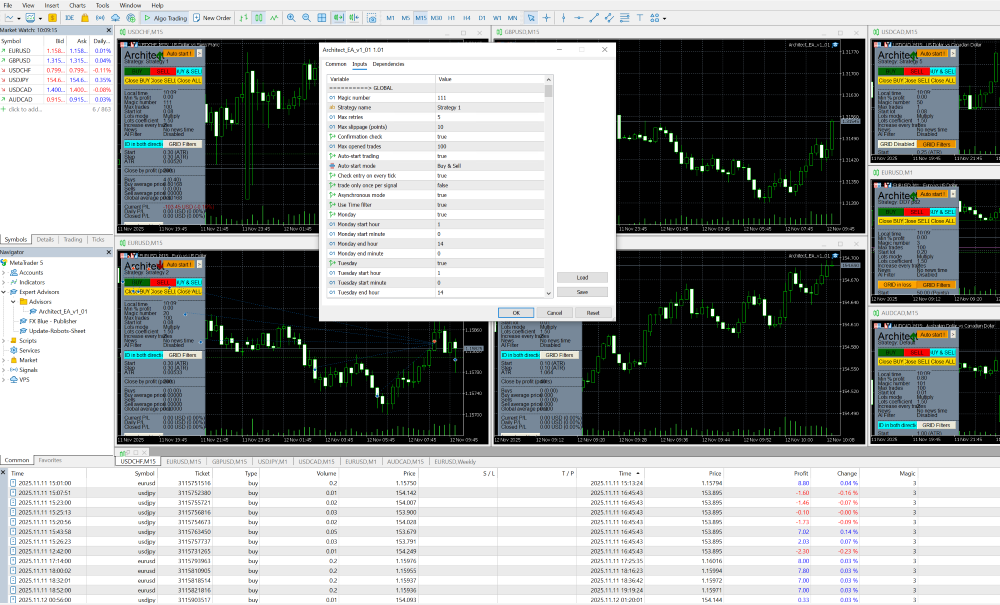
- Algorithmic trading: Using Expert Advisors (EAs) on MetaTrader to automate your forex trading strategy. EAs execute trades based on pre-programmed rules, removing emotional decision-making and allowing strategies to run 24/5 without manual intervention. This approach is a core part of the methodology taught and practiced at Algo Trading Space, where live EA results on real accounts are published and updated regularly.
Can You Trade Forex From Home Profitably?
Yes, but the realistic picture requires transparency. Forex trading from home can be profitable, but it demands significant time commitment, continuous learning, and disciplined risk management. The majority of retail traders who enter the forex market lose money, primarily due to overuse of leverage, absence of a tested strategy, and emotional decision-making.
- Time commitment: Becoming a consistently profitable forex trader typically requires months of demo trading, strategy testing, and post-trade analysis before reliable results emerge on a live account.
- Capital requirements: You do not need a large account to start, but very small accounts (under $200) are difficult to manage sustainably with proper position sizing. A realistic starting capital for a home trader is $500 to $2,000, traded with conservative leverage and strict risk management.
- Learning curve: The learning curve for forex is real but manageable. Traders who focus on one currency pair, one strategy, and consistent journaling progress considerably faster than those who trade many pairs with multiple approaches simultaneously.
- Risk expectations: Treat initial live trading as a continuation of your education, not as income generation. Consistent monthly profitability across six months or more of live trading, with drawdowns within acceptable limits, is the benchmark for genuine reliability.
Setting Up Your Home Trading Environment
A reliable home trading setup does not need to be expensive, but it does need to be stable. The following are the minimum requirements for a functional home trading environment.
- Hardware: A modern laptop or desktop computer with at least 8GB of RAM and a processor capable of running trading platforms smoothly. A dedicated monitor or a second screen significantly improves comfort during active trading sessions, particularly when monitoring multiple charts.
- Internet connection: A stable, wired internet connection is strongly preferred over WiFi for live trading. Connectivity drops during an active trade can prevent you from closing positions or adjusting stop-losses at critical moments. A minimum speed of 10Mbps is sufficient; latency and stability matter more than raw speed.
- Power backup: An uninterruptible power supply (UPS) is worth considering if your local electricity supply is unreliable. Losing power with open positions can be costly, particularly at times of high volatility.
- Trading platform: Download MT4 or MT5 directly from your broker’s website or from the official MetaQuotes website. Keep the platform updated and ensure your broker’s server address is correctly configured in the connection settings.
- VPS for automated trading: If you intend to run Expert Advisors or other automated strategies, a Virtual Private Server (VPS) hosted near your broker’s data center allows your strategies to run 24/5 without your home computer being on. Many ECN brokers offer free VPS to active traders who meet minimum monthly volume thresholds.
Frequently Asked Questions
Can beginners trade forex from home?
Yes. Forex trading is accessible to complete beginners through regulated broker platforms with demo accounts, educational resources, and low minimum deposits. However, beginners should spend significant time on a demo account before risking real money, and should prioritize learning risk management above everything else.
How much money do I need to start forex trading from home?
Most regulated forex brokers accept minimum deposits of $50 to $200. However, trading sustainably with proper position sizing is more realistic with $500 or more. Very small accounts make it difficult to apply the 1-2% risk rule per trade without position sizes too small to generate meaningful results.
Is forex trading legal from home?
In most countries, yes. Retail forex trading through a regulated broker is legal in the majority of jurisdictions. Regulations vary by country; for example, US citizens must use CFTC and NFA-regulated brokers, which significantly limits the available broker options compared to traders in other regions.
What platform is best for trading forex from home?
MetaTrader 4 remains the most widely used and beginner-friendly forex platform globally. It is free, supported by the vast majority of regulated forex brokers, and provides everything needed for both manual and automated trading. MT5 is better for traders who want access to additional asset classes. TradingView is preferred by traders who prioritize charting and analysis.
Can I trade forex part-time from home?
Yes. Forex’s 24/5 market hours make it well-suited to part-time traders. Many home traders focus on the London/New York session overlap in the early afternoon (UTC) when liquidity is highest, or use swing trading strategies that require only a few minutes of chart analysis per day.
Automated trading via Expert Advisors is another option that allows strategies to run continuously without requiring active monitoring.
What is a demo account, and should I use one?
A demo account is a practice trading account funded with virtual money that replicates real market conditions. All serious traders should use a demo account before trading live. It allows you to learn the platform, test strategies, and develop discipline without financial risk. The transition to a live account should only happen once you are consistently profitable on the demo over a meaningful period.
Is forex trading the same as CFD trading?
Forex and CFDs are closely related. Most retail forex brokers offer currency pairs as CFDs (Contracts for Difference), meaning you are speculating on price movements without owning the underlying currency. This is the most common form of online forex trading for retail traders at home. Pure spot forex trading, where currencies are physically exchanged, is the domain of institutional and interbank trading.
Further Reading
- How To Trade Forex For Beginners
- Best Forex Strategies
- Forex Indicators
- Best Currency Pairs To Trade
- How To Create A Forex Trading Without Coding
- Best Forex Brokers
- Best Forex Robots For Trading
- What Is A Magic Number In Forex
- What Does FX Stand For
- Best Forex VPS For MetaTrader
- What Is Forex Algorithmic Trading
- How To Become A Successful Forex Trader