


Grid trading is one of those strategies that generates strong opinions. Some traders swear by it; others have watched it blow accounts they spent months building. The truth, as usual, sits somewhere in the middle. Grid EAs open additional trades at set intervals as price moves against an initial position, building a basket of orders that closes collectively at a profit when conditions allow. Done right, with appropriate risk settings and sufficient margin, this approach can produce remarkably consistent returns. Done wrong, it can accelerate losses faster than almost any other automated method.
I have been testing forex grid EAs on live and demo accounts for a considerable time, and the seven systems on this list earned their place through actual performance data, credible vendor histories, and honest track records. Not all of them are pure grid systems in the strictest sense. Some blend grid mechanics with trend-following logic or martingale elements. Understanding those differences before you commit capital matters more than most marketing materials will tell you.
Forex grid EAs are automated expert advisors that place a series of buy or sell orders at defined price intervals, building a basket of trades that collectively close at a target profit level. The best forex grid EAs combine disciplined order spacing, appropriate equity management, and clear risk limits to balance the strategy’s profit potential against its inherent drawdown risk.
One more thing before we get into the picks: martingale EAs can be highly profitable in favorable conditions, but they carry a different risk profile than fixed-lot systems. Several systems on this list use martingale or grid elements. That is not a disqualification, but it is something every trader should understand clearly before going live.
Disclosure: This page contains affiliate links. Algo Trading Space may earn a commission if you purchase through these links. This does not affect our editorial independence or the integrity of our reviews.
Quick Comparison: Our Top Picks
| EA | Market | Grid Type | Martingale | Prop Firm Fit | Best For |
| Dark Kronos | Forex pairs | Directional grid | Configurable | Potentially | Trend-aware grid trading |
| Happy Forex EA | Multiple forex pairs | Grid with recovery | Yes | Limited | Established vendor, multi-pair |
| Happy Frequency EA | Forex pairs | High-frequency grid | Yes | Limited | Active market, higher frequency |
| Ranger EA | Forex pairs | Range-based grid | No | Potentially | Ranging market conditions |
| Market Master EA | USD/CAD | Conservative grid | No | Yes | Low-drawdown steady compounding |
| Multipair EA | Multiple forex pairs | Diversified grid | Configurable | Potentially | Portfolio-style grid exposure |
| Happy Index EA | Stock indices | Index-focused grid | Yes | Limited | Index market automation |
1. Dark Kronos

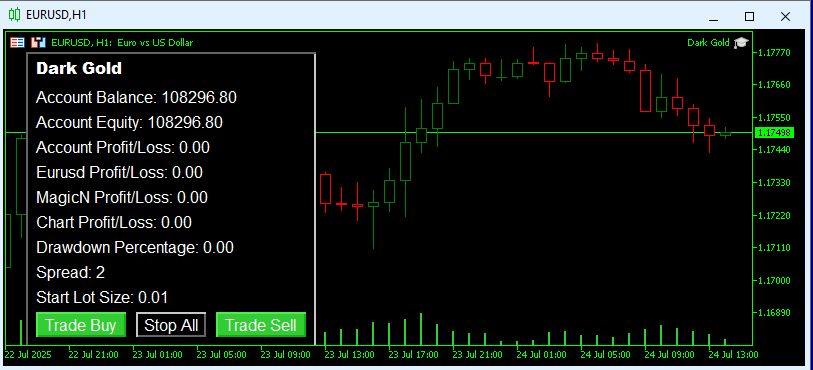
Dark Kronos is a directional grid EA that combines trend awareness with grid mechanics, opening additional trades as price moves in a defined direction rather than purely against an initial position. This distinction matters; a trend-aware grid system behaves differently from a pure mean-reversion approach, and can perform better in markets that are moving rather than ranging.
The Dark series of EAs has developed a following among algorithmic traders, and Dark Kronos is one of the more sophisticated entries in that lineup. It does not simply open grid orders at fixed intervals; it uses indicator-based signals to determine grid direction, which adds a layer of logic beyond basic price-distance spacing.
Key Features
- Directional grid strategy using trend indicators for entry bias
- Configurable grid spacing and basket management settings
- Part of the Dark EA series with an active user community
- MetaTrader compatible with VPS-friendly architecture
Performance Notes
Trend-aware grid systems tend to outperform pure reversal grids during sustained directional markets. The risk is that when the trend assumption is wrong, the grid builds exposure in the losing direction faster than a neutral grid would. Appropriate grid spacing and a well-defined maximum order count are essential for managing this.
Pros
- Trend-aware logic adds a quality filter beyond pure price-distance grid spacing
- Configurable inputs allow adjustment to different market conditions
- Part of an established EA series with documented development history
- Directional bias can reduce the frequency of large floating losses in trending markets
Cons
- Incorrect trend assumption can accelerate drawdown faster than neutral grid systems
- Requires careful grid spacing calibration per pair and market condition
- More complex to set up and monitor than simple fixed-interval grid robots
2. Happy Forex EA

Happy Forex EA is the flagship product from Happy Forex, one of the more established forex EA vendors with a documented multi-product history. The system runs a grid strategy with recovery mechanics across multiple forex pairs, building baskets of trades that close collectively once the equity target is reached.
Happy Forex as a vendor is worth noting separately from the product itself. They have been operating for a number of years, maintain live track records, and offer flexible licensing terms. That vendor credibility is a meaningful part of why this system makes the list.
Key Features
- Multi-pair grid trading with recovery mechanics
- Happy Forex vendor with documented long-term operating history
- Live track record maintained on verified platforms
- Flexible licensing for multiple MetaTrader accounts
- Grid strategies suited to ranging and moderately trending markets
Performance Notes
Multi-pair grid systems benefit from natural diversification, where strong performance on some pairs offsets difficult periods on others. The recovery mechanics mean that losing positions are not closed at a loss; instead, the grid continues building until the basket reaches its collective profit target. This requires adequate margin and patience during extended adverse moves.
Pros
- Established vendor with transparent track records and long operational history
- Multi-pair operation provides natural equity curve smoothing across markets
- Recovery mechanics allow the system to work through adverse price moves
- Flexible licensing accommodates multiple account configurations
Cons
- Grid with recovery mechanics requires significant account margin during adverse conditions
- Multi-pair simultaneous drawdown can stress smaller accounts unexpectedly
- Martingale elements increase exposure size during recovery phases
3. Happy Frequency EA

Happy Frequency EA is a higher-frequency grid system from Happy Forex, designed to trade more actively than the core Happy Forex EA by taking advantage of shorter-duration price moves. The increased trade frequency means more opportunities per session but also more frequent basket accumulation when conditions are unfavorable.
I think of Happy Frequency EA as the more aggressive sibling of Happy Forex EA. Same vendor, similar underlying mechanics, but tuned for a faster-paced approach. Whether that suits you depends entirely on your account size and risk tolerance.
Key Features
- High-frequency grid trading targeting shorter price moves
- Happy Forex vendor with established product credibility
- Grid mechanics with martingale position sizing during recovery
- Active order management across trading sessions
Performance Notes
Higher-frequency grid systems accumulate trades faster than slower counterparts, which means both wins and losses materialize more quickly. A favorable ranging session can produce multiple completed baskets in a single day. An unfavorable trending session can build a large open basket in the same timeframe. The equity drawdown profile is more volatile than lower-frequency grid approaches.
Pros
- Higher trade frequency means more completed baskets during favorable conditions
- Same trusted vendor as Happy Forex EA, with consistent documentation standards
- Suited to traders who want more active market participation from their grid robot
- Grid mechanics provide systematic order management without manual intervention
Cons
- Faster basket accumulation during adverse conditions increases drawdown risk
- Requires more active account monitoring than lower-frequency grid systems
- Martingale sizing during recovery phases can produce significant floating losses
4. Ranger EA

Ranger EA is a range-based grid system designed specifically for markets that are consolidating rather than trending. It identifies price ranges and places grid orders within those boundaries, aiming to profit from the back-and-forth movement that characterizes many forex pairs during quieter trading sessions.
The range-based approach is fundamentally different from directional grid strategies. Ranger EA is not trying to follow a trend; it is betting that price will stay within a defined zone and continue oscillating. That makes it particularly well-suited to certain market conditions and potentially problematic when those conditions break down.
Key Features
- Range-identified grid strategy targeting consolidating markets
- No martingale position sizing; fixed lot grid mechanics
- Designed for low-volatility, range-bound forex conditions
- Clear risk parameters with defined grid boundaries
Performance Notes
Range grid EAs tend to perform well during extended consolidation phases and struggle when markets break out of their established zones. The key risk is a breakout that forces all grid orders on one side of the range into significant floating loss simultaneously. Without martingale recovery, the system does not add to losing positions, which limits upside recovery speed but also limits the worst-case exposure.
Pros
- No martingale keeps the individual trade risk profile clean and predictable
- Range identification logic filters for more favorable grid conditions
- Potentially suitable for prop firm environments due to the more controlled drawdown behavior
- Defined grid boundaries provide clear risk parameters before entering a trade
Cons
- Performs poorly when price breaks out of the identified range decisively
- Fewer trading opportunities than directional or multi-pair grid systems
- Ranging market identification is not always accurate, leading to grid entries in trending conditions
5. Market Master EA

Market Master EA is perhaps the most conservative entry on this list. It focuses on USD/CAD with a defined strategy that incorporates grid-like recovery mechanics but keeps risk parameters tighter than most grid robots. The vendor maintains a live-updated track record, which immediately raises the credibility bar compared to systems relying on static backtests.
I have followed Market Master EA for a while, and what consistently stands out is the vendor’s transparency. Live-updated track records are not the norm in this space, and maintaining one signals genuine confidence in the system’s long-term behavior.
Key Features
- USD/CAD focused strategy with conservative grid-style recovery mechanics
- Live-updated verified track record
- Lifetime MetaTrader license with unlimited transfers
- 30-day money-back guarantee
- Priced at $299 for a single MT5 license
Performance Notes
At minimum lot sizing on a $1,000 account, Market Master EA produces approximately 1% monthly return with a maximum backtest drawdown staying well below $500. The conservative approach means this system will not generate dramatic monthly returns, but the risk-adjusted performance over time is among the more defensible on this list.
Pros
- Live-updated track record eliminates the primary manipulation risk with static reports
- Conservative drawdown profile makes it potentially suitable for funded account environments
- Single-pair focus makes behavior easier to monitor and understand
- Trusted vendor with documented long-term operating history
Cons
- Monthly returns at conservative settings are modest, around 1% per month
- Single-pair exposure means no diversification across currency markets
- Grid recovery mechanics still carry drawdown risk during sustained USD/CAD trends
6. Multipair EA

Multipair EA takes the grid trading concept and spreads it across several forex pairs simultaneously, creating a portfolio-style approach where the grid robot is running diversified strategies rather than concentrating all exposure in one market. When one pair experiences an adverse move, others may be completing baskets profitably, which can smooth the overall equity curve.
This is the kind of system that appeals to traders who are already comfortable with grid mechanics and want to scale up without simply increasing lot sizes on a single pair. Running grid strategies across multiple pairs is more complex to monitor, but the diversification benefit is real.
Key Features
- Grid trading across multiple forex pairs simultaneously
- Portfolio-style exposure reducing single-pair dependency
- Configurable grid settings per pair for individual market conditions
- MetaTrader compatible with VPS hosting support
Performance Notes
Multi-pair grid systems produce a higher total trade count than single-pair equivalents, which means more frequent basket completions during favorable periods. The risk is correlated drawdown: during global risk-off events or dollar-driven moves, multiple pairs can trend simultaneously, causing several open baskets to build floating losses at the same time. Adequate margin across the full portfolio is essential.
Pros
- Diversified exposure smooths equity curve during single-pair adverse conditions
- Higher total trade frequency across pairs increases basket completion opportunities
- Portfolio approach suits traders building broader algorithmic trading strategies
- Configurable per-pair settings allow risk to be adjusted based on individual pair behavior
Cons
- Correlated multi-pair drawdown can stress accounts during broad market moves
- More complex to monitor than a single-pair grid system
- Requires sufficient total account margin to support simultaneous open baskets
7. Happy Index EA

Happy Index EA is the most distinctive system on this list because it applies grid trading mechanics to stock index markets rather than forex pairs. Trading indices like the S&P 500, DAX, or similar instruments with a grid approach produces a meaningfully different experience from currency pair grids; index volatility patterns, session timing, and spread characteristics all differ from what forex traders typically encounter.
Happy Forex built this system for traders who want to extend their automated trading beyond currencies, and I think it fills a genuine gap. Most grid EAs ignore indices entirely. Whether that extension works as well in practice as it does in theory is something that requires real-world monitoring, but the vendor has enough credibility to take the product seriously.
Key Features
- Grid trading strategy applied to stock index instruments
- Happy Forex vendor with established documentation and live track records
- Martingale recovery mechanics during adverse index moves
- MetaTrader compatible; requires a broker offering index CFD trading
Performance Notes
Index grid systems face unique challenges. Indices can trend strongly for extended periods, which is particularly unfavorable for range-based grid approaches. The martingale recovery mechanics mean that during a sustained index downtrend or uptrend, the basket builds exposure significantly. Sufficient account margin and a broker with tight index spreads are baseline requirements.
Pros
- Unique application of grid mechanics to index markets, not just forex pairs
- Happy Forex vendor credibility carries over from their established EA lineup
- Index markets offer high liquidity and predictable session timing
- Diversifies automated trading beyond currency pair exposure
Cons
- Index markets can trend more persistently than ranging forex pairs, challenging grid mechanics
- Martingale recovery during strong index trends produces significant floating drawdown
- Requires a broker offering index CFD trading with tight spreads and MetaTrader compatibility
How Grid Trading Actually Works
Before running any of the systems above, it is worth being clear about the mechanics. Grid EAs open additional trades at defined intervals as price moves. The core idea is that within a trading grid, price will eventually reverse and allow the accumulated basket to close at a combined profit.
Here is a simplified example:
- The EA opens a buy at 1.1000
- Price drops to 1.0950; the EA opens another buy
- Price drops further to 1.0900; a third buy opens
- When price recovers to a level where all three trades combined show the target profit, the basket closes
The interval between orders, the lot sizing method, and the basket profit target are the primary inputs that determine both the potential return and the worst-case drawdown. Grid systems where lot sizes increase with each order, a martingale element, recover faster but accumulate risk faster too.
Grid vs. Martingale: Understanding the Difference
These two terms are often used interchangeably, but they describe different mechanics. The distinction matters for risk planning.
| Feature | Pure Grid EA | Martingale EA | Combined Grid/Martingale |
| Order spacing | Fixed price intervals | After each loss | Fixed intervals with lot scaling |
| Lot sizing | Fixed across basket | Increases after loss | Increases with each grid level |
| Recovery method | Price reversal | Larger winning trade | Reversal with scaled positions |
| Drawdown profile | Controlled but persistent | Can escalate rapidly | Moderate to high |
| Prop firm suitability | Better | Poor | Limited |
Pure grid systems with fixed lots are more predictable and generally more suitable for funded account environments. Martingale-based grid robots, including several on this list, can be highly profitable during favorable conditions but require larger margin buffers and clearer risk management rules.
Who Should Be Cautious About Grid EAs?
Grid strategies are not for everyone. Being clear about the situations where they are likely to cause problems matters as much as understanding when they work well.
Grid EAs are particularly risky for:
- Traders without enough account margin to support multiple simultaneous open orders
- Accounts where a 20 to 30% drawdown would trigger an emotional or financial crisis
- Funded prop firm accounts with strict daily drawdown limits, unless the EA has confirmed compliance
- Markets experiencing sustained one-directional trends, where the grid keeps building losing positions without reversal
- Traders who cannot monitor accounts regularly; a grid basket in trouble needs attention, not neglect
One thing I have learned from direct experience: the period when a grid system is most dangerous is not at the beginning. It is after months of smooth performance, when confidence grows and risk settings creep upward. The system that handled 3 to 5% drawdowns at conservative settings can produce very different outcomes at doubled lot sizes.
Broker and VPS Requirements for Grid Trading
Running a grid robot on the wrong infrastructure can turn a good system into a losing one.
For grid EAs, you need:
- A MetaTrader-compatible broker with low spreads on your target pairs; every additional pip of spread costs money across every grid order in the basket
- Fast order execution; delayed fills on grid orders create price gaps that reduce the strategy’s effectiveness
- A VPS with reliable uptime; a grid system that loses connection while managing an open basket is at significant risk of mismanaging the position
- A broker that explicitly permits automated trading and does not restrict grid or martingale strategies
Most reputable forex brokers running ECN or raw spread accounts are compatible. The specifics of spread during volatile periods matter more than most traders realize, because that is exactly when grid systems are accumulating positions most rapidly.
Algo Trading Space: Follow the Live Grid EA Results
All seven systems on this list are tracked or reviewed through the Algo Trading Space platform, where live trading data is published without editing. That includes the difficult periods, not just the months when everything is working smoothly.
For traders who want direct access to live performance statistics across active grid trading accounts, early analysis of new systems, and priority support, the Algo Trading Space VIP club is worth considering. Members see what is actually happening in real accounts, which is considerably more useful than vendor marketing materials when you are deciding whether a grid robot suits your risk profile.
Frequently Asked Questions
What are the best forex grid EAs in 2026?
The best forex grid EAs in 2026, based on live account testing and vendor credibility, include Market Master EA for conservative low-drawdown grid trading, Happy Forex EA for established multi-pair grid exposure, Ranger EA for range-bound conditions without martingale risk, and Dark Kronos for trend-aware directional grid strategies.
All run on MetaTrader and require a regulated broker with low spreads. The right choice depends on your account size, risk tolerance, and whether you prefer pure grid or grid-martingale mechanics.
How do forex grid EAs manage risk?
Forex grid EAs manage risk through several configurable parameters: the spacing between grid orders (wider spacing means fewer trades but larger individual drawdowns), the maximum number of orders allowed in one basket, the lot sizing method (fixed or martingale), and the basket profit target.
Well-designed grid systems also include equity stop-loss settings that close all positions if drawdown exceeds a defined threshold. Running at minimum lot sizes with adequate account margin is the most reliable risk management approach for beginners.
Are grid EAs suitable for funded prop firm accounts?
Most grid EAs carry significant challenges in funded account environments due to their floating drawdown behavior. Systems like Market Master EA and Ranger EA, which use more conservative mechanics without aggressive martingale scaling, are better candidates for prop firm use.
Grid EAs that use martingale lot sizing, including Happy Forex EA and Happy Frequency EA, are generally not suitable for accounts with strict daily or overall drawdown limits. Always verify specific prop firm rules before deploying any grid robot.
What is the difference between a grid EA and a martingale EA?
A pure grid EA opens trades at fixed price intervals with consistent lot sizes, closing the basket when the collective profit target is reached. A martingale EA increases the lot size of each subsequent order after a loss, recovering faster when price reverses but building larger exposure during adverse moves.
Many forex grid EAs combine both mechanics, using fixed spacing alongside increasing lot sizes per grid level. The combined approach can be highly profitable in ranging markets but carries higher risk during sustained trends.
How much capital do I need to run a forex grid EA?
Minimum capital depends on the specific system and grid settings. Most grid EAs can start on accounts from $500 to $1,000 at minimum lot sizes, though the margin buffer needs to be sufficient to support the maximum expected basket depth.
A grid with 10 orders at 0.01 lots each requires more margin than it appears, particularly if lot sizes increase with each level. Running backtests to identify the historical maximum basket depth and calculating the corresponding margin requirement is essential before going live.
Why do grid EAs sometimes produce large floating losses?
Grid EAs accumulate open orders as price moves against the initial position. When price trends strongly in one direction without reversing, the basket grows larger and the floating loss increases. This is the core risk of any grid trading strategy.
Systems with martingale lot scaling accumulate losses faster because each new order is larger than the previous one. The basket only closes when price reverses enough to bring the combined position to the target profit, which may take days or weeks during strong trends.
Do grid EAs work on crypto and stock index markets?
Most forex grid EAs are designed specifically for currency pairs running on MetaTrader, where broker spreads and session timing suit the strategy’s mechanics. Happy Index EA is an exception, applying grid mechanics to stock index CFDs.
Crypto markets can technically be traded with grid approaches on compatible platforms, but the extreme volatility and 24-hour trading session create different risk dynamics than forex pairs. Wider price swings mean grid baskets can accumulate faster and reach larger floating losses during adverse crypto market conditions.


Comments
No comments yet. Be the first to comment!
Leave a Comment
Your email address will not be published. Required fields are marked with *