

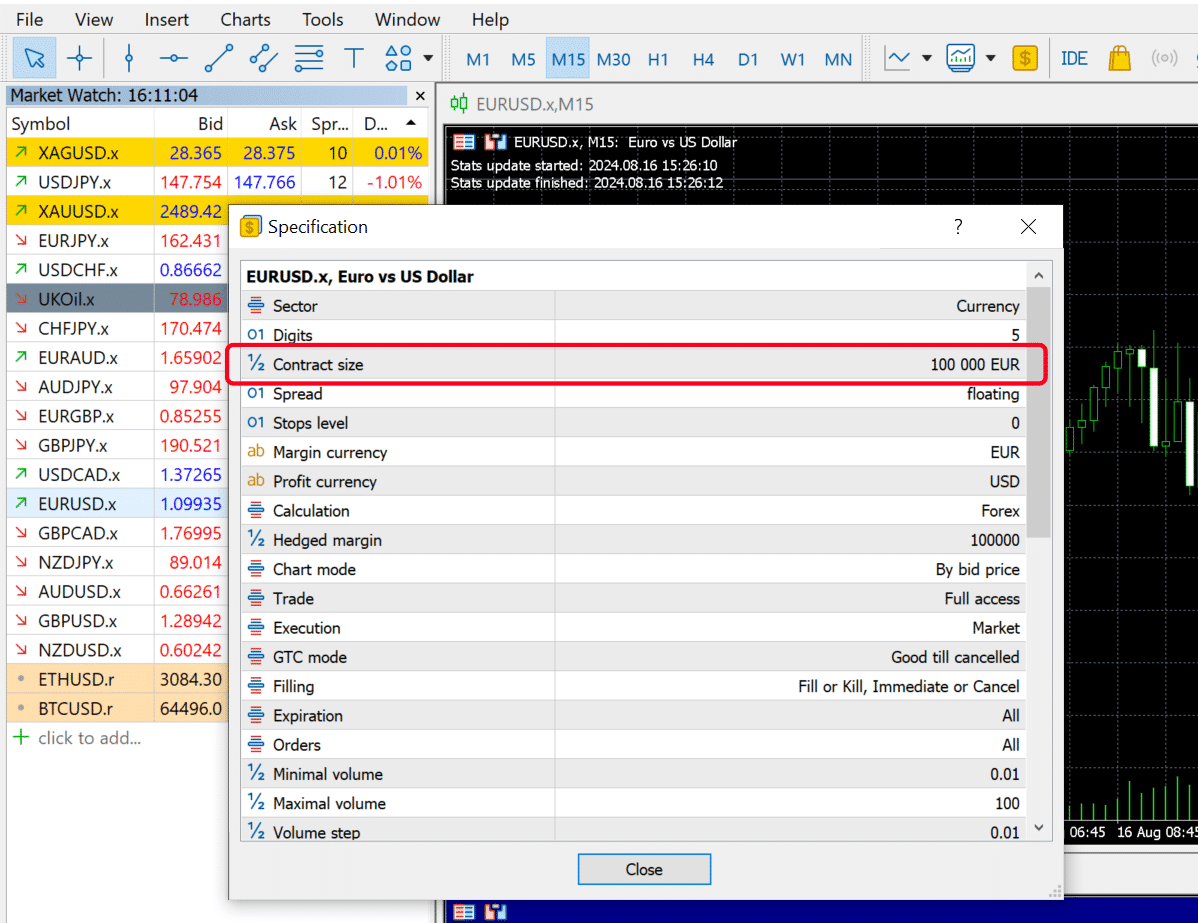
Forex trading lot size is the standardised unit that sets how many units of the base currency one position controls. A standard lot equals 100,000 units, a mini lot 10,000, a micro lot 1,000, and a nano lot 100. Since the cash value of each pip rises and falls with that number, the volume you type into the order ticket decides your risk before the market does anything at all.
| Lot type | Units of base currency | Platform notation | Approx. pip value, USD-quoted pair |
| Standard | 100,000 | 1.00 | $10.00 |
| Mini | 10,000 | 0.10 | $1.00 |
| Micro | 1,000 | 0.01 | $0.10 |
| Nano | 100 | 0.001 | $0.01 |
Values in the right-hand column assume a pair quoted in US dollars, such as EUR/USD or GBP/USD, where one pip equals 0.0001. Yen pairs and metals follow different conventions, covered further down.
What a Forex Trading Lot Size Measures
A lot counts currency units, not cash. When you open 1.00 lots of EUR/USD, you are dealing in 100,000 euros; the dollar value of that position depends on where the exchange rate sits. At 1.1000 those euros represent $110,000 of notional exposure, and at 1.0500 the same volume represents $105,000. Notional value moves; the unit count does not.
Standardisation exists for a practical reason. Currency prices move in increments too small to quote meaningfully on single units, so the market bundles them, which keeps quoting and settlement consistent across brokers. MetaTrader 4 and MetaTrader 5 both express trade volume in lots rather than units, and most retail accounts allow a minimum step of 0.01, meaning micro lots. Nano-lot execution at 0.001 exists but depends entirely on the broker; treat it as a feature to verify, never as a given.
Whichever currency is named first in the pair is the one the lot count applies to. In buying or selling a currency pair, a long EUR/USD position of one mini lot means you buy 10,000 euros against dollars, while a short position of the same volume means the reverse. Direction changes the sign of the outcome. Volume changes its magnitude.
Why Lot Size Sets Your Risk Before the Market Does
Most beginners treat risk as something the market hands them: volatility, news, spread widening. Position size arrives earlier in that chain, which makes volume the opening move in risk management rather than a detail settled afterwards. Once volume is fixed and a protective exit is placed, the maximum loss on the trade is already determined in cash terms, whatever the market subsequently does.
Consider two accounts holding identical opinions about EUR/USD. Both go long, both place a stop 30 pips away. One trades 1.00 lots and one trades 0.05. The first account risks roughly $300 on the idea and the second roughly $15. Same analysis, same entry, same exit, twenty-fold difference in consequence.
This is why professional risk frameworks start from the loss and work backwards to the volume, rather than picking a comfortable-looking number and hoping the exit holds. It also explains why lot sizing tends to be the leading parameter any serious expert advisor exposes: an automated system with a fixed 1.00 lot setting behaves very differently on a $2,000 account than on a $200,000 one, even though the logic is untouched.
Standard, Mini, Micro and Nano Lots Compared
Four lot sizes cover almost all retail activity, each a factor of ten apart, which makes the arithmetic simple as soon as the top of the ladder is fixed.
Standard Lots (1.00)
One standard lot controls 100,000 units of the first currency in the pair. On a USD-quoted pair, each pip is worth about $10, so a favourable price move of 50 pips returns roughly $500 and an adverse one of the same size costs as much. Traders using this size generally run five- or six-figure accounts, since one position at 1.00 lots consumes a meaningful share of the margin available on anything smaller.
Mini Lots (0.10)
At 10,000 units, the mini lot is one tenth of the size above it, and each unit of movement is worth roughly $1 on dollar-quoted pairs. This is the workhorse volume for accounts in the low thousands, and it is granular enough that a risk-based calculation usually lands on a sensible whole number of them.
Micro Lots (0.01)
Micro lots represent 1,000 units, worth about $0.10 per pip. Two groups use them heavily: newer traders moving off demo, and experienced ones running a strategy live at deliberately small size to compare real fills against backtest assumptions. Because 0.01 is the minimum step on most MetaTrader accounts, micro lots also set the resolution of your position sizing. A calculation that says 0.037 lots has to be rounded, and rounding down is the safer habit.
Nano Lots (0.001)
The smallest tier controls just 100 units, roughly one cent per pip. Availability varies: many brokers do not support 0.001 volumes, and those that do often restrict them to particular account types. Where nano sizing is offered, it makes live testing genuinely cheap, which matters when you want weeks of real execution data on a scalping approach without funding it out of profits you have not made yet.
These unit conventions are consistent across broker education material, including Vantage’s academy guide and TIOmarkets’ lot size explainer (both accessed September 2026).
How Pip Value Changes With Lot Size
Pip value is arithmetic, not a fixed table, and understanding the calculation is more useful than memorising the outputs. For a pair quoted in US dollars, one pip is 0.0001 of the quote, so:
Pip value = units traded × 0.0001
Run that on 100,000 units and you get $10. Ten thousand units returns $1, and a thousand units returns ten cents. The tidy round figures in the opening table come from this single line, which is why they hold for EUR/USD, GBP/USD and AUD/USD but not universally.
Two common exceptions matter in practice:
- Yen pairs. USD/JPY and its relatives quote to two decimal places, so one pip equals 0.01 rather than 0.0001. A standard lot then gives 100,000 × 0.01 = ¥1,000 for each pip, which must be converted at the prevailing rate. With USD/JPY near 150, that works out at roughly $6.67 rather than $10.
- Metals. Gold on MetaTrader uses a contract of 100 ounces per lot with its own tick convention, so applying forex sizing logic to XAU/USD produces sizing errors that are usually an order of magnitude out.
Does the account currency change anything? Yes, whenever the quote currency differs from it. A euro-denominated account trading GBP/USD earns dollars rather than euros, and the conversion at settlement is immaterial at 0.01 while being noticeable across ten full-size positions.
How to Calculate Forex Trading Lot Size From Your Risk
Here is the sequence that turns a risk decision into a volume. It needs four inputs: account balance, the percentage you are willing to lose on the trade, the stop distance in pips, and the pip value per lot for the instrument.
Position size in lots = (balance × risk %) ÷ (stop distance in pips × pip value per standard lot)
Worked example
- Account balance: $5,000
- Risk per trade: 1%, so $50
- Instrument: EUR/USD
- Stop distance: 25 pips
- Pip value per standard lot: $10
Divide the cash at risk by the loss one standard lot would produce over that distance: 25 × $10 = $250 per standard lot. Then $50 ÷ $250 = 0.20 lots, which is two mini lots. Verify it backwards: 0.20 lots gives $2 per pip, and $2 × 25 pips = $50. The numbers close.
A second pass with awkward numbers
Real inputs rarely divide cleanly. Take a $2,000 balance, 1.5% risk ($30), and an exit 40 pips away on the same pair. The calculation gives $30 ÷ (40 × $10) = 0.075 lots. Since MetaTrader accounts typically step in hundredths, round down to 0.07, which risks $28 rather than $30. Rounding up to 0.08 would put $32 at stake, over the limit you set thirty seconds earlier.
Three adjustments belong in any serious version of this calculation. Spread widens the effective stop distance, so a 25-pip stop paired with a spread of 1.2 pips costs slightly more than the model suggests. Commission on raw-spread accounts is charged per lot, which means it scales with volume rather than with pips. Slippage on exit fills is unpredictable, so treat it as a reason to keep the share of equity at risk modest rather than a number to add to the formula.
For repeat use, a position calculator saves the arithmetic: the lot sizing calculator thread in the community forum holds a spreadsheet that applies this formula across a whole trade list.
Lot Size and Stop-Loss Distance Move Together
These two settings are not independent, and treating them as though they were is a quick way to blow up an account. Widening the exit while holding volume constant increases the cash at risk proportionally. Holding the risk figure constant instead means a wider exit must be paid for with a smaller position.
Put numbers on it. With $50 at stake on EUR/USD, a stop 25 pips away supports 0.20 lots, one at 50 pips supports 0.10, and one at 100 pips supports 0.05. All three trades lose exactly $50 if that level is hit. What differs is how much room the idea gets before that happens.
Traders who slide their exit further away mid-trade “to give it space” break this relationship after the fact, converting a $50 loss into a $150 one without ever deciding to accept the larger figure. Volatility-adjusted stops, sized from an indicator such as average true range and then fed into the position sizing formula, keep the relationship intact while still adapting to conditions.
Margin, Leverage and the Capital One Lot Really Needs
A persistent myth says you need $100,000 in the account to trade a standard lot. That confuses notional exposure with margin, and it is worth correcting because the real figures are much lower and set by regulation.
Margin is a deposit against the position, expressed as a percentage of notional value. In the United States, NFA Financial Requirements Section 12 obliges forex dealer members to collect at least 2% of notional on transactions in listed major currencies, and 5% on everything else (NFA rulebook, accessed September 2026). Two percent of a $110,000 EUR/USD position is roughly $2,200, not $110,000.
Under European rules the constraint is expressed as a cap on borrowing rather than a floor under the collateral. ESMA’s product intervention measures, in force from 1 August 2018 and subsequently maintained through national measures, limit retail positions in major currency pairs to 30:1 (ESMA, “ESMA adopts final product intervention measures on CFDs and binary options”). At that ceiling the same $110,000 position requires about $3,670 of margin.
So the honest answer to “how much capital does one standard lot need” has two parts. Margin governs what the broker will let you open, and that figure is a few thousand dollars. Prudent account size governs what you can survive, which comes instead from your own risk rules: if 1% risk is the limit and a typical stop is 30 pips, one standard lot puts $300 at risk, which implies an account near $30,000. That second figure is the one that keeps traders solvent, and it is far larger than the first.
Matching Lot Size to Strategy and Account
Sizing rules should follow from how you trade, not from what feels comfortable on the day. A swing trader and a scalper can hold identical views on price and still need very different volumes to keep risk management consistent.
Short-horizon systems, including most day trading approaches, use tight stops and take many trades, so each individual position tends to be larger while the cumulative daily exposure stays capped by a maximum-open-lots rule. Swing methods invert that: wider stops, fewer positions, smaller volume per trade, longer holding periods that carry overnight financing.
Automated systems introduce a third consideration, which is how the sizing rule behaves as equity changes. Fixed lots keep risk constant in cash but let the proportion of equity exposed drift as the balance moves. Percent-risk sizing keeps the percentage constant and compounds gains, though it also compounds drawdowns, so any percent-based rule deserves testing across simulated equity paths before it goes live.
Whichever route you take, write the rule down and give it a hard limit: maximum risk per trade, maximum concurrent positions, maximum total volume open at once. Rules that live only in your head get renegotiated at exactly the wrong moment.
Common Lot Size Mistakes
Most sizing errors come from applying lot sizes out of habit rather than from a calculation.
- Sizing from account balance alone. “One micro lot per $500” ignores stop distance entirely, so identical volume carries wildly different risk depending on where that exit sits.
- Copying a signal provider’s volume. Their 0.50 lots reflects their equity, not yours. Convert their percentage risk instead.
- Increasing size to recover a loss. Doubling volume after a losing streak raises the probability of ruin sharply, since the larger position needs a smaller adverse move to do serious damage.
- Ignoring correlation. Three mini lots each of EUR/USD, GBP/USD and AUD/USD is closer to one directional dollar bet at 0.30 lots than to three independent trades.
- Forgetting the platform minimum. A calculation returning 0.004 lots on a broker with a 0.01 floor means the trade cannot be taken at your stated risk. Widen the account or tighten the exit; do not quietly take 2.5 times the intended size.
FAQs
What does 1.00 lot mean in forex?
It means one standard lot, or 100,000 units of the base currency in the pair being traded. On EUR/USD that is 100,000 euros, worth roughly $110,000 of notional exposure at a rate of 1.1000. Each pip on a dollar-quoted pair moves the position by about $10, so a swing of 40 pips is worth $400 either way. Most platforms display the position simply as 1.00 in the volume field, with the unit conversion shown only in the instrument’s trading specification.
What does 0.01 lot mean?
That notation indicates one micro lot, equal to 1,000 units of the pair’s first currency and roughly ten cents per pip on pairs quoted in US dollars. Because 0.01 is the smallest step most MetaTrader accounts accept, it also defines the granularity of every position sizing calculation you run. Traders use micro volumes for live strategy testing, for very small accounts, and for scaling into positions in measured increments rather than all at once.
How many units are in one forex lot?
One hundred thousand units of the base currency, if “lot” is used without qualification, since the standard lot is the reference size from which the others derive. Below it sit the mini lot at 10,000 units, micro lots at 1,000, and the nano lot at 100 where a broker supports that tier. Each step down divides both exposure and value per point by ten, keeping the mental arithmetic straightforward as long as that top figure is memorised.
What is the smallest lot size in forex?
The nano lot, at 100 units and about one cent per pip, is the smallest tier defined by convention. Availability is the catch: plenty of brokers go no lower than 0.01, which is the practical floor on most retail accounts. Check the instrument specification in your own platform, since it lists the minimum volume and the step size separately, and the two are not always the same. Some cent accounts achieve similar granularity through a different mechanism.
How do you calculate lot size from a stop loss?
Multiply the account balance by the fraction you are willing to lose to get cash at risk, then divide that by the stop distance in pips multiplied by the pip value of one standard lot. A $4,000 balance risking 1% with a 20-pip stop on EUR/USD gives $40 ÷ (20 × $10) = 0.20 lots. Always round the result down to the platform’s volume step so actual risk stays below the figure you authorised.
Does lot size affect margin and leverage?
Margin scales directly with volume, since it is charged as a percentage of notional value. Double the lots and the margin requirement doubles. Regulatory caps set the floor for that percentage: 2% on major currencies for US dealer members under NFA rules, and a 30:1 ceiling on majors for retail clients under the ESMA measures. Borrowing capacity itself does not change with volume; what changes is how much of yours a single position consumes.
What lot size should a beginner start with?
Micro lots, at 0.01, make the sensible starting point for most people, because ten cents per pip keeps the cost of learning proportionate to the lesson. Rather than fixing on one volume permanently, use the risk-based formula from the outset and let the calculation produce the number, capping risk at 1% or less per trade. Sizing habits formed on a small account are the ones that survive when the balance grows.
Trading foreign exchange carries a risk of loss and is not suitable for every investor. Nothing above is financial advice, and the figures shown are illustrative calculations rather than expected outcomes.


Comments
No comments yet. Be the first to comment!
Leave a Comment
Your email address will not be published. Required fields are marked with *